How AI Is Fixing Professional Services' Oldest Problem: Bad Scoping

•
•
Summarize blog with






Your best solution architect just walked out the door. So did your rate card knowledge, your integration estimate ranges, and the institutional memory behind every quote your team has sent in the last five years. This is the PS scoping problem in one sentence—and it has nothing to do with AI, yet.
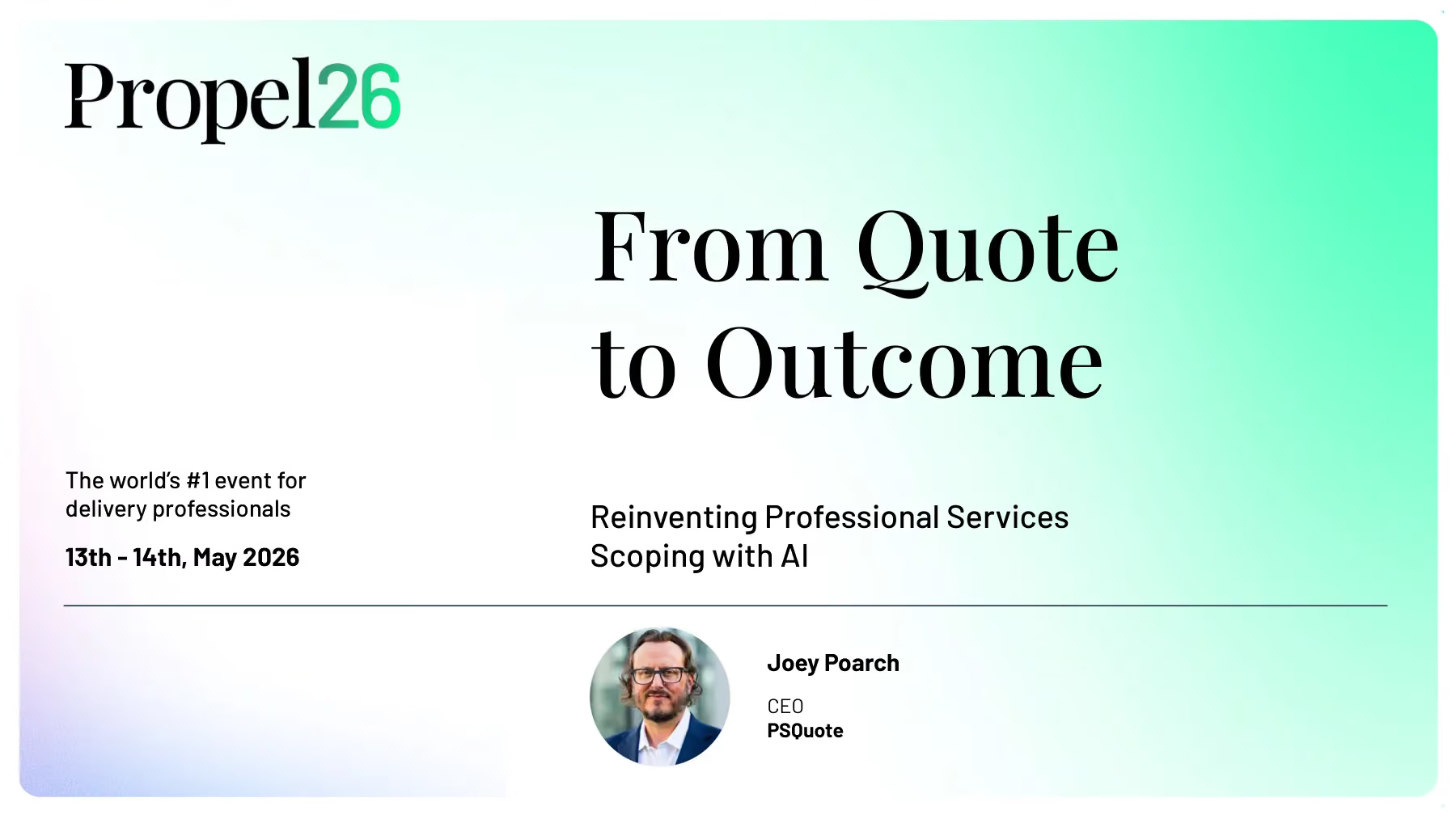
Joey Poarch, CEO of PS Quote and a 27-year professional services veteran, took the stage at Propel 26 to make a direct argument: the way PS organizations scope, estimate, and price work hasn't meaningfully changed in two decades—and that stagnation is now a competitive liability.
Read on for the key takeaways from the session.
Why PS Scoping Has Been Broken for 20 Years
The mechanics of professional services scoping have barely evolved since the early 2000s. Discovery call ends. Work gets handed off to a solution architect. That architect builds a quote in a spreadsheet—sometimes an impressive one, with tabs, macros, and its own informal change management process.
But the spreadsheet runs on tribal knowledge. One or two people hold the institutional memory: what integrations typically cost in which regions, what contingencies apply for which customer profiles, and how to read between the lines of a 200-page RFP.
When those people leave, that knowledge leaves with them.
The results are predictable. Inconsistent pricing across geographies, where an identical integration might be quoted at 40 hours in one market and 80 in another, each number based on what someone saw last time.
Slow deal cycles, where assembling a single estimate requires pulling in an integration architect, a training lead, and a change management resource, each adding their own round-trip delays. And scope creep that puts the burden on delivery teams to absorb whatever the quote missed.
"The fundamental way we did scope work didn't really change," said Poarch, who spent nearly 20 years scoping projects before becoming CEO of PS Quote. "This is across technologies, across platforms, across firms."
The Data Problem Underneath Every Bad Estimate
Before AI can fix scoping, it has to confront the data problem. And most PS organizations are sitting on a problem bigger than they realize.
HFS Research reports that nearly 60% of enterprises are already looking to AI-led solutions to replace services. AI-led firms are generating gross margins of 50–65%, compared to traditional models—a gap that research firm Terceira expects to widen as those firms compound their data and delivery advantages.
The margin difference isn't random. It's powered by one thing: clean, structured, accessible data.
Roughly 75% of PS data is unstructured.
Project notes buried in email threads. Scope documents scattered across shared drives. RFP responses archived in someone's downloads folder. Years of delivery actuals sitting in spreadsheets that no one queries.
CRM systems that capture opportunity data but are missing the fundamentals AI agents need to work—rate cards, estimate history, structured scope definitions, and resource plans.
The consequence is direct. "Without that, you can't automate," Poarch said. "And without automation, you can't scale."
Fifteen to twenty percent of the margin is lost to bad estimates. Not too bad luck—to missing data. Teams always want to measure as-delivered versus as-sold, but it never happens because everyone has moved on to the next deal or the next implementation.
AI can close that loop—but only if the data foundation exists first.
Three Pillars of AI-Powered Scoping
Poarch laid out how AI transforms the quote process across three interconnected capabilities.
Intelligent estimation. AI crawls historical project data—actuals, outcomes, customer profiles—and generates probabilistic ranges with confidence levels rather than single-point estimates.
His example: rather than estimating 40 hours for an integration, AI can say, "Based on 23 similar projects with this customer profile, I have 90% confidence the range is 38 to 50 hours." That's a data-backed position any delivery team can defend.
Scope awareness through note-to-quote. Unstructured inputs—call transcripts, emails, RFP documents—pass through AI to extract scope signals.
Those signals map to similar historical projects, pull matching resource roles and rate cards, and generate a first-pass estimate. Poarch's team calls this note-to-quote (or voice-to-quote).
In a live demo at the session, he showed Claude ingesting meeting notes, identifying relevant offerings, and generating a structured PS Quote with hours, resources, and a timeline in minutes.
"70% of the work is done automatically," he said. "Your team reviews, tweaks as needed, and you're done."
Continuous learning loops. Every engagement generates new data. AI compares as-sold to as-delivered: which line items ran over, which were consistently underscoped, and where margin leaked.
The system learns pricing patterns and auto-optimizes with each deal. The practical payoff is significant: "When your senior solution architect leaves, their gut feel stays—because it's embedded into the system."
The combined result Poarch's customers are seeing: 3x faster quote turnaround, 3x more consistent pricing, 50% more accurate estimates, and 50% fewer scope surprises on delivery.
For teams using Rocketlane for delivery, PS Quote connects directly to the platform—handing off the quote to create the project, pulling back real-time actuals, and closing the loop automatically.
4 Key Takeaways on AI-Powered Professional Services Scoping
You can't build AI on top of chaos. Standardization comes first. Centralize your rate cards, define your standard roles, document your cost rates, and structure your scope library. Poarch is direct: "That's table stakes. It's not going to work without that foundation."
The upside is that standardization alone—before any AI layer—transforms quote visibility and consistency.
Every quote is training data. Start logging quotes with discipline. Track which ones convert. Measure sold versus delivered. Your CRM contains years of historical data that could be powering better estimates today—but only if it's structured and auditable. The firms that start building that repository now will have a compounding advantage within 12 to 18 months.
Pick one AI use case and build traction before expanding. The biggest mistake is trying to do everything at once. Start with note-to-quote—turning a discovery call transcript into a first-pass estimate—or RFP automation. "Build confidence, get buy-in from the team," Poarch said. "Then step four is closing the loop and letting the system learn."
The flywheel only runs if you close the loop. Quote → deliver → analyze → learn. Without comparing every quote to delivery actuals, AI tools stay static. With it, margins improve deal after deal. "The firms that move first will quote faster, win more deals, and be more profitable at scale," Poarch said. "It's not magic, it's data."
Conclusion
Professional services scoping has run on tribal knowledge for two decades. The spreadsheets got bigger. The solution architects got more experienced. But the underlying problem—inconsistent data, no feedback loop from delivery, estimates built on gut feel—stayed the same.
Joey Poarch's session at Propel 26 made clear that this is the last generation of that problem. AI can now extract scope signals from unstructured inputs, generate probabilistic estimates backed by historical data, and learn from every deal a team closes.
The organizations that build clean data foundations now will have a measurable advantage within 12 months—faster quotes, tighter margins, and a scoping process that scales without adding pre-sales headcount.
For embedded PS teams, this is how you prove your value to the CFO. For pure-play services firms, this is your margin defense in a market shifting toward outcome-based pricing. Either way, the window to move first is open.
Based on live session data from Propel 26 (May 2026) and aggregate outcomes from 750+ Rocketlane customers.
Check out the rest of our Propel 26 recaps here for more insights from the industry's best.

Authored by

Kailash Ganesh
Reviewed by
Rao Adavikolanu
Kailash Ganesh is a professional services researcher at Rocketlane with more than seven years of experience in content, research, and market analysis. He studies how enterprise PS teams are adopting agentic AI to transform delivery operations, has evaluated every major PSA platform in the category, and writes from the perspective of a practitioner who watches enterprise PS teams make these exact decisions daily.
Table of Contents

Regsiter for the live webinar


Great consultants didn't join your team to spend Fridays writing documentation.
Table of contents
18 of Forbes Cloud 100 chose Rocketlane. The best PS teams aren't waiting around.
FAQs













Copyright © 2026 Rocketlane Corp. All rights reserved.
















.webp)