Why Customer Outcomes Get Lost Between Departments—and How to Fix It

•
•
Summarize blog with






You can close the deal, hit go-live on time, maintain strong utilization, and still get a call six months later from a customer asking whether they're actually getting the value they paid for.
Every team did its job. Nobody owned the outcome.
That is what Jeremy Taylor and Haukenberry, call operating in the outcome era with a delivery-era operating model.
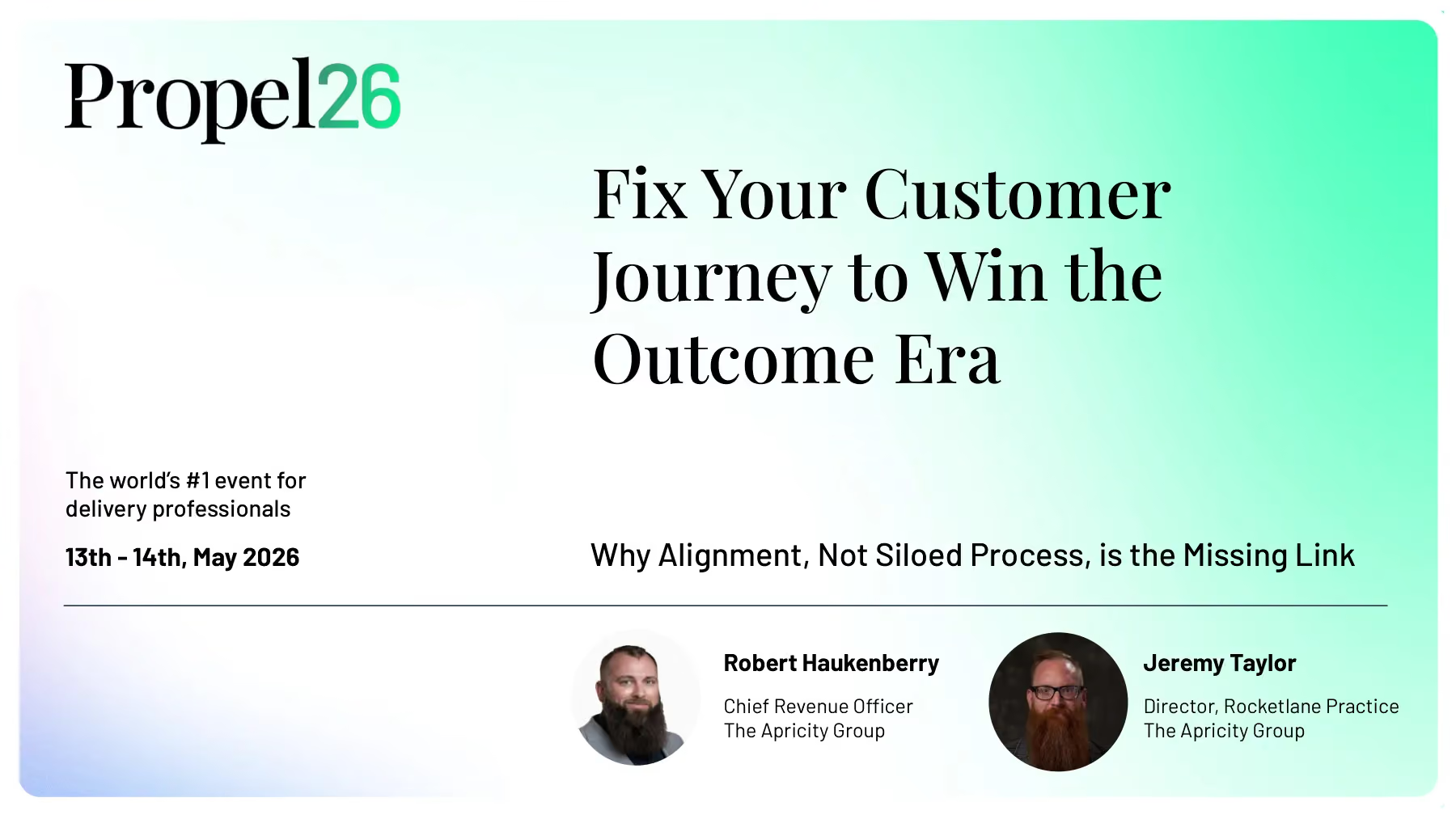
At Propel 26, the co-presenters from The Group, a PS consultancy focused on lead-to-ledger transformation across CRM, PSA, and ERP, opened with a skit every services leader recognized: a sales rep handing off a deal with a promised $15M efficiency gain, no validated baseline, and no measurement plan.
The lesson was clear. Customer outcome alignment does not happen because every department tracks its own KPIs. It happens when the value thread stays visible across sales, implementation, customer success, and renewal.
Why Departmental KPIs Don't Equal Customer Outcomes
The metrics are not wrong. Sales is measured on bookings. Services is measured on margin, utilization, and go-live dates. Customer Success is measured on health scores, adoption, and renewals. These numbers matter, and executives need them.
The problem is that none of them, by themselves, equals a customer outcome.
A deal can close, implementation can finish on schedule, and CS can maintain regular account coverage while the customer still struggles to prove value internally. That is the core failure mode: every department hits its target, but the customer's business goal never had a clearly defined owner, baseline, or measurement plan.
Taylor and Haukenberry's skit made this painfully familiar. A sales rep promised $15M in efficiency gains based on a rough scenario, then handed the deal to delivery without a clear answer for how that value would be validated.
The delivery lead's question was the one many PS teams inherit too late: how are we going to show the customer we actually delivered that value?
It was a skit. Most PS leaders have lived some version of it.
What's the Difference Between a Stated Goal and a Substantiated Goal?
"Improve efficiency" sounds like an outcome, but it is not. It is an aspiration.
Taylor outlined the questions that turn vague value language into something teams can actually deliver against: which processes improve, by how much, compared to what baseline, for which team or department, and what could prevent the value from being realized?
Until those questions are answered, teams are not aligned around an outcome. They are aligned around language.
As Taylor put it, a stated goal creates interest. A substantiated goal creates alignment with the customer.
That is why the value assessment cannot live only in the sales deck. Before signature, it helps validate that the promised outcome is real and measurable. After signature, it should become the North Star for implementation priorities, CS handoff, executive reporting, and renewal conversations.
A good-better-best scenario can also help set realistic expectations. Selling into the middle and delivering toward the top builds trust. Selling the best-case scenario and landing at baseline creates churn risk.
Customer outcome alignment depends on being honest about what adoption, data readiness, and execution can actually support.
How Should PS and CS Keep the Value Thread Intact?
Professional Services and Customer Success do not own the entire customer journey, but they often see more of it than anyone else. They see what was sold, what the customer actually needs, where the scope aligns with value, and where it does not.
They see whether the sponsor is engaged, whether the data is ready, and whether the customer's internal capacity exists to succeed.
That makes PS and CS a natural early warning system.
But people alone are not enough. PS and CS may have the business context to spot drift first, but the mechanism that catches it before it cascades is a system that watches delivery as it unfolds. Milestone drift, stalled dependencies, adoption gaps, and budget pressure need to surface in real time, not after the fact.
This is where a connected PSA becomes critical. When project execution, resource allocation, financials, and customer goals live in one system of record, the value thread stays visible across every handoff. The customer context does not disappear when Sales exits, when Services completes go-live, or when CS takes over renewal ownership.
Haukenberry, challenged the room with a question: how many customers feel like they are being passed to a completely different company every time a new team is introduced?
The goal is not just a smoother transition meeting. It is a full transfer of context: what value was promised, what baseline was validated, where implementation met the mark, where gaps remain, and what the customer still needs to achieve the outcome they originally signed up for.
How Rocketlane Keeps Customer Outcomes Visible Across Handoffs
Most organizations already have metrics and teams. What they often lack is a system built for outcome delivery.
Rocketlane helps keep the value assessment alive across the customer journey by connecting implementation milestones, project health, resource planning, financials, and customer collaboration in one place. The outcome does not stay trapped in a sales deck or buried in a handoff doc. It becomes part of the operating system PS and CS use every day.
That matters because value realization is not a single checkpoint. It changes as the customer's business changes. New priorities emerge. Sponsors move. Adoption stalls. Scope shifts. A connected PSA gives teams the visibility to revisit the value thread continuously, surface gaps early, and protect both customer outcomes and delivery margins.
Shared ownership is not just a framework. It is a system where every team can see the same source of truth: what the customer signed up for, how delivery is progressing, and whether the promised value is still on track.
4 Key Takeaways from The Group's Outcome Alignment Framework
Substantiate the Goal Before the Deal Closes
An outcome needs a baseline, a target value, a measurable definition, an owner, and evidence that it is achievable. "Reduce ticket resolution time from 48 hours to 24 hours in the support org by Q3" is an outcome. "Improve efficiency" is not.
Make the Value Assessment Travel
The business case created during sales cannot die when the deal closes. It should drive implementation priority, shape the CS handoff, and become the executive narrative after go-live.
Orchestrate Handoffs, Don't Just Execute Them
Departmental metrics still matter, but none of them in isolation equals a customer outcome. A connected PSA helps ensure customer context—not just task status—transfers automatically at every handoff.
Plan for the Outcome to Shift
Customer priorities change. M&A, new leadership, shifting budgets, and internal restructuring can all change what value means. A continuous value assessment helps teams stay aligned to the customer's current business, not just the business case from 18 months ago.
Conclusion
Taylor and Haukenberry's argument is direct: the customer journey is not a relay race where one team hands the baton to the next and exits. It is a connected journey with a single thread running through it—the validated outcome the customer signed up to achieve.
Most organizations already have metrics, tools, and teams. What they are missing is the mechanism to keep that outcome alive across handoffs, visible to every function, and revisited as the customer's business evolves.
In the outcome era, a go-live date is not enough. A renewal health score is not enough. A closed deal is not enough.
The customer outcome has to travel.
And the organizations that make it visible, measurable, and shared across every stage of the journey will be the ones customers trust to deliver value long after the project ends.

Authored by

Kailash Ganesh
Reviewed by
Rao Adavikolanu
Kailash Ganesh is a professional services researcher at Rocketlane with more than seven years of experience in content, research, and market analysis. He studies how enterprise PS teams are adopting agentic AI to transform delivery operations, has evaluated every major PSA platform in the category, and writes from the perspective of a practitioner who watches enterprise PS teams make these exact decisions daily.
Table of Contents

Regsiter for the live webinar


Great consultants didn't join your team to spend Fridays writing documentation.
Table of contents
18 of Forbes Cloud 100 chose Rocketlane. The best PS teams aren't waiting around.
FAQs













Copyright © 2026 Rocketlane Corp. All rights reserved.


















.webp)