Make Good Delivery Outcomes the Default, Not the Exception

•
•
Summarize blog with






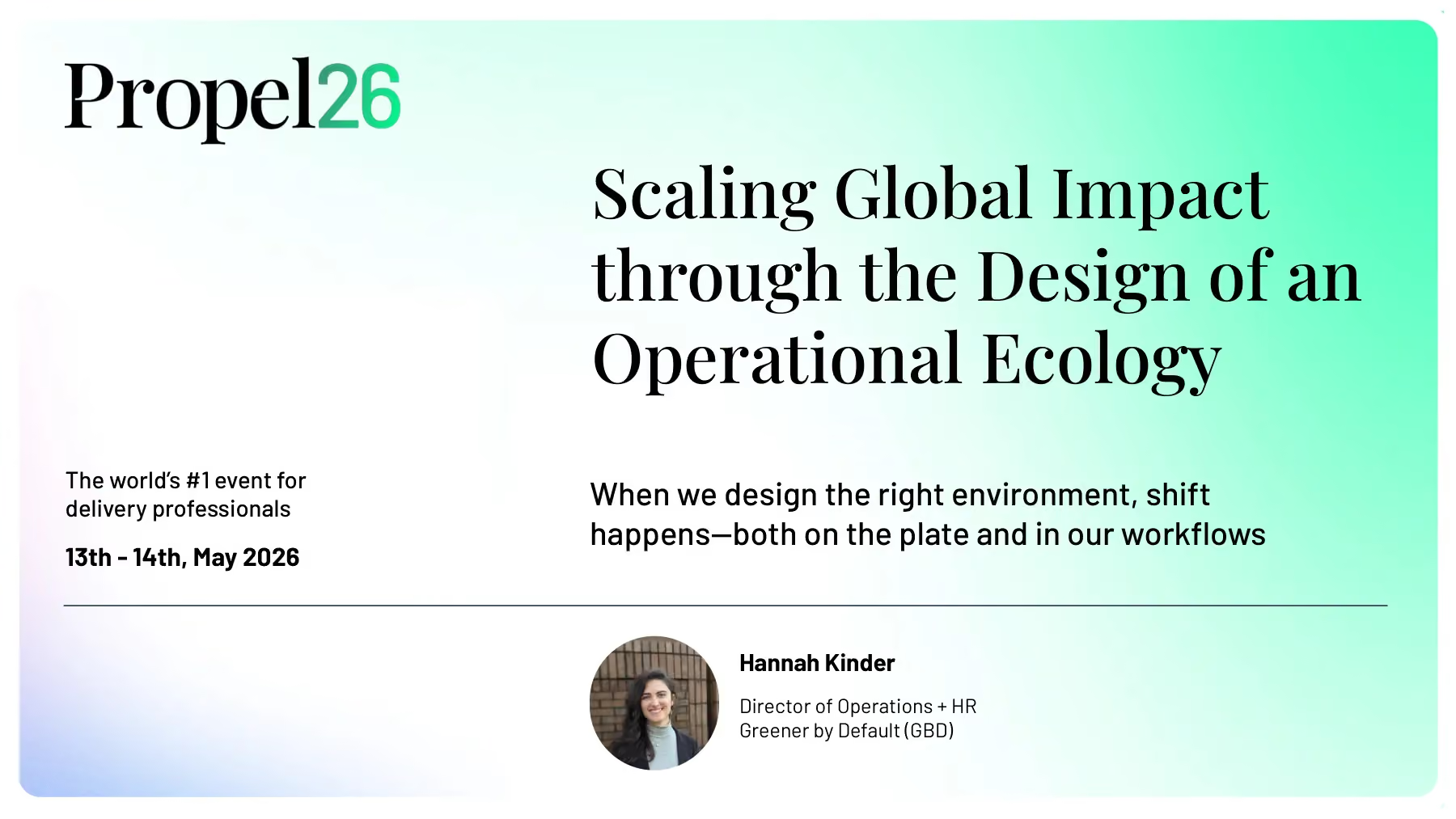
When teams struggle to follow a process, most leaders reach for more training, clearer documentation, or tighter accountability. Hannah Kinder thinks that's the wrong starting point.
Her analogy comes from ecology. Forests don't convince trees to grow. They create the conditions where growth becomes natural. In the same way, service organizations shouldn't rely on constant effort to create good outcomes. They should design delivery systems where the right action is the path of least resistance.
That operating philosophy helped Greener by Default cut client-facing staff effort by 72%, compress a 40-hour process into 20 minutes, and set a goal to shift 10 million meals in a single year without expanding the team or budget.
At Propel 26, Kinder, Operations and HR Director at Greener by Default, shared how the nonprofit consulting firm redesigned its delivery model around what she calls the operational ecology: building systems in which good delivery outcomes become the default.
What Happens When Delivery Overhead Crowds Out High-Value Work
Two years ago, Greener by Default had the mission, expertise, and client demand to grow. What it didn't have was an operating system that could scale with the work.
Delivery lived in Asana. Sales lived in Airtable. Client contacts were managed through individual spreadsheets. There was no shared view of project progress, no consistent handoff model, and no single place to understand where work stood across the organization.
The biggest bottleneck was the menu audit, a diagnostic assessment that started each client relationship. Before a client even signed a contract, one person could spend 40 hours reviewing menus, identifying opportunities, and building recommendations.
At low volume, that kind of effort was survivable. At scale, it became a ceiling.
The team wasn't underperforming. The system was. Too much time was being spent on administrative effort, manual diagnosis, and repeated client education.
The work that required human judgment—strategy, stakeholder alignment, and client relationship-building—was being crowded out by process overhead.
That's the first lesson for service leaders: before you scale, audit what your process actually costs. A workflow that feels manageable at five clients can become fatal at fifty.
How to Design Delivery Systems Where the Right Step Is the Easiest Step
Kinder's breakthrough came from reframing the problem. Instead of asking, "How do we get people to do the right thing?" the team started asking, "What would make the right thing the easiest thing to do?"
That shift matters because most operational problems are not motivation problems. They're environmental problems. If the process requires people to remember every step, chase every input, and make every good decision manually, the system depends on willpower.
Greener by Default wanted a system that worked more like an ecosystem. In a healthy ecosystem, the right conditions naturally produce the right behavior. The same idea applies to delivery: reduce unnecessary choices, eliminate repetitive work, and design workflows in which the next best action is obvious.
The menu audit became the first proof point. Kinder built AI into the delivery workflow, training it on Greener by Default's behavioral science methodology. What once took 40 hours now takes 20 minutes. The system scans menus, suggests strategies, and generates a report. The consultant still reviews and adjusts the output, but the heavy manual lift disappears.
That staff time didn't vanish into generic productivity gains. It was redirected into high-judgment client work—the relationship-building, strategic guidance, and change management that actually move outcomes forward.
For a services organization, that's the real value of automation: not simply doing work faster, but protecting the time and margin required to deliver meaningful outcomes.
How to Make Your Methodology Self-Serve Without Losing Control
The harder challenge was client-side adoption.
Greener by Default's work depends on changing institutional food environments so plant-based choices become the default. If the team had to stay deeply involved forever, the model would never scale.
The goal was to embed the methodology so deeply into the client's own operations that the impact continued after the engagement ended.
To do that, Kinder used Rocketlane to move key parts of onboarding, education, and collaboration into a structured delivery system. Pre-kickoff questionnaires helped clients share context before the first meeting.
A resource library gave clients access not just to what they needed to do, but also to why each strategy mattered. The client portal became more than a project tracker—it became a guided knowledge base that reduced repetitive questions and helped clients act without constant consultant support.
This is where Rocketlane became more than a collaboration tool. It served as the system of record connecting delivery execution, client collaboration, resource planning, and project visibility. That foundation allowed the team to standardize the methodology while still preserving room for strategic judgment.
The outcome was a different kind of client relationship. Instead of relying on consultants to repeat the same explanations across every engagement, clients could access the reasoning behind the work themselves. The team could then spend more time on the moments where human expertise mattered most.
Kinder also acknowledged a real challenge: not every client user naturally lives in a portal. Some stakeholders, such as chefs, may not read email regularly or use software tools in the same way project sponsors do. That doesn't weaken the model. It clarifies the design challenge. Good defaults have to meet users where they actually are, not where the process assumes they should be.
How Operational Ecology Protects Both Mission and Margin
Operational ecology is not just a nicer way to think about process improvement. It has direct implications for service economics.
When administrative overhead fills the calendar, teams burn out, and delivery margins suffer. People work harder to compensate for what the system should have handled automatically. Leaders add headcount to absorb complexity rather than redesign the conditions that created it.
Greener by Default took the opposite path. By redesigning the work around defaults, automation, and self-service client enablement, the team reduced effort without sacrificing quality. Client-facing staff effort dropped by 72%. Audit time fell from 40 hours to 20 minutes.
And the organization was able to pursue a much larger impact goal without expanding the team.
That's the services lesson hiding inside the ecology metaphor.
Burnout is often a systems failure, not a personal one. Margin pressure is often a workflow design problem, not just a staffing problem. When teams spend too much time on low-judgment work, the work that creates value gets squeezed out.
The right delivery system protects both the people and the economics of delivery.
4 Key Takeaways from Hannah Kinder's Operational Ecology Model
Design for Defaults, Not Willpower
If your team or clients have to consciously choose the right step every time, the system is working too hard. Remove unnecessary decisions and make the right path the easiest path.
Audit the True Cost of Your Process Before You Scale
A 40-hour pre-sales or onboarding task may be manageable at low volume, but it quickly becomes a scaling constraint. Identify hidden effort before growth exposes it.
Make Your Methodology Self-Serve
If clients need you in the room to execute correctly, you've built dependency rather than capability. Embed the reasoning behind your methodology into client-facing resources so the impact can continue after handoff.
Protect Time to Protect Outcomes and Margin
Administrative overhead doesn't just slow teams down. It eats into strategic capacity, increases delivery cost, and puts margin at risk. Protecting your team's time is part of protecting delivery quality.
Conclusion
The 72% reduction in staff effort at Greener by Default didn't come from asking people to work harder. It came from asking a better question: what conditions would make the right outcomes inevitable?
That is what operational ecology means in practice. The tool supports the system. The system supports the people. And the people are freed up to do the work that requires judgment, empathy, and strategy.
For professional services leaders, the lesson is clear. Good delivery outcomes should not depend on heroics, reminders, or perfect compliance. They should be built into the way work happens.
Nature doesn't bloom all year round. Neither do teams. Build delivery operations that protect the energy of the people doing the work, keep delivery visible, and make the right step the easiest step.
The outcomes will follow.

Authored by

Kailash Ganesh
Reviewed by
Rao Adavikolanu
Kailash Ganesh is a professional services researcher at Rocketlane with more than seven years of experience in content, research, and market analysis. He studies how enterprise PS teams are adopting agentic AI to transform delivery operations, has evaluated every major PSA platform in the category, and writes from the perspective of a practitioner who watches enterprise PS teams make these exact decisions daily.
Table of Contents

Regsiter for the live webinar


Great consultants didn't join your team to spend Fridays writing documentation.
Table of contents
18 of Forbes Cloud 100 chose Rocketlane. The best PS teams aren't waiting around.
FAQs












Copyright © 2026 Rocketlane Corp. All rights reserved.
















.webp)