Three Decisions Every PS Leader Needs to Make Before 2027

•
•
Summarize blog with






45% of executives report meaningful AI ROI.
Only 27% of managers agree.
That gap isn't a tool's problem. It's a decision problem.
Most professional services teams are experimenting with AI in isolation. The harder question—and the one not enough leaders are asking—is whether that AI is connected to a system of record for delivery, or just solving today's problem without building tomorrow's foundation.
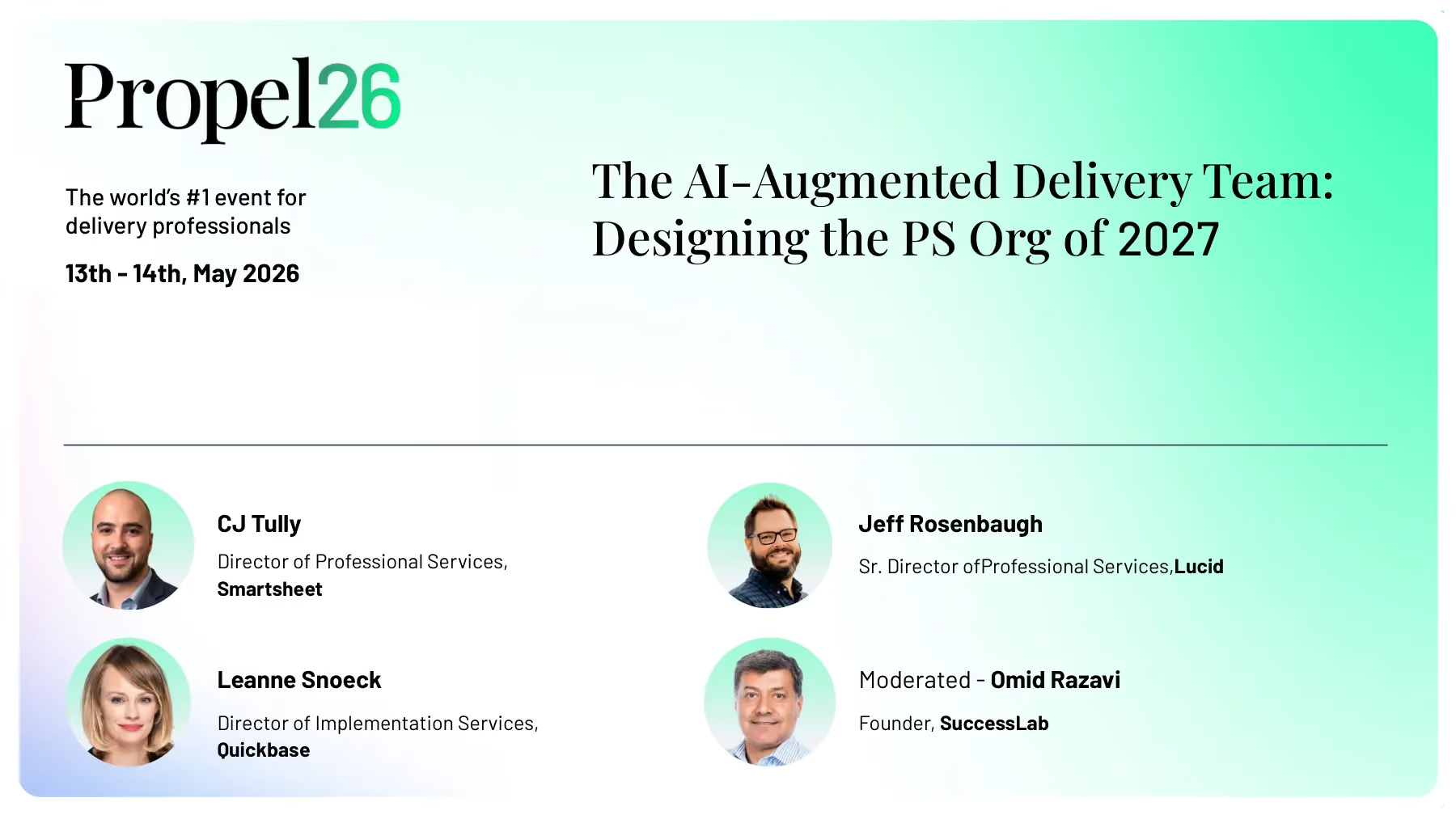
At Propel 26, Jeff Rosenbaugh from Lucid Software, Leanne Snoeck from Quickbase, and CJ Tully from Smartsheet shared what AI adoption actually looks like inside mid-market services organizations.
What's working. What failed.
And which decisions can PS leaders not afford to delay before 2027?
Where Is AI Working in Professional Services Today?
The fastest AI wins aren't always the flashiest ones.
They're usually the tasks that consume time, create friction, and don't require deep human judgment.
At Quickbase, one of the biggest unlocks has been using presales and post-sales call transcripts to automatically generate kickoff materials. Instead of relying on long knowledge-transfer meetings, delivery teams receive cleaner, more actionable briefs.
The result is faster mobilization and fewer gaps between sales and implementation.
At Lucid, AI is helping with project administration and content production. Consultants can now handle some design-related work in-house instead of waiting multiple days for marketing support. The learning services team is using AI for script generation, freeing up more time to focus on production and delivery.
Jeff's principle was simple: Use AI to lift the repetitive work so people can focus on tasks that require judgment and unique human capability.
At Smartsheet, the early wins came from compressing presales-to-post-sales knowledge transfer into more useful outputs. CJ also emphasized a metric that doesn't always appear on dashboards but matters deeply: morale.
The best early AI use cases removed work that teams didn't enjoy, took the most time, and created the greatest friction.
The pattern is clear.
The fastest AI wins are in repetitive work that doesn't require judgment—but only when that AI is embedded in a system that connects project execution, resource planning, and financials.
Without that connective tissue, AI becomes a standalone tool. With it, AI becomes a force multiplier.
Why AI Adoption Failed at Smartsheet—and What Fixed It
CJ shared one of the most candid moments of the session.
Smartsheet had been running an AI innovation program for two years. The team shipped roughly a dozen tools.
Adoption stayed low. The issue wasn't a lack of tooling. It was a lack of change management.
As CJ put it, the team had failed to take its own change management principles to heart.
The fix wasn't more mandates. It was peer visibility.
Smartsheet started elevating stories from individual contributors who had used AI to achieve tangible results. One consultant saved two hours by standing up a UAT script. Another saved 20 hours of solution configuration through an MCP integration.
These weren't polished executive narratives. They were specific, practical wins from people doing the same work as everyone else.
And that changed adoption.
When peers see someone in their role using AI to solve a real problem, the tool becomes less abstract and less intimidating.
That matters because managers often carry more AI risk than executives realize. If they fear an agent will break a customer environment, create billing confusion, or cause downstream rework, experimentation stalls.
Purpose-built AI for delivery needs governance by design.
Defined rules. Validation before execution.
Approval flows where customer outcomes, margins, or delivery quality could be affected.
Adoption grows when teams trust not just the tool but the system around it.
What Decisions Should PS Leaders Make Before 2027?
The panel ended with a sharp question: What should PS leaders stop postponing?
Three answers stood out.
1. Decide Whether You're Outcome-Oriented or Hours-Based
This decision shapes everything else.
If your organization is still primarily measured on utilization and billable hours, AI can create a strange incentive problem.
An AI tool that saves two hours on a deliverable may be great for the customer.
But if you're billing purely by time, it can reduce revenue.
In an outcome-based or fixed-fee model, that same AI improvement protects margin. The team delivers the same result with less effort, creating more capacity and stronger project economics.
The business model has to come first. The technology serves the model—not the other way around.
This is where PSA infrastructure matters. Teams need a way to connect time, cost, revenue, delivery progress, and customer outcomes so the financial impact of AI is visible either way.
Otherwise, AI efficiency gains can disappear into disconnected spreadsheets and anecdotal stories.
2. Consolidate Your Knowledge Before You Build More AI
Leanne called this "the very unsexy work."
It's also some of the most important.
High-growth organizations usually have years of process knowledge scattered across documentation tools, Slack threads, spreadsheets, project plans, and people's heads.
That makes AI adoption harder.
Without clean, consolidated knowledge sources, standalone AI tools hallucinate. Agents point teams toward unreliable answers. Teams lose trust quickly.
But when knowledge lives in a purpose-built delivery system—where AI has first-party context on projects, resources, processes, and outcomes—agents can ground their recommendations in real data.
Jeff added that companies with structured and documented process information reach AI adoption milestones two to three times faster.
That gap compounds.
Organizations with clean delivery knowledge can build on it. Organizations with fragmented knowledge are building AI on sand.
3. Build a Formal AI Innovation Program
The goal isn't tool proliferation. It's organizational learning.
Jeff described the need for a structured program that captures what teams are trying, curates what works, and turns successful experiments into repeatable standards.
That requires more than a suggestion box.
It requires a system to capture field-level learning and feed it back into the organization.
Professional services teams are uniquely positioned here because they sit close to customer workflows. They see where customers struggle. They see where implementation slows. They see which product patterns create value.
When those insights remain trapped in individual projects, the organization learns slowly.
When they flow back into product, engineering, and delivery operations, the organization improves faster.
That's the real value of a formal AI innovation program. It turns isolated experiments into institutional capability.
Why the System of Record Matters
These three decisions—outcome orientation, knowledge consolidation, and structured experimentation—aren't just strategic ideas.
They need operational infrastructure.
Teams can't become outcome-oriented if project outcomes, time, cost, revenue, and adoption signals live in separate systems.
They can't consolidate knowledge if every project captures information differently.
They can't scale AI experiments if successful use cases never make it back into the standard delivery playbook.
This is where Rocketlane becomes relevant.
Rocketlane gives professional services teams a single system of record for delivery—connecting projects, resources, financials, customer collaboration, and playbooks in one place.
That foundation makes AI adoption more practical because the context AI needs already exists inside the delivery workflow.
When AI is embedded in the system of record, it can do more than summarize calls or draft documents.
It can help teams understand delivery risk, surface project drift, identify capacity constraints, protect margins, and turn successful patterns into repeatable operating models.
The platform doesn't replace the decisions PS leaders need to make.
It makes those decisions executable.
4 Key Takeaways from PS Teams at the Front Edge of AI Adoption
The Fastest AI Wins Are in Repetitive, Low-Judgment Work
Knowledge transfer, kickoff preparation, project administration, and solution configuration are strong starting points.
These wins show up in morale, utilization, and margin—when connected to time tracking, project financials, and billing in real time.
Peer Stories Drive Adoption
Leadership mandates rarely create lasting behavior change.
Specific wins from individual contributors are far more effective because they reduce fear and make AI feel practical.
Outcome Orientation Comes First
Applying AI to an hours-based delivery model can optimize the wrong metric.
Decide what you're measuring first. Then decide how AI supports that goal.
Knowledge Consolidation Is Urgent
AI agents are only as useful as the context they can access.
The organizations that document processes and centralize delivery knowledge now will move faster in 2026 and 2027.
Conclusion
The gap between "we're using AI" and "AI is changing how we operate" is wider than most professional services leaders want to admit.
This panel made the reason clear.
The gap isn't primarily a technology problem. It's a change management problem.
A knowledge architecture problem. A pricing model problem.
And increasingly, a system-of-record problem.
Jeff, Leanne, and CJ are running different teams at different companies, but they arrived at the same conclusion: AI adoption doesn't start with tools.
It starts with deciding which outcomes the team is accountable for, building the knowledge foundation those tools need, and creating the conditions for experimentation to surface and scale.
2027 isn't far away.
The teams that will be ready aren't waiting for perfect AI maturity.
They're making the hard decisions now.

Authored by

Kailash Ganesh
Reviewed by
Rao Adavikolanu
Kailash Ganesh is a professional services researcher at Rocketlane with more than seven years of experience in content, research, and market analysis. He studies how enterprise PS teams are adopting agentic AI to transform delivery operations, has evaluated every major PSA platform in the category, and writes from the perspective of a practitioner who watches enterprise PS teams make these exact decisions daily.
Table of Contents

Regsiter for the live webinar


Great consultants didn't join your team to spend Fridays writing documentation.
Table of contents
18 of Forbes Cloud 100 chose Rocketlane. The best PS teams aren't waiting around.
FAQs













Copyright © 2026 Rocketlane Corp. All rights reserved.
















.webp)