How CFOs Are Rethinking AI Budgets — and What PS Teams Need to Know


•
•
Summarize blog with






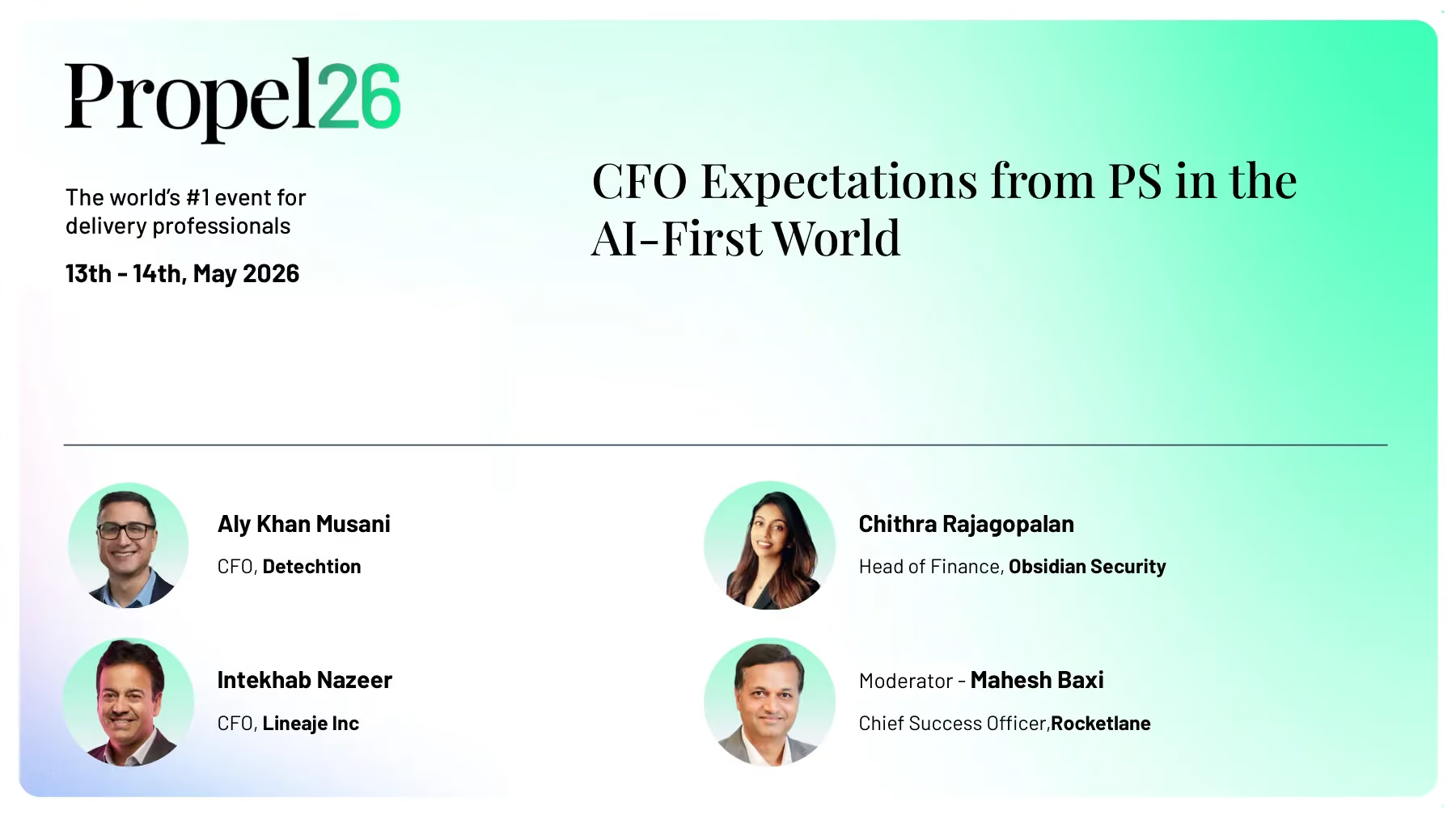
As Aly put it during a Propel 26 panel discussion, professional services leaders often walk into the CFO conversation full of conviction—then "all the blood just drains from their face" when the first question is asked.
The enthusiasm is real. The preparation often isn't.
That's because the conversation around AI investment has changed dramatically over the last 18 months.
Only 1 in 8 CFOs say they have a clear formula for AI ROI. The ones who don't aren't being careless. They're navigating a new world of consumption-based pricing, token budgets that can spike mid-month, and boardrooms expecting AI investments to show up in the gross margin line.
For professional services leaders, this shift matters. The CFO across the table isn't your adversary.
But they are asking very different questions than they were a year ago.
At Propel 26, three finance leaders shared how they evaluate AI investments, what ROI actually means in 2026, and why professional services teams need to rethink how they build their business cases.
How Has AI Budget Accountability Changed for PS Teams in 2026?
The biggest shift wasn't the technology. It was accountability.
In 2025, many organizations treated AI spend as a centralized IT budget.
Teams experimented freely. Departments purchased tools independently. Consumption often grew faster than visibility.
As one panelist described it, spending occasionally went "a little rogue."
In 2026, that model began to break down.
AI budgets are increasingly moved to department-level ownership.
Instead of broad experimentation funds, leaders became responsible for justifying spending, tracking usage, and connecting investments to outcomes.
Several organizations represented on the panel introduced new governance structures specifically for AI.
- Threshold alerts.
- Consumption reviews.
- Department-level budget ownership.
- Dedicated AI governance teams.
One organization even moved to six-month planning cycles because annual budgeting couldn't keep pace with changing AI costs and usage patterns.
The common theme was clear.
The experimentation phase is ending.
AI is becoming a managed operating expense.
And like every other operating expense, finance expects accountability.
For professional services leaders, that means showing value before costs become visible—not explaining value after the invoice arrives.
How Do CFOs Measure AI ROI in Professional Services?
The panel offered a useful framework.
AI investments generally create value in one of three ways:
- They help you make money.
- They help you save money.
- They help you avoid risk.
The challenge is that some functions produce clearer ROI signals than others.
- Marketing can point to the pipeline.
- Sales can point to conversion.
- Finance can point to efficiency.
Professional services often fall into a more complex category.
Its value is deeply connected to customer outcomes.
And customer outcomes aren't always easy to isolate.
Aly, who has served as both a COO and CFO, argued that this complexity is exactly why professional services matter so much.
- Customer-facing teams influence renewal decisions.
- Expansion opportunities.
- Adoption outcomes.
- Long-term retention.
As he explained, implementation managers, customer success teams, and solutions consultants often represent the company's point of maximum contact and maximum impact.
When those functions perform well, customers stay longer and grow faster.
When they don't, the damage is often invisible until churn starts appearing months later.
That's why many finance leaders increasingly view professional services as a strategic ROI category rather than simply a delivery cost center.
The challenge isn't proving professional services matter. The challenge is proving how it matters.
How to Build an AI Business Case That Actually Lands with Your CFO
One of the strongest themes from the discussion was that finance leaders don't reject ideas.
They reject vague ideas. Professional services leaders often enter AI conversations with enthusiasm.
CFOs enter with questions.
The organizations that secure a budget consistently are the ones that arrive with answers.
Before requesting funding, finance leaders expect teams to understand:
- The specific problem being solved
- The operational impact of the solution
- The metrics that will improve
- The timeline for realizing value
- The cost of doing nothing
The strongest business cases make the use case tangible.
Not: "We want AI."
But: "We want to automate implementation documentation, reducing administrative work by 30%, improving consultant capacity, and avoiding one additional hire this year."
The more specific the connection between investment and outcome, the easier the conversation becomes.
Aly emphasized another important point.
Understand what the CFO is accountable for before asking for a budget.
- Gross margin.
- Net revenue retention.
- Customer retention.
- Expansion revenue.
- Operating efficiency.
If you can connect your proposal to one of those metrics, the conversation becomes significantly easier.
If you can't, finance will likely ask you to do more homework.
Why Systems Matter More Than Spreadsheets
One insight surfaced repeatedly throughout the discussion:
Finance leaders don't want projections.
They want evidence. That's where operational systems become critical.
Professional services teams often struggle to prove ROI because the underlying delivery data is fragmented.
- Utilization lives in one place.
- Project performance lives somewhere else.
- Capacity planning sits in a spreadsheet.
- Customer outcomes are tracked separately.
Building a business case becomes difficult when the underlying metrics aren't connected.
Platforms like Rocketlane help close that gap by bringing delivery execution, resource planning, project financials, and customer outcomes into a single system of record.
When PS leaders can show:
- Utilization trends by role
- Margin performance by project
- Capacity forecasts
- Delivery efficiency improvements
- Customer outcome indicators
The conversation shifts.
Finance stops evaluating assumptions. Finance starts evaluating evidence.
That's a fundamentally different discussion. And it's one that tends to produce better decisions.
Why CFOs Care About Governance as Much as ROI
The panel also highlighted a second dimension of AI investment that many teams overlook.
Governance. CFOs aren't simply evaluating whether an investment creates value.
They're evaluating whether costs remain predictable. Consumption-based pricing creates new challenges.
Usage can spike unexpectedly. Costs can increase mid-cycle.
Teams can exceed budgets without realizing it.
That's why many finance organizations are introducing:
- Token budgets
- Threshold alerts
- Mid-period reviews
- Department-level accountability
Professional services leaders can strengthen their business case significantly by proposing governance alongside investment.
Instead of saying: "Here's what we want to buy."
Say: "Here's how we'll manage the spend."
That signals partnership. And partnerships tend to get funded more often than requests.
4 Key Takeaways from the CFO Perspective on AI Spend
The Free Experimentation Phase Is Ending
AI spend is moving from broad IT budgets to department-level accountability. Teams need clear business cases before costs appear.
Professional Services Has One of the Most Strategic ROI Stories
Customer-facing teams directly influence retention, expansion, and long-term revenue growth. The challenge is translating that impact into financial language.
Specificity Wins Budget Conversations
Know the use case, the problem, the expected outcome, and the business metric you're improving before you ask for funding.
Governance Matters as Much as Value
Token budgets, consumption controls, and spending visibility are becoming essential parts of every AI investment conversation.
Conclusion
The relationship between professional services leaders and CFOs doesn't need to be adversarial.
In the strongest organizations, it isn't. Finance cares about gross margin, retention, and sustainable growth.
Professional services directly influence all three.
The challenge is creating visibility into that connection.
What's changing is the speed at which these conversations happen.
- AI spending can rise quickly.
- Consumption can spike unexpectedly.
- Boards want answers faster than ever.
The professional services teams that navigate this successfully won't wait for someone to ask for proof.
- They'll arrive with the evidence already in hand.
- They'll understand the metrics finance cares about.
- They'll connect investments directly to outcomes.
And they'll treat their CFO not as a gatekeeper to convince—but as a partner responsible for the same thing they are:
Building a business that grows efficiently, retains customers, and delivers measurable value.
The budget tends to follow.
Table of Contents

Regsiter for the live webinar


Great consultants didn't join your team to spend Fridays writing documentation.
Table of contents
18 of Forbes Cloud 100 chose Rocketlane. The best PS teams aren't waiting around.
FAQs













Copyright © 2026 Rocketlane Corp. All rights reserved.



















.webp)