What Postman's Co-Founder Learned About Building for the AI-First Era


•
•
Summarize blog with






From PLG ceiling to enterprise depth: why APIs, agents, and compounding patterns determine whether your AI investments create momentum—or multiply your problems.
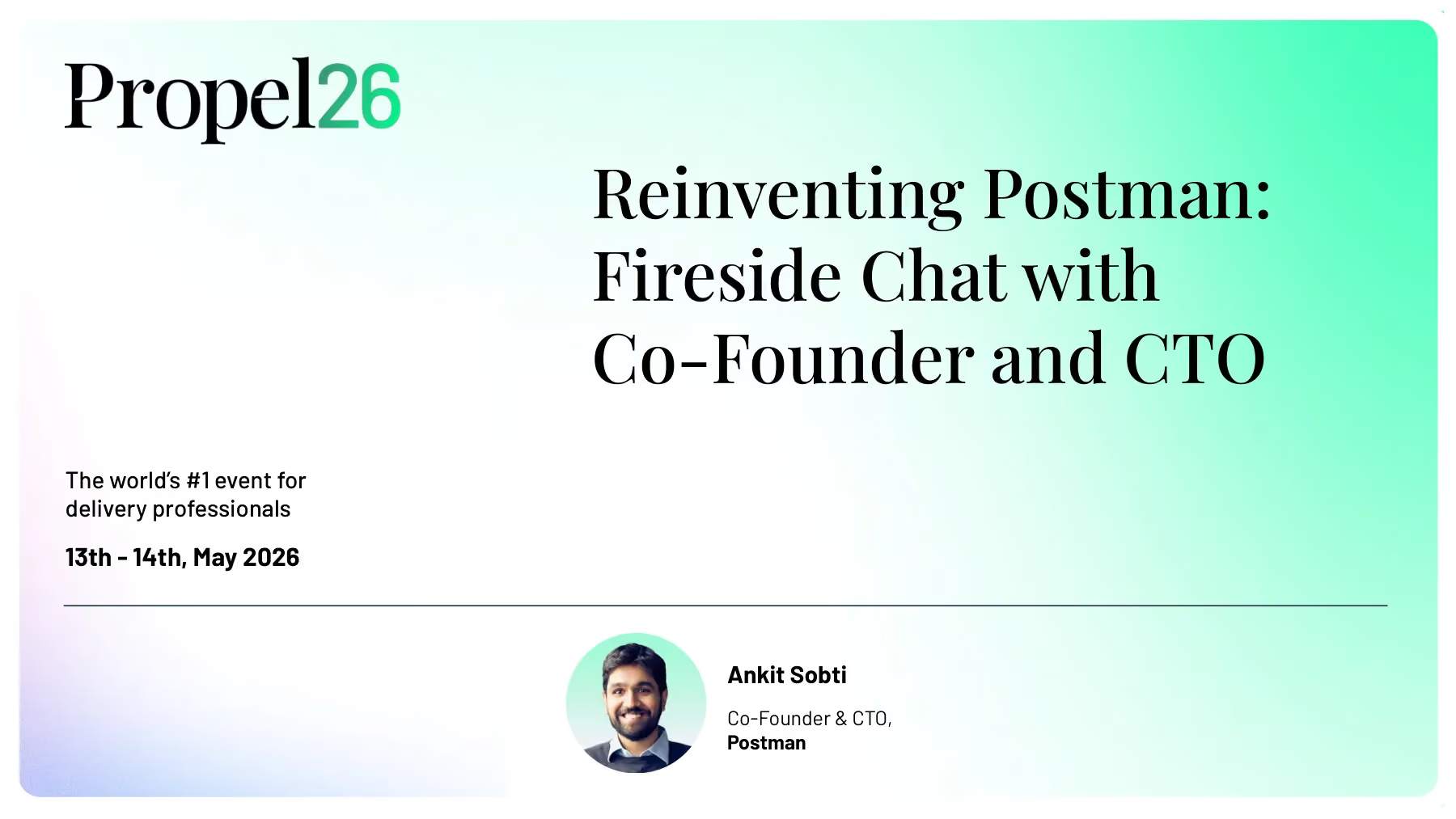
Product-led growth got Postman into 98% of the Fortune 500. But according to co-founder Ankit Sobti, the product alone wasn't enough to unlock enterprise value.
As AI adoption accelerated, Postman found itself confronting a new challenge: helping customers turn experimentation into outcomes. That meant building a Professional Services organization, standing up a Forward Deployed Engineering (FDE) function, and rethinking what it actually takes for enterprises to become AI-ready.
At Propel 26, Sobti reflected on that journey—from scaling one of the world's most widely adopted developer platforms to helping customers operationalize AI at enterprise scale.
The conversation covered APIs, AI agents, delivery readiness, and a warning every PS leader should heed: good patterns compound, but bad ones do too.
Read on for the key takeaways from the session.
Why API governance determines AI implementation success
Sobti offered one of the clearest explanations of the AI stack heard throughout Propel 26:
"APIs are the hands and legs that bring the probabilistic thoughts of an agent or an AI into action."
AI agents can reason, plan, and recommend. But they can't actually do anything without access to systems that execute those decisions.
Updating customer records. Triggering workflows. Sending notifications. Modifying project status. Pulling data from enterprise systems.
Every one of those actions ultimately happens through an API.
That's why Sobti sees today's AI wave as an extension of Postman's original mission rather than a departure from it. Before AI, APIs helped companies expose capabilities and create new business value. Now those same APIs have become the execution layer for intelligent agents.
The implication for Professional Services teams is significant.
AI implementations aren't simply software deployments anymore. They're operational deployments. Services teams are increasingly responsible for helping customers connect intelligence to action—and that requires secure, discoverable, and well-governed APIs.
As organizations deploy more agents, implementation complexity grows. Every new workflow introduces dependencies, integrations, governance requirements, and operational risk.
The question isn't whether customers will adopt AI. It's whether their underlying systems are ready to support it.
What PS teams need before deploying AI: the three-layer readiness model
One of the most practical frameworks from the session was Sobti's explanation of why many AI initiatives stall despite promising early results.
Most organizations focus almost exclusively on the agent layer.
They choose a model. Select a platform. Build a proof of concept. And then wonder why adoption stalls.
According to Sobti, successful AI deployments require three layers working together:
1. The Agent Layer
This is where most organizations spend their energy.
- Which model should we use?
- Which orchestration framework?
- Which agent platform?
These are important questions—but they represent only one-third of the problem.
2. The Data and Knowledge Layer
Agents need context.
In many organizations, institutional knowledge lives in documents, meetings, Slack conversations, and the heads of experienced employees.
If that knowledge isn't structured, discoverable, and accessible, agents can't operate on it reliably.
This is often where implementations begin breaking down.
3. The Tool and API Layer
Even with intelligence and context, agents still need ways to act.
If APIs aren't documented, discoverable, and governed, AI systems become recommendation engines rather than execution engines.
As Sobti explained:
"I need this trifecta to work together. I need the agents to have a system of intelligence. I need the data layers to serve as the system of record. And I need the system of action through APIs."
For PS leaders, this provides a useful lens for implementation.
Before scoping an AI initiative, assess all three layers. Organizations that focus exclusively on models often end up with impressive demos that never make it into production. Organizations that invest equally in data, process, and execution foundations are far more likely to achieve durable outcomes.
Why bad AI patterns compound as quickly as good ones
Sobti's strongest warning wasn't about technology.
It was about organizational behavior.
"Good things compound. But bad things also compound."
He described a scenario many leaders will recognize.
An engineer experiments with an AI tool and solves a legitimate customer problem. The result spreads internally. Other teams adopt the approach. Leadership starts by recognizing the success. Compensation plans begin rewarding the behavior.
Months later, the organization discovers that the underlying assumption was flawed.
By then, the pattern is embedded everywhere.
- Processes depend on it.
- Teams are organized around it.
- Customers expect it.
What started as a local optimization has become part of the operating model.
The challenge isn't AI itself. It's the speed at which AI can accelerate both good and bad decisions.
Sobti's recommendation wasn't to slow down experimentation.
Quite the opposite. Move quickly. Learn aggressively. But build observability into the system from day one.
The faster organizations move, the more important it becomes to understand what's actually happening beneath the surface.
For Professional Services leaders, this lesson applies directly to delivery operations. Before scaling a new workflow, process, or AI capability across the organization, define what success looks like and establish mechanisms to measure it continuously.
Otherwise, you'll eventually find yourself scaling problems alongside the wins.
How Rocketlane helps teams build AI readiness
Sobti's three-layer framework highlights a challenge many services organizations face today: AI readiness isn't just a technology problem.
It's an operational visibility problem.
Professional Services teams often manage projects, customer communications, resource plans, implementation workflows, and business outcomes across disconnected systems. That fragmentation makes it difficult to understand whether new AI-driven processes are actually creating value—or quietly introducing risk.
This is where a system of record becomes critical.
Rocketlane gives delivery organizations a unified view of project execution, customer collaboration, resource allocation, and delivery outcomes. When teams begin introducing AI into implementation and onboarding workflows, that connected foundation makes it easier to measure results, identify emerging patterns, and catch issues before they scale across the portfolio.
The same principle Sobti described applies here as well: good delivery habits compound, but so do bad ones. Visibility determines which ones survive.
How to apply Postman's PS playbook to your delivery organization
Sobti's journey from product-led growth to enterprise delivery revealed several lessons that extend well beyond Postman.
Build PS before FDE. Postman established a Professional Services motion before investing heavily in Forward Deployed Engineering. Services created customer trust, surfaced high-value problems, and generated the insight needed to justify deeper investments.
Use FDE as a product feedback engine. The goal isn't to solve one customer's problem forever. It's identifying repeatable patterns, validating demand, and feeding successful solutions back into the product.
Earn the right to solve bigger problems. Every successful engagement creates trust. That trust becomes the foundation for tackling more strategic customer challenges over time.
Scale carefully, but learn quickly. Start with visible customer wins. Let outcomes drive adoption rather than organizational mandates.
Conclusion
Ankit Sobti's session wasn't really about APIs.
It was about leverage.
APIs are the mechanism that allows AI agents to act. But the broader lesson for Professional Services leaders is that every decision compounds. Delivery processes compound. Customer trust compounds. AI adoption patterns compound.
The organizations that pull ahead won't necessarily be the ones deploying the most AI. They'll be the ones who build the right foundations first: trustworthy data, observable delivery systems, and clear feedback loops among customers, service teams, and product organizations.
Move fast, Sobti argued.
Just make sure you can see what you're accelerating.
That's ultimately what separates AI experimentation from AI advantage.
Table of Contents

Regsiter for the live webinar


Great consultants didn't join your team to spend Fridays writing documentation.
Table of contents
18 of Forbes Cloud 100 chose Rocketlane. The best PS teams aren't waiting around.
FAQs













Copyright © 2026 Rocketlane Corp. All rights reserved.


















.webp)