How to Automate Project Hygiene — Replacing Gut Feel with Real-Time Risk Scoring


•
•
Summarize blog with






A portfolio of 150 active projects with green health statuses across the board looks like a team that has it together.
But green only tells you what someone reported. It doesn't tell you whether the plan is reliable, the dates are credible, the dependencies are intact, or the milestones actually align with go-live.
That gap between reported health and actual health is where One Source Virtual's story starts.
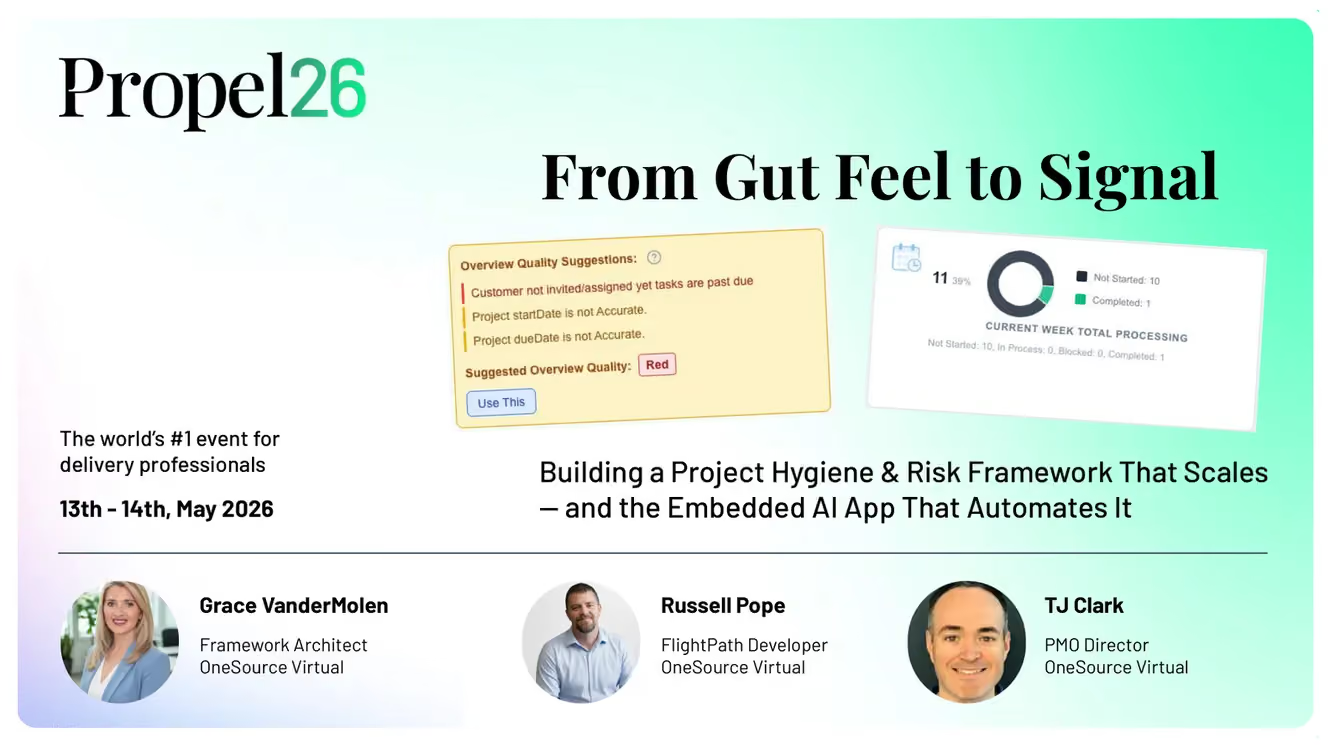
At Propel 26, Grace VanderMolen, Russell Pope, and TJ Clark from OSV's PMO team shared how they moved from instinct-based escalation to automated project hygiene scoring built on Rocketlane.
Their lesson was simple: before you can automate project health, you need a shared definition of what healthy actually means.
Why Project Health Statuses Fail to Predict Risk
When OSV transitioned to Rocketlane in April 2025, the portfolio looked healthy on the surface. Project lists were green. Escalations were limited. Leadership had no obvious reason to panic.
Underneath that surface, the plans told a different story.
"Our biggest challenge wasn't the tool," VanderMolen said. "It was inconsistent definitions of what 'healthy' actually meant."
Some green projects had broken dependencies. Others had tasks without owners or dates. Some milestones had incorrect durations. Some phases were misaligned with go-live. Even the phrase "go-live" did not mean the same thing across the team.
One PM considered a project done when the last task was checked off. Another waited until the customer's first payroll processed.
For OSV's payroll services business, that ambiguity mattered. Delivery timing was tied directly to operational execution, customer trust, and financial predictability.
A vague project status was not enough when missed milestones could affect revenue recognition, delivery margins, and customer outcomes.
Leadership was escalating based on instinct. OSV needed a shared framework. That became Operation Stabilize.
Why PMOs Should Define Project Hygiene Before Automating It
Most PMOs automate the wrong thing first. They buy dashboards before defining what health means. OSV did the opposite.
Before building anything, VanderMolen spent five weeks manually applying a project hygiene framework across 211 active projects. The team reviewed broken dependencies, missing task owners, incomplete dates, incorrect milestone durations, phase misalignment, and health statuses that didn't match reality.
The goal was not to fix every project one by one. It was to create a consistent, teachable definition of project hygiene.
That distinction matters. Automation is only useful when the underlying framework is trusted. If every PM has a different definition of healthy, automating health scores only scales confusion. OSV first proved the framework manually, then automated it once the signals were clear.
"This stopped being about individual judgment," VanderMolen said. "It became repeatable, teachable, and scalable."
Once the team could see hygiene consistently, the next question was obvious: if the framework works manually, why not automate it?
How OSV Built Automated Project Hygiene Scoring on Rocketlane
OSV built Flight Path, an app embedded directly in Rocketlane that gives the PMO a real-time, objective view of project health across the portfolio.
It pulls delivery context from Rocketlane and connects with external systems like Salesforce and Workday to create a single source of truth for project risk, hygiene, and go-live readiness.
This is where Rocketlane became more than the project system. It became the foundation for operational intelligence. Because project plans, tasks, owners, dates, milestones, and delivery workflows already lived in Rocketlane, OSV could build scoring directly into the flow of work rather than forcing PMs to manage yet another reporting layer.
Flight Path does four things that manual review could not do consistently at scale.
Automated Risk Scoring
Every project receives an objective risk score using the same criteria. The score is weighted by task priority because not every overdue item carries the same consequence.
A low-priority task slipping is not the same as a critical payroll milestone drifting. PMs can see what is driving the score and act before leadership has to ask.
More importantly, the team can understand what that risk means for timelines, customer commitments, and project profitability before overruns happen.
AI-Driven Project Hygiene Governance
The hygiene signals VanderMolen documented manually during Operation Stabilize were turned into automated checks. Flight Path now evaluates broken dependencies, missing owners, misaligned milestones, incomplete dates, and other plan-quality issues continuously.
The result is not just cleaner project plans. It is governance that runs in the background. Instead of waiting for a leadership review to discover drift, PMs and managers see signals as delivery unfolds.
Go-Live Tied to Real Operational Events
Rather than treating go-live as a box a PM checks, Flight Path confirms it through operational milestones: the customer's first payroll processes, collections clear, and disbursements run.
That matters because go-live now has a shared definition tied to real business events. It also makes reporting more credible. Delivery status, revenue recognition, margin closure, and financial forecasting all depend on knowing whether a project truly crossed the finish line.
"Go-live had no universal meaning," Pope said. "Now it does."
Coaching Over Time
Flight Path stores scores historically and pushes them back into Rocketlane project fields. That gives managers a trend line, not just a snapshot.
In one-on-ones, Clark and her leaders can see whether a PM's projects are improving, where issues repeat, and which patterns require coaching. A hygiene score does not replace judgment, but it tells leaders where to look.
"The most valuable part is when the risk score spits out a different rating than the project health status,"
Clark said. "It starts a conversation: what's going on here? Are you considering everything? It tells us exactly where to look."
Why Rocketlane Was the Right Platform for This Build
Flight Path worked because OSV could build on top of the delivery system its teams were already using. The app lives inside Rocketlane, uses the same access controls, and surfaces insights without forcing PMs into a separate tool.
That matters for adoption. If the signal lives outside the system where work happens, it becomes another dashboard someone has to remember to check. If the signal lives inside the delivery workflow, it becomes part of how the team operates.
Rocketlane's API, SDK, and integration flexibility gave OSV the ability to extend the platform around its own delivery model without replacing the system of record.
Salesforce and Workday data could be pulled into the same operating view, while Rocketlane remained the place where PMs managed projects and leaders reviewed health.
The broader lesson is clear: embedded intelligence scales faster than disconnected reporting. Teams stay in one system, signals stay tied to real work, and governance becomes part of delivery rather than a separate inspection process.
4 Key Takeaways from the Flight Path Build
Prove the Framework Manually Before Automating It
OSV spent five weeks applying the hygiene framework by hand before writing a single line of code. That manual work made the automation trustworthy. The framework had to be right before the scoring could be useful.
Definitions Matter More Than Dashboards
The core issue was not a missing tool. It was inconsistent definitions of health, risk, and go-live. Once the team aligned on those definitions, every downstream signal became more meaningful.
Use Hygiene Scores to Guide Coaching
A strong hygiene score often signals that a PM is engaged, organized, and close to the customer. A weak score shows where leaders should look. The score starts the conversation; coaching turns it into behavior change.
Extend Your System of Record Without Creating Another Silo
Flight Path worked because it lived inside Rocketlane. It extended the platform without forcing context switching, duplicated data entry, or separate reporting workflows.
Conclusion
The shift from gut feel to signal is not primarily a technology problem. It is a discipline problem.
OSV had to define what healthy meant before it could automate project health. Operation Stabilize created the shared language. Flight Path enforced it. The coaching cadence built around both turned scoring into behavior change across a 27-person PM team.
The principle applies to every services organization: before you automate project hygiene, define the signals that matter. What makes a plan reliable? What makes a milestone credible? What does go-live actually mean? Which risks affect margin, timeline, and customer outcomes?
Once those definitions are clear, automation becomes powerful.
Not because it replaces judgment, but because it gives judgment better signal.
Table of Contents

Regsiter for the live webinar


Great consultants didn't join your team to spend Fridays writing documentation.
Table of contents
18 of Forbes Cloud 100 chose Rocketlane. The best PS teams aren't waiting around.
FAQs













Copyright © 2026 Rocketlane Corp. All rights reserved.



















.webp)