Strategies for effective go-lives and solution adoption

•
•
Summarize blog with






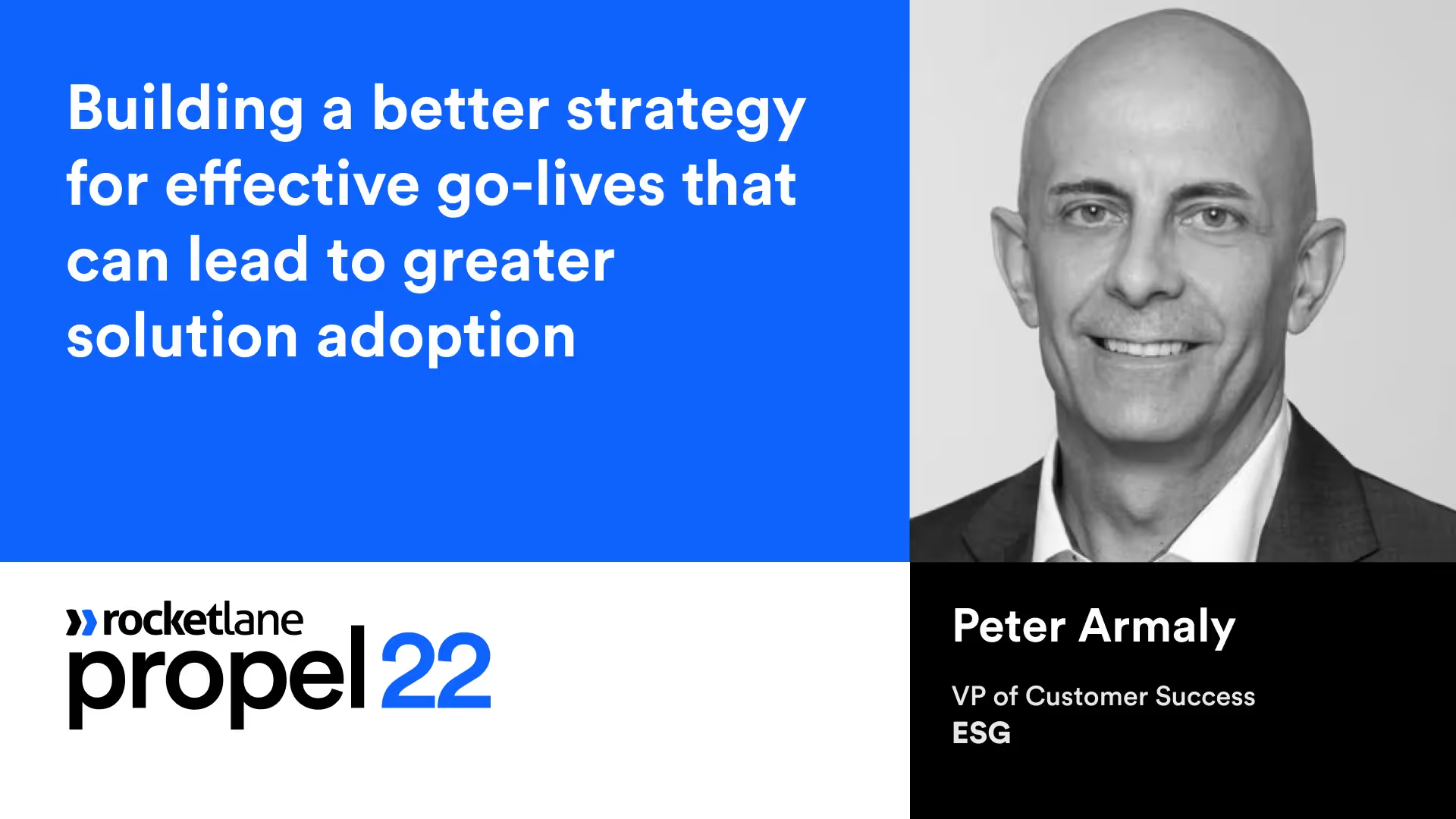
At Propel22, Peter Armaly, VP of Customer Success at ESG, talked about how you can increase the odds of successful customer solution adoption through the development of a professional strategy.
Here are key takeaways from the session.
The strategies you employ during onboarding are supercritical for the eventual success of your customers. You get it wrong, solution adoption suffers.
What customers want
- Quick go-lives
- Quick time-to-value
- Technical support that’s easy to access, responsive, accurate
- Clarity on what should be done to make the solution usable
- A roadmap to value realization
According to Chasm Group, customer success is a broken promise in 95% of tech companies. Peter says this is true to some extent. CEOs, CROs, and sales teams chase logos, and CSMs scramble to minimize churn.
Reasons for customer churn
- The pricing. Especially true of commodity products
- Value: they haven’t realized the desired value from the product
- The value is not communicated to the functional, executive, or economic buyers. QBRs and EBRs are ineffective
- Value is not communicated continuously to the functional, executive, or economic buyers. You are not relying on continuous Digital Business Reviews (DBRs)
- Customer success is limited to high-paying segments
- Micro pyramids: CSMs are paying more attention to the bigger accounts in their portfolio
- Competitor-driven churn: competitors are offering better value at a lower price
- Product-customer fit: selling to customers who aren’t a good fit for the product
- Bad user experience
- Lack of customer education and proper onboarding
- Not onboarding executive and economic buyers at the customer’s organization
- Features customers do not need are bundled together, and therefore the pricing doesn’t make sense for the value they are able to realize
- Cash flow problems at the customer’s organization
- Loss of a champion or executive sponsor at the customer’s organization
According to a Zonka survey, poor onboarding was the topmost cause for churn:

The telescope

If you take a telescope, you’ll see there are lenses on both ends. We point it at the intended object, and we observe. But what happens in between?
With customer success, the two lenses are conversions and go-lives.
However, for the customer, the distance between signing the contract and going live is riddled with stumble stones. This is largely due to an ineffective onboarding process.
Here’s what customers would rather have:

While you see the contract signing as a moment for celebration, customers view it more as a handshake. Onboarding is a process to get them to go-live. Go-live isn’t a moment for fireworks either, they are happy, but aren’t celebrating. The celebration happens when they realize value, which is during the adoption stage.
Onboarding myths
- Onboarding involves specific and obvious steps
- Onboarding is boring
- Onboarding is an exercise in project management
- It’s just checking all the boxes in the process
- Post-onboarding, the customer is good to go
Onboarding facts
- It’s fraught with challenges
- Onboarding is often viewed as the lesser cousin of selling
- It involves multiple groups, multiple points of view
- It can have a damaging effect on adoption if done wrong
- Vendor executives often steer clear of involvement in onboarding
Onboarding aspirations
Here’s what Peter says onboarding teams should aspire to:
- Meet both strategic and tactical goals of the customer
- Inspire the customer
- Be more than checklists
- Steadily increase the customer’s energy and engagement; the customer shouldn’t get despondent when faced with challenges
- Build a strong foundation for customer relationships and journeys
What checklists don’t account for
- Customer teams outside the vendor’s sphere of influence
- Disengaged or distracted economic buyers; eventually leads to churn
- Long timelines
- Data complexity
- Insufficient communication
- No clear connection between the onboarding process and business effects for all stakeholders
- Swapped out vendors and/or partner team members
Customer emotions at various stages

Between the purchase and the renewal/expansion phase, the customer can experience anxiety, frustration, confusion, etc. as they go through the onboarding and adoption phases. This is because they have a lot riding on successful onboarding and adoption, and may be worried about things going south. The goal of Customer Success is to bring them to the renewal/expansion stage at the earliest.
Here’s how you can do that:
- The onus is on Customer Success to drive alignment among all stakeholders to make sure that the customer’s experience is the best it can be
- You need to work as a team, and that includes the customer’s teams
- Respect the customer’s processes; you are their expert, not their boss. Make sure that their processes make sense and are complementary to your tool

Best practices
- Ensure you involve CS Ops so they can collect customer data and use it as input
- Build the skill to communicate with clarity, precision, inspiration
- Solicit the customer’s executive endorsement and support as go-live approaches
- Stay involved and supportive towards the customer throughout the onboarding process
- Get all stakeholders to engage and meet their committed deadlines
The onboarding strategy for successful go-live and product adoption
Peter’s recommendations for a successful onboarding strategy that can lead to effective go-lives and better product adoption:
- Think long-term. Every task, every checklist item matters when it all comes together
- Embrace complexity. It’s part of business, and accepting the complexities help you manage relationships better
- Take lead with customer success. Step up. That’s what customers are hoping you’d do too
- Build partnerships through transparent and respectful communication
- Sweat the details. Make sure critical items are completed
- Be a storyteller. Customers need to understand how your solution matters to their business. Even if they are low-level working on their tasks, they’ll appreciate it if you remind them how those tasks fit into the bigger picture
- Be brave. Yes, it’s a complex phase, but it is critical. It needs to play out well to get customers to product adoption
More resources from industry leaders and experts
Table of Contents

Regsiter for the live webinar


Great consultants didn't join your team to spend Fridays writing documentation.
Table of contents
18 of Forbes Cloud 100 chose Rocketlane. The best PS teams aren't waiting around.
FAQs













Copyright © 2026 Rocketlane Corp. All rights reserved.



















.webp)