How PS can work with CS to improve the customer journey

•
•
Summarize blog with






When professional services and customer success teams join forces for customer onboarding, magic happens.
This partnership not only smooths out the process but also ensures customers see value faster and stick around longer.
In this Propel24 session, Sadee Akhtar, Director of Flow Expert Services at Pluralsight, shares how PS teams can work with CS teams to improve the customer journey. Sadie leads a dedicated team that is passionate about delivering seamless implementation and expert enablement services to ensure accelerated time to value, optimized platform utilization, and tangible business impact.
In the session, Sadie shed light on:
- The evolution of Pluralsight Flow and its customer journey
- How Pluralsight created a winning CS x PS collaboration
- Tips to make a PS X CS collaboration work
- Cultivating a culture of collaboration
- Ways to celebrate wins and empower action in your organization
Here are the key takeaways from the session.
The evolution of Pluralsight Flow and its customer journey
Pluralsight's mission is to advance the world's tech force. In 2019, Pluralsight acquired GitPrime, a small startup that was a leader in engineering analytics. This acquisition became Pluralsight's Flow product.
In 2022, the company decided that it was time to provide focused leadership for the product line. That’s when they established a unified Customer Experience (CX) function, encompassing IT support, professional services, customer success, and documentation.
As a startup, Flow had a strong customer success team that managed onboarding, renewals, and overall customer management. To enhance capabilities, Pluralsight introduced a new deployment function focused on implementing, onboarding, and supporting new customers with platform configuration and maintenance throughout their journey.
However, this transition brought its share of challenges, such as:
- Different priorities across teams: Balancing the influx of new product features with supporting existing customers was challenging for the customer success team, while the professional services team focused on onboarding new customers.
- Resource constraints: Significant organizational changes stretched resources thin. Teams had to improve efficiency in their core areas while adapting to broader organizational shifts.
- Communication gaps: Miscommunications arose as teams adjusted to new workflows and organizational changes, affecting collaboration efficiency.
- Gaps in data and integration: Integrating data across different functions and ensuring seamless information flow proved challenging, impacting decision-making and coordination.
How Pluralsight created the winning team
With the goal of delivering improved and predictable outcomes for all customers, here is how the team approached the process
1. Defining principles in creating the customer journey
- Design with data: As an engineering analytics company, Pluralsight leveraged data to shape the customer journey. It was crucial to understand which data mattered to each team and what outcomes they aimed to achieve.
- Be consistent, not uniform: Supporting complex customer scenarios requires a consistent approach but also flexibility to cater to individual needs. The team had to ensure their approach could adapt to different customers.
- Understand the context: It was important to determine if the customer journey was for onboarding new customers, supporting existing ones, or helping customers upskill. This understanding guided their approach.
- Do the hard work to simplify things for the customer: The team was focused on making sure to do whatever it took, and then periodically iterating and reviewing their progress, to ensure that the customer had a seamless journey.
2. Building the team
Pluralsight assembled a small team from various business functions, including customer success, support, professional services, and business operations. This diverse team helped understand data points, design the customer journey, and ensure all aspects were covered.
3. Piloting and feedback
Once the journey was designed, it was shared internally for feedback and piloted with a few customers.
Pluralsight's customers were initially unaware that a structured customer journey had been implemented, but their feedback highlighted that they felt supported, understood, and heard throughout the process. During onboarding, customers frequently asked about upcoming steps, and the team was equipped to reassure them that everything was covered, adapting to meet their needs seamlessly.
The journey didn't end with deployment. Pluralsight continually sought feedback to identify areas for improvement and determine the next steps. They treated the customer journey as an internal organizational asset, constantly refining their approach based on feedback and evolving needs.
The anatomy of the customer journey at Pluralsight Flow
Pluralsight's customer journey is meticulously designed like a road map, tailored specifically for engineering teams who are accustomed to this format.
The journey is divided into several key segments to ensure clarity and effectiveness.
- Platform configuration stages: Once customers purchase the product, the first step is to configure it and present it to their end users. The team partners with customers to guide them through this initial stage, ensuring they understand the configuration process.
- Delivery phases of onboarding: This segment outlines what happens at each stage of the onboarding process. Pluralsight aligns with the customer's workflow, clearly defining "done" for each stage to maintain transparency about progress and pending tasks.
- Persona-Level Accountability: Accountability is assigned at the persona level, meaning specific actions are designated either to Pluralsight or the customer. This ensures that roles and responsibilities are clear during meetings and discussions.
- Timelines: A predefined timeline is presented to the customers, highlighting a standard pace for launching and implementing the product. However, the actual speed of deployment is flexible and can be adjusted based on the customer's preferences and needs.
Cultivating a culture of collaboration: Celebrating wins and gaining insights
The team at Pluralsight places a strong emphasis on delivering value at every stage of the customer journey.
Rather than waiting until the end of an onboarding exercise, they prioritize ensuring that customers see value at each phase. This involves identifying key points of value early on and working diligently to achieve them swiftly. For instance, simply ingesting data onto the platform provides immediate visibility and value creation for customers, and the team makes it their responsibility to highlight this.
When it comes to continuous improvement, the customer success team conducts weekly retrospectives and stand-ups with the onboarding teams to discuss successes and address any blockers. This practice allows them to iterate on assets based on direct customer feedback.
In addition, they celebrate wins in their biweekly revenue and CX meetings. Their customer success function is integrated within the revenue function, fostering a close relationship with the sales team. This collaboration extends to the product team, where they share insights and support, ultimately enhancing the overall customer experience.
To track effectiveness, they focus on multiple aspects of customer experience by tracking the speed of value realization, platform adoption, and even support volume.
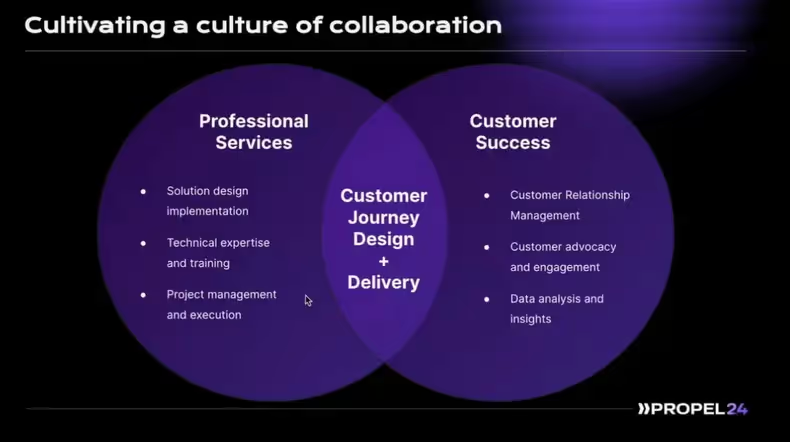
Recognize that teams might have different names or functions, but they all contribute to the larger goal. For instance, your professional services team focuses on solution design and implementation. They possess technical expertise, train users, manage projects, and ensure smooth program delivery, whether for small startups or large enterprises.
These teams are proficient in technical aspects, product training, project management, and execution. They ensure projects move forward efficiently during customer onboarding and enablement phases.
Customer success teams excel in relationship management. They understand the subtleties of customer interactions, advocate for customer needs, analyze data, and focus on long-term engagement.
Bringing these teams together fosters powerful conversations and quick shifts in strategy. For example, small cross-functional teams or internal sprints can drive initiatives forward effectively. Pluralsight even has a transformation team that works closely with professional services, customer success, and engineering teams to deliver any updates to the customer journey.
Advice for teams to foster CS and PX collaboration
- Start with data and anecdotal evidence: Begin by gathering quantitative data from systems and qualitative data from conversations with customers and success teams. This blend of insights will provide a comprehensive understanding of the customer experience.
- Agree on design principles: Establish design principles that align with your customer journey. Regularly review and update these principles to ensure they reflect current customer needs and business goals.
- Define value explicitly: Clearly define what value means from both the company and customer perspectives. Break down the customer journey into segments and validate each segment's value with customer feedback.
- Think about tooling: Assess the tools and resources you have. Utilize them effectively to support collaboration. For example, use Jira for project management and support ticket integration. Make sure to monitor project metrics like cycle time and backlog rate.
- Ongoing education: Invest in continuous education for both customers and your internal team. Regularly update training materials and ensure new team members are well-versed in the latest processes. Host sessions with customers to reinforce their understanding and engagement.
- Double down on handovers: Pay special attention to handover points between teams. These can be potential weak spots, so ensure clear communication and process management to maintain service quality during transitions.
{{demo}}
Table of Contents

Regsiter for the live webinar


Great consultants didn't join your team to spend Fridays writing documentation.
Table of contents
18 of Forbes Cloud 100 chose Rocketlane. The best PS teams aren't waiting around.
FAQs













Copyright © 2026 Rocketlane Corp. All rights reserved.

















.webp)