UX of delivery: Unlock the service experience


•
•
Summarize blog with






When you think of great UX, you don't typically think about professional services.
The rise of the cloud transformed how we interact with software, making products more accessible and user-friendly.
While SaaS companies quickly embraced this shift, professional services seem to be stuck in the past – despite the potential for significant impact.
In a special session at Propel24, Brett Jarvis, VP of Customer Success and Experience at Rocketlane, and Srikrishnan Ganesan, co-founder and CEO, Rocketlane, share their perspective. They discuss why it's time to take the UX of service delivery seriously -- and what that entails.
Learnings from the Oracle customer service story
Reflecting on his time at Oracle, Brett shares insights from the early 2000s when Oracle transitioned to delivering software over the Internet. Back then, Oracle implementations were massive undertakings lasting over a year. Companies had to handle their hardware and software upgrades, posing significant support challenges. Seeing the promise of internet-based software delivery, Oracle pioneered "Oracle on Demand," an early precursor to today's SaaS model.
This move was transformative but posed significant challenges, requiring extensive infrastructure and support to ensure seamless service delivery. It involved setting up dedicated data centers and ensuring customers were always up-to-date with the latest software. However, since customers no longer controlled their software management, they lacked visibility into their operations.
To address this, Oracle created a customer portal that displayed uptime, performance, software upgrades, and support tickets. To address customer concerns about visibility and control, Oracle introduced a customer portal, providing real-time insights into uptime, performance, upgrades, and support tickets, enhancing transparency and trust.
Although the user experience wasn't the most elegant, this move was highly effective in providing transparency and instilling confidence in Oracle's services.
Why it’s time to improve the CX of onboarding and implementation
Bad user experience hurts everyone – it derails progress and creates a trust deficit in customers. Customers want results, but they also value the experience they have throughout the implementation journey.
Customer onboarding and implementation remain challenging in professional services. This is only made worse by the lack of attention to CX. And yet, this struggle persists in an enormous industry poised for great growth. For perspective, the global professional services market is valued at $870 billion, with a projected growth rate of 9.5% CAGR from 2024 to 2030.
Here’s why: Companies often believe their products are as intuitive as Slack and assume they won’t need to provide services to their customers. They overlook the value of services and the user experience that accompanies them.
However, even Slack needs services for integrations and ensuring users get the most out of the product.
Even Tesla, with its cutting-edge technology, understands the importance of services. They have focused on creating UX that includes tracking battery levels, locating charging stations, and more, which fuels the company’s growth.
It’s time for service companies to aspire to have excellent UX so they can also benefit from:
- Standardization and ease of use
- Efficiency and productivity
- Visibility and collaboration
- Retention and growth
It's only by improving the UX in service delivery that firms can enhance the overall customer experience, drive efficiencies, and foster stronger, more successful partnerships.
How Rocketlane is ushering the services UX revolution
At Rocketlane, we want to be at the forefront of revolutionizing the user experience in service delivery. Through thoughtful enhancements to our product, we're reshaping how users engage with service delivery. Here are a few ways Rocketlane is unlocking CX in professional services:
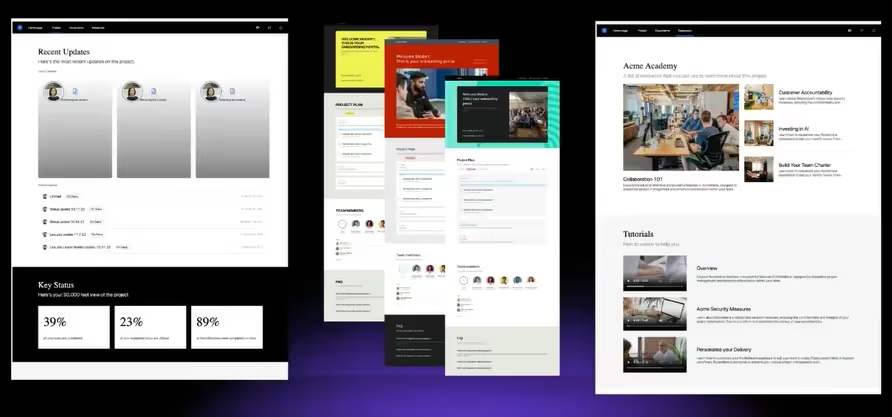
1. Enhanced project statuses and updates: Rocketlane is dedicated to simplifying the process of reviewing project statuses far enough to make it enjoyable. With Rocketlane’s update features, customers can easily access relevant information in a format that feels natural to them. This encourages more active participation in the service and fosters a deeper understanding of project progress.
2. Custom-branded dedicated customer portals: Rocketlane’s UX focus extends beyond functionality to aesthetics. With custom-branded customer portals, users can experience project statuses and engagements through an interface that reflects their brand identity.
3. Centralized resource access: In our commitment to streamline user interaction, Rocketlane offers centralized access to all resources. From documentation to videos, users can conveniently find everything they need in one location.
Q&A with Brett and Sri
1. What’s the best way to go about pitching the idea of improving the UX of services at an organization?
Brett: I've often heard concerns about sharing statistics and service data with customers because there's a lot of behind-the-scenes work involved. My approach is to say that the data won't improve without transparency. By being open about what you’re doing for your customers, your data will improve. It can be tempting to wait until things look better. But if you are transparent and work through issues with customers, the data and services will improve faster – and customers will appreciate the openness.
2. What metrics can we look at to indicate/assess great UX?
Brett: The key metric is user engagement. Are customers engaging with your service? Are they interacting with the UX? Tracking this engagement provides a great indicator of UX effectiveness.
Sri: Additionally, consider the level of stakeholder involvement. If your UX stands out, you'll see leadership buy-in. Leaders often push for impressive UX after seeing it elsewhere because it enhances the company's and brand's image. In my experience, CXO-level individuals get excited about making the company look better in front of customers, rather than shying away from it.
3. Is there a transformation that you would suggest to a customer service portal where you can self-serve answers and check the status of inquiries?
Sri: Current customer service portals, like Zendesk or custom community portals, focus mainly on support services. Our view is to expand this concept into a more all-encompassing partnership portal. This portal should include everything from partnership goals and current deliverables to a summary of inquiries and issues raised. Think of it as a dynamic representation of the partnership that evolves with the engagement stage.
For instance, at the start of the customer relationship, the portal could feature a welcome video outlining what to expect in the next six weeks. It could also include unique customer needs and an intake form for additional requests. As the partnership progresses, it could reveal different elements such as ongoing UAT issues (with forms for submitting bugs). After completing a project, it could collect feedback and highlight relevant aspects of the journey.
Brett: To add to that, existing customer portals are often transactional. What we're suggesting is a more interactive experience that facilitates a collaborative working relationship, using its UX to guide customers through their journey with us, as Sri described.
4. How is the UX of service delivery different from service design?
Sri: Service design is more all-encompassing than just UX. It includes the entire methodology and every touchpoint in the customer journey – how meetings are conducted, the initiation of engagements, and what happens before and after each stage. It’s about laying out the entire journey, including positioning and pricing. Service design ensures that every aspect of the service is well thought out and seamlessly integrated.
5. What are some common challenges that PS teams face when trying to improve the UX of delivery?
Sri: One of the main challenges is achieving true standardization, which is difficult when human beings are involved.
From my discussions with customers, I've found that a significant reason they are excited about using Rocketlane is that it serves as a forcing function to standardize their delivery processes.
Table of Contents

Regsiter for the live webinar


Great consultants didn't join your team to spend Fridays writing documentation.
Table of contents
18 of Forbes Cloud 100 chose Rocketlane. The best PS teams aren't waiting around.
FAQs













Copyright © 2026 Rocketlane Corp. All rights reserved.



















.webp)