What is Project Governance? A Complete Guide to Frameworks, Components, and Best Practices in 2026

•
•
Summarize blog with






Introduction
Only about 50% of projects meet their original goals.
The gap is typically driven by unclear objectives, weak planning discipline, and misalignment among stakeholders, rather than by a single failure point.
In other words, it’s a project governance problem.
Project governance is the system of roles, decision rights, processes, and oversight structures that ensure projects stay aligned with business objectives throughout their lifecycle.
It defines who makes decisions, how performance is monitored, how risks are escalated, and how accountability is maintained from project initiation through completion.
Effective governance is built on core principles such as transparency, accountability, and alignment with organizational strategy, which underpin all governance structures and processes.
This article covers the key components of project governance, the frameworks teams use to implement them, and the best practices that set high-performing delivery organizations apart.
What is project governance?

As a management framework, it includes defining roles and responsibilities, establishing communication channels, and implementing performance measures and reporting mechanisms to monitor project progress.
In practice, project governance establishes the structure through which projects are supervised and controlled. Leadership teams typically define governance frameworks during project initiation or portfolio planning to ensure that projects operate within a clear system of authority, reporting, and oversight.
Project governance plays an essential role in decision-making, accountability, and ensuring that projects remain aligned with organizational objectives throughout their lifecycle.
Unlike organizational governance, which guides overall corporate strategy, compliance, and broad decision-making frameworks within a company, project governance focuses specifically on the oversight and direction of individual projects.
Governance determines several critical aspects of project execution:
- Decision authority: Who approves scope changes, budget adjustments, and strategic pivots
- Role accountability: Which stakeholders are responsible for delivery outcomes and performance monitoring
- Risk escalation: How emerging issues are surfaced and addressed before they disrupt delivery
- Communication cadence: How progress and performance are reported across leadership, delivery teams, and stakeholders
Project governance ensures clear roles, systematic communication, risk mitigation, and strategic alignment throughout the project lifecycle, providing structure, oversight, and accountability.
For example, consider a SaaS implementation organization managing 20+ concurrent client onboarding projects. In this case, project governance answers three operational questions:
- Who approves scope changes?
- How are delivery risks escalated?
- How is project performance reviewed across leadership teams?
While governance defines how projects are overseen, project management defines how the work itself is executed. Understanding the distinction between the two helps organizations design governance frameworks that support delivery rather than slow it down.
Project governance vs. project management: what is the difference?

The difference between project management and project governance comes down to this: Governance sets the rules. Project management runs the play.
These two disciplines are related but structurally distinct, and treating them as interchangeable creates accountability gaps that surface during delivery.
While project management focuses on the operational aspects, managing projects effectively requires a structured framework established by governance to ensure oversight, clear responsibilities, and accountability.
Governance is the oversight layer that sits above day-to-day delivery. Project management is the operational layer that operates within the boundaries defined by governance.
Strong task management and solid execution both depend on a governance layer that defines who holds decision-making authority at every level.
A key component of project governance is the project management control process, which ensures that project tasks and metrics are consistently monitored and managed for effective oversight.
Why is project governance important?
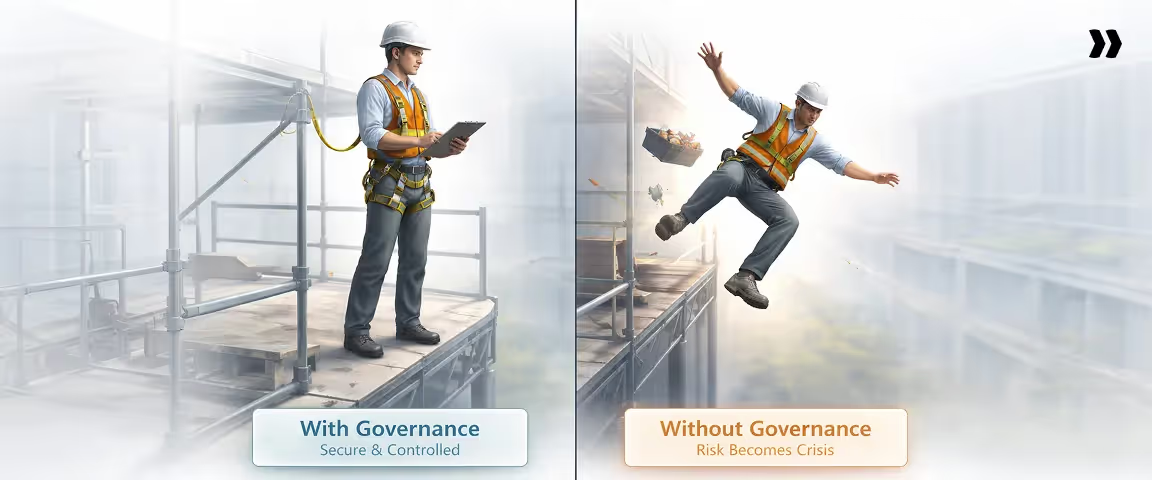
Project governance is important because it creates the structure that keeps projects aligned with business objectives while delivery progresses.
Good project governance provides a comprehensive framework that includes clear roles, decision-making processes, risk management, and communication strategies, ensuring projects align with organizational goals and are delivered successfully through structured oversight and accountability.
When decision authority is clear, risks are surfaced early, and accountability is assigned, projects resolve issues quickly and stay on track.
When decision authority is clear, risks are surfaced early, and accountability is assigned, projects resolve issues quickly and stay on track.
Four reasons governance matters operationally:
Reduces project failure risk: PMI data consistently shows that organizations with stronger governance maturity experience fewer cost overruns and schedule failures. Mature governance surfaces risk early enough for teams to act on it, keeping issues in the escalation queue before they reach the critical path.
Creates accountability chains: When decision authority is mapped before kickoff, scope changes, stakeholder disputes, and budget adjustments get resolved mid-delivery because someone owns the call. Governance structures make ownership explicit at every level, and establishing a single point of accountability is fundamental for clarity, responsibility, and streamlined decision-making.
Keeps stakeholders aligned: Large projects involve executives, delivery teams, finance leaders, and external partners operating with different priorities. Governance structures ensure consistent information flow and participation at the right level, so each group works from the same set of project facts.
Makes delivery predictable at scale: For enterprise services teams running 10 or more concurrent projects, governance creates repeatable reporting and escalation structures. Each delivery runs within a consistent, defined framework, which makes portfolio-level oversight operational.
The bottom line: Unmanaged project risk accumulates until it becomes a crisis; governance is the system that keeps risk visible, assigned, and resolved.
What are the 7 key components of project governance?
The 7 key components of project governance are:
- Project goals and objectives
- Roles and responsibilities of stakeholders
- Decision-making processes
- Communication and reporting mechanisms
- Risk and issue management
- Quality assurance, and
- Monitoring and control.
A structured governance framework brings these elements together, ensuring effective decision-making, accountability, risk management, and strategic alignment throughout the project's lifecycle.
Each component maps to a specific governance document.
A complete project governance template includes: a RACI matrix, a stakeholder register, a risk register, a communication plan, a quality assurance log, a decision log, and a performance dashboard.
1. Project goals and objectives
Without a clear understanding of what the project aims to achieve, it becomes difficult to manage resources, track progress, or evaluate success. Project goals define the overall desired outcome, while objectives translate that into specific, measurable, time-bound targets.
Governance uses this definition as a reference point for all decisions. Trade-offs around scope, timelines, and resources are evaluated against these goals, preventing drift as stakeholder expectations evolve.
Establishing these with stakeholder alignment upfront ensures consistency throughout the lifecycle.
In practice:
A SaaS implementation defines go-live timelines, adoption targets, and sign-off criteria before kickoff, so that all changes are evaluated against agreed-upon outcomes.
Primary governance document or artifact:
A project charter is a formal document that defines project objectives, scope, success criteria, and key stakeholders.
2. Roles and responsibilities of project stakeholders
Clear roles and responsibilities ensure accountability, coordination, and smooth execution. Governance formalizes ownership across stakeholders, not just for tasks but for decisions and approvals.
Misalignment here often results in stalled decisions or duplicated effort, where responsibility is assumed rather than defined. Misalignment here often results in stalled decisions or duplicated effort, where responsibility is assumed rather than defined.
Decision-makers are essential for approving workflows and maintaining oversight, helping prevent bottlenecks and scope creep. Engaging key project stakeholders in the governance process further supports effective decision-making and project success.
In practice (PS/SaaS):
Defining whether integration approvals sit with the client or the delivery team avoids delays when dependencies emerge mid-project.
Primary governance document or artifact:
RACI matrix + stakeholder register, a record of key decisions, including context, owner, and rationale.
Role of the steering committee in project governance
The steering committee acts as the senior decision-making layer within the governance structure, responsible for strategic oversight and high-impact decisions. It provides direction on scope changes, resource allocation, and risk resolution when issues are escalated beyond the delivery team.
The committee is also responsible for defining, reviewing, and approving key project decisions, ensuring accountability and clear communication throughout the project lifecycle.
In practice, the steering committee works in tandem with the PMO, which operationalizes governance through reporting, process standardization, and communication flow between stakeholders and delivery teams.
3. Decision-making processes
Decision-making processes define how choices are made, what inputs are required, and who has authority at each stage. Governance ensures decisions are structured, data-informed, and aligned with project objectives.
Clear processes prevent delays caused by ambiguity and ensure consistency across similar decisions.
In practice (PS/SaaS):
Scope changes are evaluated based on impact and routed through predefined approval levels, ensuring timely and consistent decisions.
Primary governance document or artifact:
Decision log, a record of key decisions, including context, owner, and rationale.
4. Communication and reporting mechanisms
Effective governance requires structured communication and reporting to maintain transparency and enable timely decisions. Information must be delivered to the right stakeholders in the right format and cadence.
Reporting is not just about visibility, but about enabling action and accountability. Regularly tracking and communicating project status is essential for maintaining transparency, supporting informed decision-making, and ensuring all stakeholders are aware of progress and potential risks.
In practice (PS/SaaS):
Weekly updates track execution and blockers, while dashboards provide real-time visibility into project health and project status for stakeholders.
Primary governance document or artifact:
A communication plan, a framework that defines who is responsible, accountable, consulted, and informed for each decision.
5. Risk and issue management
Proactive risk identification reduces uncertainty, while structured issue resolution minimizes disruption. Effective risk and issue management within project governance is essential to ensure successful project outcomes.
Risk management focuses on identifying and mitigating potential threats, while issue management addresses problems that arise during execution. Governance defines processes for both, ensuring they are handled systematically.
Proactive risk identification reduces uncertainty, while structured issue resolution minimizes disruption.
In practice (PS/SaaS):
Client-side delays are identified early as risks with mitigation plans; missed deadlines are escalated as issues with defined response timelines.
Primary governance document or artifact:
Risk register + issue log, a tracked list of risks, their likelihood, impact, owners, and mitigation plans.
6. Quality assurance
Quality assurance ensures deliverables meet predefined standards and expectations. Governance establishes quality criteria, validation checkpoints, and approval processes early in the project.
This prevents ambiguity around acceptance and reduces rework later in the lifecycle.
In practice (PS/SaaS):
User acceptance testing (UAT) completion criteria and defect thresholds are defined up front to determine readiness for go-live.
Primary governance document or artifact:
Quality assurance log, a record of quality checks, validation criteria, and acceptance outcomes.
7. Monitoring and control
Monitoring and control involve tracking performance against objectives and taking corrective action when deviations occur. Governance defines the metrics, review cadence, and escalation mechanisms required to maintain alignment.
Project milestones play a crucial role in this process by providing key points in the project's timeline to assess progress and ensure alignment with organizational goals.
This ensures that projects respond to issues in real time rather than reacting too late.
Project assurance is a key element of effective project governance, providing an independent layer of oversight to ensure projects are delivered as intended—on time, within budget, and to the agreed-upon quality standards.
While project governance establishes the framework for decision-making and accountability, project assurance acts as a safeguard, verifying that these frameworks are being applied consistently and effectively throughout the project lifecycle. The importance of project assurance lies in its ability to provide objective evaluation and continuous improvement.
In practice (PS/SaaS):
Tracking milestone progress and schedule variance, with predefined triggers for escalation or replanning when thresholds are exceeded.
Primary governance document or artifact:
Performance dashboard, a real-time view of project metrics such as progress, cost, and resource utilization.
Monitoring tracks performance. Control enables intervention. Assurance ensures both are actually working as intended.
The three pillars of project governance: Data, people, and organization

Every effective project governance structure rests on three interdependent pillars: data, people, and organization.
These three pillars are essential for achieving successful project governance, as they enable proactive communication, stakeholder engagement, and effective data management.
Data
Data feeds every governance decision. It provides the visibility required to identify risks, track progress, and evaluate performance against defined objectives. Without reliable, real-time data, governance shifts from evidence-based decision-making to opinion and assumption.
The key is to:
- Establish a single source of truth for project health
- Ensure data is timely, accurate, and consistently reported
- Use data to anchor decisions, not justify them after the fact
When data is incomplete, delayed, or fragmented, even well-defined governance processes break down because decisions are made without shared context.
People
Governance is only as strong as the people enforcing it. This includes the project owner, steering or oversight groups, and consultative stakeholders who bring expertise and perspective.
Leaders need to:
- Define clear ownership for decisions, not just participation
- Ensure escalation paths are backed by actual authority
- Involve the right stakeholders at the right decision points
Weak governance often manifests as delayed decisions or unresolved conflicts because ownership is unclear or not exercised.
Organization
An organization is the structure that makes governance repeatable. It defines how decisions flow, how information moves, and how accountability is enforced across the project lifecycle.
Make sure to:
- Establish clear hierarchy and escalation paths
- Define communication cadence and reporting formats
- Standardize processes for risk, decision-making, and performance tracking
Without this structure, governance becomes inconsistent. Decisions stall, communication fragments, and accountability weakens because there is no system ensuring continuity.
Types of project governance frameworks and models
The four most widely used project governance frameworks are:
1. PMBOK / PMI governance framework
This project governance framework is structured, process-driven, and designed for environments where predictability and control are critical.
Developed by the Project Management Institute, the PMBOK framework defines governance through standardized processes across initiation, planning, execution, monitoring, and closure.
It is widely used in enterprise IT, infrastructure, and capital-intensive projects, where multiple dependencies, regulatory constraints, and the high cost of failure require rigor.
Governance here is formal, documentation-heavy, and tightly linked to performance tracking and risk control.
2. PRINCE2 governance structure
The PRINCE2 project governance model is built around a stage-gate approach, where projects are divided into controlled phases with defined approval points. Each stage requires validation before proceeding, ensuring accountability at every step.
A central feature is the project board, which provides oversight and decision authority. This model is common in government, public sector, and multi-stakeholder enterprise environments, especially across the UK and Europe. It emphasizes control, justification, and clear escalation paths.
3. Agile governance model
The Agile project governance model is lightweight and adaptive, designed for digital project governance, SaaS delivery, and product-led teams. Instead of rigid phase gates, governance is embedded into sprint cycles, reviews, and continuous feedback loops.
Decision-making is decentralized, with teams empowered to act within defined boundaries. Governance focuses on visibility, iteration, and rapid response rather than strict control. This makes it well-suited for environments where requirements evolve quickly.
4. PMO portfolio governance framework
The project management office (PMO) governance or project portfolio governance framework operates at a higher level, overseeing multiple projects and programs simultaneously. It ensures alignment with organizational strategy, resource allocation, and prioritization across initiatives.
This model is used in large enterprises managing multiple concurrent projects or programs, where visibility across the portfolio is critical. It connects individual project governance to broader program governance frameworks and business outcomes.
Comparison of project governance frameworks
There is no universally “best” project governance model. The right choice depends on project type, organizational complexity, and risk tolerance.
Implementing a project governance framework: Steps to success
Establishing a robust project governance framework is essential for organizations aiming to achieve successful project delivery and maintain alignment with strategic business objectives.
A well-implemented governance framework not only clarifies roles and responsibilities but also streamlines decision-making, ensuring every project stays on track from initiation to completion.
Here are the key steps to successfully implement a project governance framework:
Define project objectives and success criteria
Start by clearly articulating the project’s goals and intended outcomes. This provides a foundation for all governance activities and ensures that every decision supports the broader business strategy.
Design the governance framework
Develop a structured framework that outlines the hierarchy, decision rights, and escalation paths. This should include the governance committees, reporting structures, and the mechanisms for monitoring project progress.
Assign roles and responsibilities
Identify key stakeholders, including the project sponsor, project manager, steering committee, and project team members. Clearly document each role’s responsibilities and authority within the governance structure to avoid ambiguity during project delivery.
Establish decision-making processes
Define how decisions will be made, who has the authority to make them, and how conflicts or escalations will be handled. Transparent decision-making processes help maintain momentum and prevent bottlenecks throughout the project lifecycle.
Develop supporting documentation and tools
Create essential governance documents, including the governance plan, RACI matrix, and communication protocols. Leverage project management tools that support real-time reporting, stakeholder engagement, and performance tracking.
Communicate the governance framework
Ensure all project stakeholders understand the governance structure, their roles, and the processes in place. Regular communication and training sessions help embed the framework into daily project management practices.
Monitor, review, and adapt
Continuously track project performance against objectives and review the effectiveness of the governance framework. Be prepared to adapt processes and structures as the project evolves to ensure ongoing alignment and successful project outcomes.
Following these steps helps organizations implement a project governance framework that supports effective project management, drives successful project delivery, and ensures that every initiative remains strategically aligned from start to finish.
Beyond minimizing risk, a structured framework also empowers teams to make informed decisions, ultimately leading to more predictable and successful project results.
Project governance best practices

In most cases, even the strongest governance fails because the framework exists on paper but is not operationalized in the way projects actually run.
The five project governance best practices that separate high-performing professional services teams from the rest are:
1. Define decision authority before kickoff, not during
The most expensive delivery delays often occur when teams discover mid-project that no one has clear authority to approve a scope change or resolve a stakeholder dispute. Decision rights should be documented during project initiation so escalation paths are clear from the start.
2. Match governance complexity to project risk
Not every project requires the same governance structure. Smaller internal initiatives may require only a project sponsor and a delivery lead, while large enterprise implementations often require steering committees and formal governance reviews. Governance efforts should scale with project size, strategic importance, and risk exposure.
3. Treat the governance plan as a living document
A governance plan written during kickoff but never revisited quickly becomes outdated. As projects evolve, governance structures may need to adapt to changes in scope, stakeholders, or risk conditions. Updating the governance plan ensures the framework remains relevant throughout the delivery process.
4. Build escalation paths directly into the RACI matrix
Most teams use RACI matrices to assign responsibilities, but fewer define how issues escalate when decisions stall. Explicit escalation paths prevent delivery teams from improvising decision structures under pressure.
5. Run governance reviews at phase gates, not just post-mortems.
Governance reviews should occur at major milestones or phase transitions. Waiting until the end of a project to evaluate governance effectiveness often reveals problems after the opportunity to correct them has passed.
Successful project governance is achieved by overcoming challenges and implementing strategies that ensure proactive communication, stakeholder engagement, and effective data management.
The importance of a project governance plan template
A project governance plan template typically includes: project scope and objectives, a RACI matrix, a decision log, a risk management protocol, a communication cadence, and performance metrics. Maintaining these elements in a single living document helps governance go from purely procedural to truly actionable.
Benefits of effective project governance
Effective project governance establishes the decision-making structure that enables organizations to run complex initiatives without losing alignment between leadership expectations and execution.
Establishing clear processes and accountability is a key driver of effective governance and successful project management.
Here are five benefits that illustrate why governance matters operationally:
1. Clear direction that prevents scope drift
A defined governance framework anchors the project to agreed goals and measurable objectives. This reduces mid-project ambiguity and prevents informal scope expansion, which is a primary driver of timeline overruns in complex implementations.
2. Stakeholder alignment that reduces rework
Effective governance ensures stakeholders are involved at the right decision points, not just informed after the fact. This prevents late-stage changes and conflicting expectations, which often lead to rework, delayed approvals, and strained client relationships.
3. Risk mitigation that avoids cost and schedule overruns
Structured risk and issue management allows teams to identify dependencies, constraints, and potential blockers early. Addressing these proactively reduces the likelihood of delays and budget overruns that typically emerge when risks are handled reactively.
4. Faster, more consistent decision-making
Governance defines decision authority and escalation paths, ensuring decisions are made by the right stakeholders without delay. This prevents execution slowdowns caused by unclear ownership or prolonged approval cycles, especially in multi-stakeholder environments.
5. Accountability that prevents decision gaps
Clear ownership of decisions, not just tasks, ensures that trade-offs, risks, and escalations are actively managed. This prevents situations where issues persist because no one is explicitly responsible for resolving them, a common failure point in poorly governed projects.
Common challenges in implementing project governance
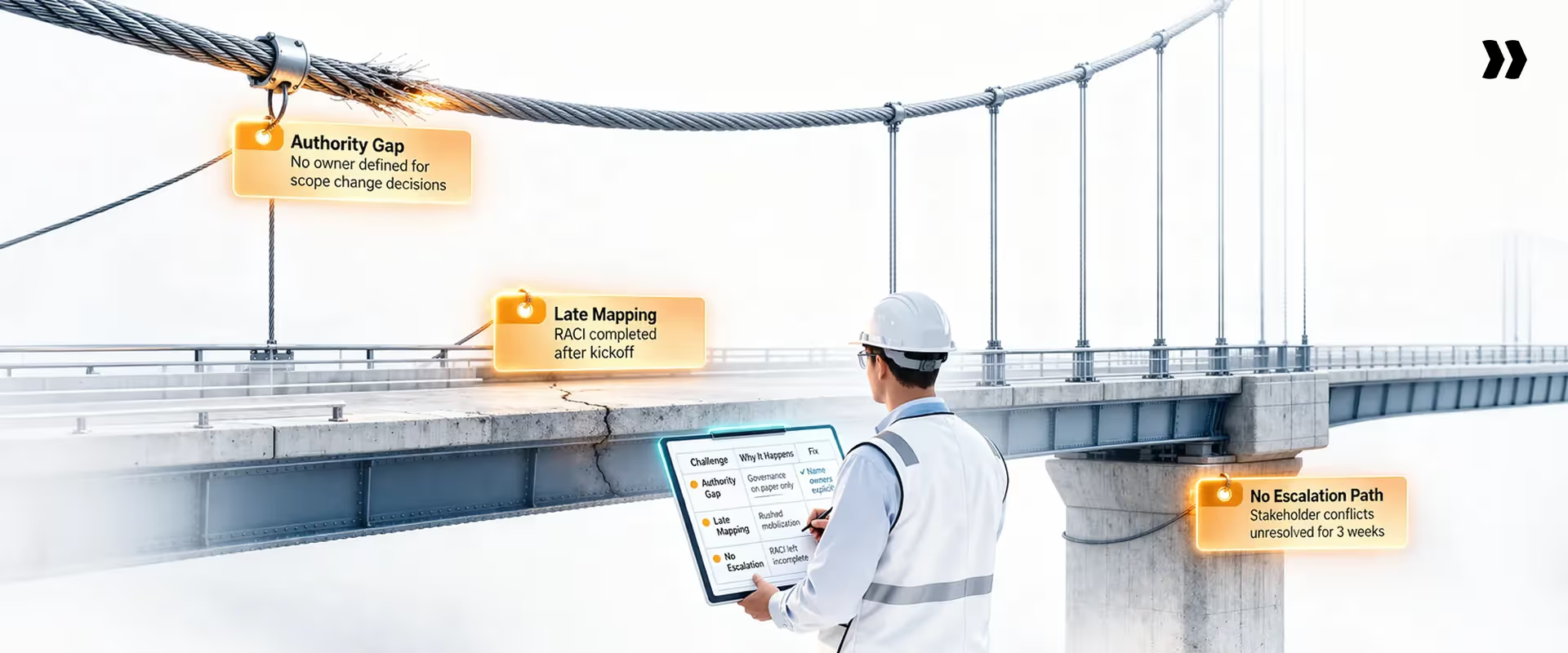
Implementing a project governance framework often breaks down not because the structure is wrong, but because adoption, alignment, and execution are inconsistent.
Even organizations that understand the value of governance often struggle to implement it consistently. Governance frameworks are easy to document but harder to operationalize across multiple projects and teams.
The most common implementation challenges typically follow predictable patterns:
1. Stakeholder resistance to governance
Why does it happen:
Governance introduces structure around decision-making, ownership, and accountability. These formal oversight and decision rules can be perceived by some teams as bureaucracy. Stakeholders who are accustomed to informal decision-making may resist structured governance processes.
Stakeholders may perceive this as a loss of control or added process, especially when roles and authority are redefined midstream.
Fix:
Align stakeholders early by clearly defining decision rights, escalation paths, and expected outcomes before kickoff. Position governance as a way to reduce friction, not add overhead.
2. Misaligned governance framework
Why does it happen:
Organizations often adopt a project governance framework that does not match project complexity or operating style. Overly rigid models slow execution, while overly loose models create gaps in control and accountability.
Fix:
Match the governance model to project type, scale, and risk. For example, use lightweight governance for SaaS delivery and more structured frameworks for enterprise or multi-stakeholder programs.
3. Lack of understanding and training
Why does it happen:
Teams are expected to follow governance processes without fully understanding how they work or why they matter. This leads to inconsistent adoption, workarounds, and breakdowns in execution.
Fix:
Invest in project governance training and embed governance into day-to-day workflows. Reinforce through real project scenarios so teams understand how governance supports decision-making and delivery outcomes.
When governance is treated as an operational practice rather than documentation, these challenges become significantly easier to manage.
What to look for in a project governance tool
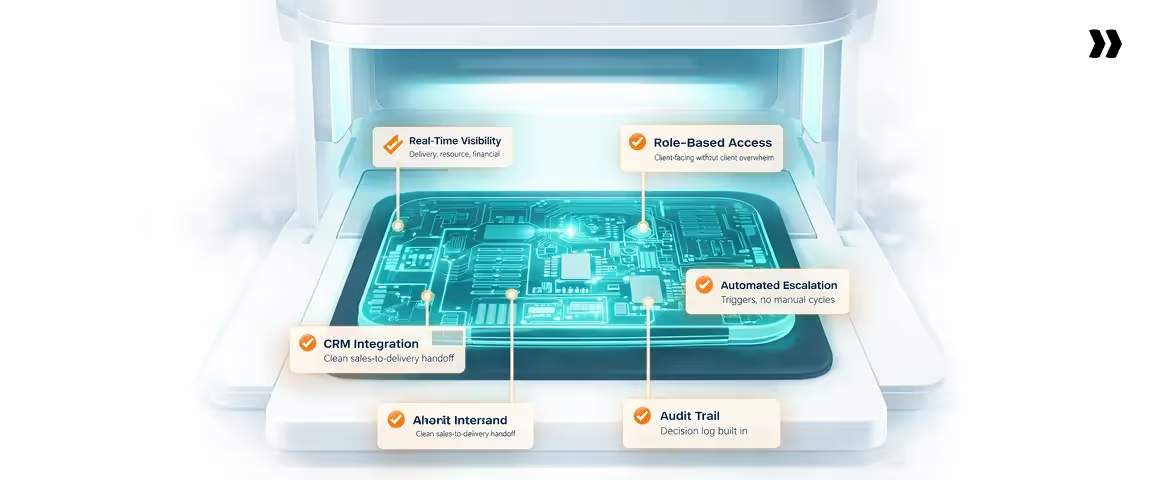
Project governance frameworks depend heavily on visibility and coordination. When governance relies on spreadsheets, disconnected reporting systems, and manual updates, oversight becomes delayed and inconsistent.
The right project governance software reduces this friction by embedding governance signals directly into project delivery workflows.
When evaluating a project governance tool, five capabilities matter most:
1. Real-time project visibility
Governance depends on timely information. Tools should surface real-time signals across milestones, timelines, resource allocation, and financial performance, enabling leadership to continuously assess project health as delivery evolves.
2. Role-based stakeholder access
Governance involves different audiences with different needs. Delivery teams require operational detail, while executives and clients need structured summaries. Role-based views ensure each stakeholder sees relevant signals without unnecessary noise.
3. Automated reporting and escalation triggers
Governance improves when systems surface signals as thresholds are crossed. Tools should define variance thresholds and automatically flag risks, enabling teams to respond during delivery rather than after formal reporting cycles.
4. Integration across delivery systems
Governance spans multiple systems across the delivery lifecycle. Connecting CRM, project execution, time tracking, and financial data creates a unified view, ensuring all stakeholders work from the same information.
5. Decision logging and audit trails
Governance requires traceability. Tools should capture decisions, approvals, and escalation histories as part of the workflow, creating a record that supports accountability and continuous improvement.
Platforms like Rocketlane combine project execution with an embedded intelligence layer. Nitro, its agentic AI layer, operates directly within project workflows, monitoring structured delivery data and surfacing governance-relevant signals as they emerge.
Rocketlane brings governance signals such as delivery progress, resource capacity, financial performance, and client communication into one operational environment. Instead of governance existing as a separate reporting layer, it becomes embedded in how projects are planned, monitored, and executed.
In practice, this shows up in a few ways:
- Governance agents monitor milestone progress, task velocity, and scope changes, highlighting emerging delivery risks.
- Time policy agents track time-entry discipline and allocation patterns, helping to maintain accurate cost and utilization signals.
- Account-level signals combine delivery patterns and engagement data to identify accounts that may require attention.
- Delivery analytics are continuously interpreted to provide insight into utilization trends, margin movement, and forecast shifts.
Governance becomes part of how projects are run day to day – simply because signals appear in context, alongside the work they relate to, and support decisions while delivery is still in motion.
Why Rocketlane Is the Best PSA for Project Governance
Most project governance tools give you a place to document your process. Rocketlane enforces it.
Project management platforms like Asana or Monday let teams build governance workflows — but enforcement is manual. Someone has to check. Someone has to chase.
Legacy PSAs like Certinia or OpenAir record what happened after the fact. Neither approach stops a governance failure before it costs you.
Rocketlane is an agentic AI-powered PSA platform built for customer-facing professional services teams. Governance isn't a module bolted on — it's the operating model.
Built-in governance across the full delivery lifecycle:
- Phase gates that hold. Rocketlane prevents phase advancement until exit criteria are met. UAT sign-off required before go-live? The system blocks the transition — no exceptions, no workarounds.
- Closure checklists that close the loop. Projects can't be marked complete if outstanding invoices remain. Open risks, undocumented decisions, and unsigned-off deliverables — all flagged before your team moves on.
- Dependency enforcement, not dependency suggestion. Task sequencing is enforced at the workflow level. Downstream tasks don't open until upstream tasks are verified complete.
- Status changes require documentation. When a project status changes, Rocketlane requires a documented reason — creating an auditable trail that matters for enterprise clients, renewals, and margin reviews.
- Front office and back office in one system. Governance spans from scoping and SOW through delivery, billing, and renewal. No handoff gaps. No, "we thought the other team had it."
For VP of Professional Services and delivery directors managing 50–200 concurrent projects, the difference is measurable.
One avoided escalation is worth $10,000–$30,000 in retained revenue.
One prevented billing gap is $5,000–$15,000 in recovered revenue.
Teams running Rocketlane report 85% billable utilization, 30–50% faster time-to-value for customers, and the capacity to run 2–3x more projects without adding headcount — because governance happens automatically, not manually.
See how delivery teams run governance in Rocketlane → [Book a 30-minute demo]
How Rocketlane Nitro's Project Governance Agent Helps Project Managers in 2026
The hardest part of project governance isn't knowing the rules — it's enforcing them under delivery pressure.
When a client is pushing for go-live, it's tempting to skip the checklist. When a project looks "mostly done," closing it early feels harmless.
When a team member submits late timesheets, chasing them down feels like admin overhead no one has time for.
Governance breaks down not because teams don't care, but because enforcement is reactive and manual.
Rocketlane Nitro changes that. It operates as an AI governance layer embedded in your delivery workflow — proactive, always-on, and policy-driven.
What the Project Governance Agent does:
Blocks premature project closure. The Project Governance Agent checks for outstanding invoices, unresolved risks, and incomplete deliverables before allowing a project to close. If a $20,000 invoice hasn't been raised and a team member tries to archive the project, the system automatically prevents it.
Enforces UAT and phase gates. Before a project advances to the next phase, Nitro verifies that all required sign-offs are in place. No manual check. No follow-up email chain. The gate holds until the criteria are met.
Requires documented reasons for status changes. When a project slips from Green to Amber — or from Active to On Hold — the agent requires a documented reason at the point of change. This builds an audit trail in real time, not retrospectively.
Enforces task sequencing. Nitro's governance agent respects and enforces task dependencies. If Task B requires Task A to be verified complete, the system prevents Task B from being opened early — even if a project manager manually tries to override it.
Timesheet governance runs in parallel. Nitro's Timesheet Policy Agent enforces time-entry rules at the point of entry — flagging entries that violate billing thresholds, project codes, or approval windows before they hit your invoicing cycle.
For a team of 50 consultants billing at $150/hour, tight timesheet governance protects over $90,000 in annual revenue that would otherwise leak through untracked or miscoded hours.
The net impact for project managers:
Project managers running delivery on Nitro recover 2–4 hours per project previously spent on manual governance checks, status chasing, and audit preparation.
At 50 active projects, that's 100–200 hours per quarter freed up for billable delivery work.
In 2026, governance isn't a process you design once and hope teams follow. It's a system that runs itself — so your best project managers can focus on delivery, not compliance.
See Rocketlane Nitro in action → [Book a demo]
Blog summary
Table of Contents

Regsiter for the live webinar


Great consultants didn't join your team to spend Fridays writing documentation.
Table of contents
18 of Forbes Cloud 100 chose Rocketlane. The best PS teams aren't waiting around.
FAQs
What is project governance?
Project governance is the system of roles, decision rights, processes, and oversight structures that ensure projects stay aligned with business objectives throughout their lifecycle. It defines who makes decisions, how performance is monitored, how risks are escalated, and how accountability is maintained from project initiation through completion.
What are the 7 key components of project governance?
The seven key components of project governance are roles and responsibilities, decision-making authority, risk management, stakeholder engagement, communication and reporting cadence, quality assurance, and performance monitoring. These components are typically documented through governance artifacts such as a RACI matrix, risk register, stakeholder register, communication plan, decision log, quality assurance log, and project performance dashboard.
What’s the difference between project governance and project management?
Project governance defines the oversight framework that determines who makes decisions, how risks are escalated, and how accountability is maintained across stakeholders. Project management focuses on executing the work required to deliver the project, including planning tasks, managing schedules, coordinating resources, and producing deliverables within the governance structure.
Why is project governance important?
Project governance is important because it creates the structure that keeps projects aligned with business objectives while delivery progresses. Key benefits of project governance include improved project success rates, better risk mitigation, increased stakeholder confidence, and stronger organizational alignment. Establishing an effective project governance framework is crucial for balancing oversight with operational efficiency and avoiding unnecessary bureaucracy.
What is a project governance plan?
A project governance plan is a document that defines decision authority, roles, risk management protocols, escalation paths, and performance metrics for a project. It serves as the operating manual for making governance decisions throughout the project lifecycle.












Copyright © 2026 Rocketlane Corp. All rights reserved.


















.webp)