10 Best Monday.com Alternatives for Professional Services Teams (2026)
•
•
Summarize blog with






A Director of Professional Services opens Monday.com and everything feels in place. Boards are clear. Automations are running. The team has visibility into work.
By the end of the week, a different question comes into focus: Which projects are profitable?
Answering that pulls in multiple systems. Time tracking, financial data, pipeline context, and reporting each sit in different places, and the picture only comes together when they’re combined. It’s often at this point that teams start exploring Monday.com alternatives.
Many teams look for alternatives to Monday.com due to eventual high running costs, especially those that require advanced features like reporting and resource management.
This is where the search for a more purpose-built system begins. The reality is that beyond organizing work, professional services teams need visibility into delivery itself, how resources are allocated, how utilization evolves, and how revenue tracks against execution.
This guide breaks down 10 Monday.com alternatives through the lens that matters in 2026: how well each platform supports the realities of professional services delivery. The guide covers project management software options that enable structured project management, support managing multiple clients, and allow for unlimited projects to scale with your business.
Each option is evaluated on resource planning, utilization tracking, financial visibility, client collaboration, and scalability, not just task management or interface design. The goal is to help you identify which systems can move beyond organizing work and actually support how delivery teams operate day to day, including how these alternatives help manage multiple clients and support unlimited projects for scalable operations.
Best Monday.com alternatives for PS teams (2026)
How we evaluated these Monday.com alternatives
This guide evaluates Monday.com alternatives against the operational requirements that define modern professional services delivery.
Monday.com is widely adopted for its usability and flexibility. The evaluation here focuses on what happens as delivery becomes more complex: multiple clients, concurrent projects, resource dependencies, and increasing pressure on margins and forecasting.
Each platform is assessed against criteria that reflect how delivery actually runs, not how tools are marketed.
Evaluation criteria
Monday.com alternatives: side-by-side comparison
What is Monday.com?
Monday.com is a work operating system. It is less a project management tool and more a platform on which teams build their own version of project management, using a visual, low-code interface.
That combination of ease of use and visual clarity has made Monday.com one of the most recognized names in work management. It is frequently the first platform organizations trial when they outgrow spreadsheets.
What Monday.com is not is a professional services platform. The same open-ended configurability that makes it broadly applicable means it has no opinionated structure for how PS delivery should work. Project financials, resource utilization, billable time tracking, and client portal access are not part of what Monday.com provides natively.
They are capabilities teams build around it, through integrations and workarounds, as their delivery operations demand them. It’s this limitation that brings users to explore Monday.com competitors.
Why professional services teams are looking for Monday.com alternatives

The shift starts with a mismatch that becomes visible as delivery scales.
What works well for internal coordination begins to stretch under the weight of client-facing execution, financial accountability, and multi-project complexity. Over time, a set of recurring gaps surfaces. Individually manageable.
These are the patterns that most consistently trigger evaluation.
Monday.com is a project or work management tool, not a delivery system
Monday.com is designed for organizing work. Professional services teams operate in a different context: client-facing delivery tied to revenue, resources, and outcomes.
That difference shows up in the architecture. Internal coordination can be handled within boards and automations. External delivery requires systems that connect execution with utilization, billing, and client collaboration.
Time tracking exists outside the system
Time tracking is not a native, structured layer. There are no built-in approval workflows, no consistent way to distinguish billable from non-billable work, and no direct connection between logged hours and project financials.
Teams compensate by adding tools like Harvest or Clockify. This introduces cost, but more importantly, fragmentation. Time data lives separately from project execution, and reconciliation becomes part of weekly operations.
Financial visibility becomes a manual process
As delivery matures, financial questions become more frequent. Project margins, budget tracking, and revenue recognition remain opaque.
Monday.com does not natively support these workflows. Financial reporting typically requires exporting data, combining it with time tracking and CRM inputs, and rebuilding visibility externally.
For many teams, this is the point where evaluation begins because the tool cannot answer questions the business now depends on.
Client collaboration relies on workarounds
Guest access provides visibility into boards, but it does not function as a structured client environment.
Professional services teams need a shared layer where clients can track progress, review deliverables, submit approvals, and collaborate in context. In practice, teams recreate this through status reports, emails, and shared documents.
This adds recurring effort and introduces gaps in alignment, particularly in longer or more complex implementations.
Tool sprawl becomes the operating model
To bridge these gaps, teams assemble a parallel stack. Project tracking happens in Monday.com, time tracking is done elsewhere, financials in a professional services automation (PSA) tool, and reporting in spreadsheets.
Each tool solves a specific problem. Together, they introduce coordination overhead.
Data moves between systems manually. Reporting depends on reconciliation. Information becomes stale between updates. What begins as flexibility gradually becomes operational friction.
The pattern: coordination works, delivery fragments
Across teams, the pattern is consistent.
Monday.com continues to function as a coordination layer. But delivery itself, resources, financials, client collaboration, lives across multiple systems.
That separation is manageable at smaller scales. As delivery grows, it becomes harder to sustain without adding overhead or reducing visibility.
The 10 best Monday alternatives in 2026
1. Rocketlane
.avif)
Rocketlane is an agentic AI-powered professional services automation platform built for customer-facing teams across implementation, onboarding, consulting, and managed services. It brings projects, resources, financials, and client collaboration into a single system where execution and operational control stay tightly connected.
At the center of Rocketlane is Nitro, an embedded AI execution layer made up of specialized agents. Each agent operates within the delivery workflow and takes ownership of a specific category of work that typically slows teams down.
Nitro AI: Agentic execution across delivery
Rocketlane’s Nitro agents work across the lifecycle to handle documentation, data preparation, risk visibility, governance, and analysis. Instead of relying on manual coordination, these agents operate continuously within the same system that manages delivery.
Documentation Agent
Captures and structures delivery knowledge directly from source interactions.
- Generates BRDs, SOWs, design documents, and handoffs from calls, emails, and knowledge bases
- Keeps every statement traceable to its source and updates as scope evolves
- Allows teams to query project documentation within the platform
Migration Agents
Manage data preparation with accumulated intelligence from past projects.
- Handle field mapping, transformation logic, validation, and gap identification
- Build reusable playbooks that improve accuracy across engagements
- Enable teams to review and approve instead of reconstructing data logic
Nitro Signals
Provides continuous visibility into delivery health across accounts.
- Monitors calls, emails, and client activity
- Surfaces risks, churn signals, and expansion opportunities with context
- Links every signal to the exact interaction where it originated
Project Governance Agents
Enforces execution standards throughout the delivery process.
- Controls sequencing, milestone sign-offs, and completion criteria
- Ensures projects progress and close with all requirements met
AI Governance
Maintains financial accuracy at the point of action.
- Applies billing and time-entry rules during submission
- Flags incorrect or incomplete entries immediately
- Enforces region-specific policies automatically
Nitro Analyst
Turns live delivery data into decision-ready answers.
- Responds to questions on margin, utilization, and project health in plain language
- Surfaces root causes alongside metrics
- Supports recurring analyses through reusable templates
- Coordinate execution, governance, and insight within the same workflow
- Reduce manual effort across documentation, reporting, and data preparation
- Keep delivery, financials, and client signals continuously aligned
Together, these agents operate within Rocketlane’s core system, handling the coordination, governance, and intelligence work that surrounds delivery.
Teams stay focused on execution, while the system maintains structure, visibility, and continuity across every engagement
Key Rocketlane features
Native bi-directional CRM and delivery integration: Sales, delivery, and reporting operate on the same system of record.
- Salesforce and Jira integrations operate without middleware
- Automatic project creation from closed-won deals
- Delivery data, time entries, and milestones sync back to CRM
Real-time margin and budget tracking: Financial outcomes stay visible during execution, not after reporting cycles.
- Budget burn connected directly to time entries at the task level
- Margin visibility available per project, client, and portfolio
- Continuous updates as work progresses across delivery
Portfolio dashboards with real-time visibility: Leadership gets a live view across all engagements.
- Portfolio view includes project health, utilization, and margin
- Real-time refresh across multiple concurrent projects
- Dashboards designed for leadership reviews and ongoing monitoring
Resource allocation with real-time skills and capacity context: Staffing decisions are grounded in capacity and capability.
- Live resource heat map shows current and future allocation across projects
- Skills matrix aligns work with capability, not just availability
- Soft and hard allocations support both planning and committed work
- Workload and capacity visibility across teams and regions
Conditional templates with inheritance: Delivery processes stay consistent across projects.
- Conditional logic adapts templates based on deal structure, product, or customer segment
- Centralized updates propagate across active projects
- Standardized workflows maintained without template duplication
White-labeled client portal with controlled visibility: Client-facing delivery is structured and centralized.
- Magic link access enables frictionless entry without logins or additional seats
- Role-based permissions define exactly what each stakeholder can access
- Real-time project visibility, task ownership, and document collaboration in one place
- Branded experience aligned with client-facing delivery standards
Agentic AI embedded across delivery workflows: Execution, governance, and reporting operate within the system.
- AI operates across planning, execution, and governance workflows
- Documentation generated from project activity and conversations
- Policy enforcement applied at the point of time entry and workflow execution
- Resource and staffing inputs supported through context-aware queries
- Operational and financial questions answered in natural language
- Delivery signals surfaced from client interactions and engagement patterns
Enterprise-ready, global delivery support: Supports distributed teams and multi-region operations.
- Multi-currency financials support global delivery models
- Regional holiday calendars align planning across geographies
- GDPR compliance and data residency options for global operations
- Role-based access control and audit logs across the system
Bonus: Enterprise-ready capabilities for professional services teams
Rocketlane is built to support large, distributed delivery teams without introducing additional layers of operational complexity. Its architecture keeps execution, planning, and financials connected across regions.
Unified delivery model: Delivery operates as a single system rather than a set of stitched tools.
- Projects, resources, and financials aligned in one environment
- Portfolio-level visibility across teams and geographies
- No need for reconciliation across systems
Built-in governance and compliance: Control is enforced within workflows rather than through external processes.
- SOC 2 compliance, SSO, role-based access, and audit logs included
- Full traceability without slowing down execution
Bi-directional CRM alignment: Sales and delivery share the same source of truth.
- Salesforce data syncs in real time across both systems
- Delivery reflects what was sold without manual intervention
Ecosystem-ready integrations: Fits into existing enterprise stacks without disruption.
- Native integrations with NetSuite, HubSpot, QuickBooks, and Salesforce
- Flexible APIs for extending workflows
Rapid implementation: Transition from fragmented tools happens in a controlled, phased manner.
- Parallel run supported for active engagements
- Teams typically go live within weeks
Pros and cons
Best for
- Directors and VPs of Professional Services who need to connect delivery execution with financial and resource visibility
- Project management office (PMO) leaders managing multi-project portfolios who require real-time insights without relying on dashboards and exports
- Implementation teams operating across sales and delivery systems that need alignment without manual sync
- PS organizations outgrowing Monday’s work management layer and needing a full delivery system
Key takeaways
What customers say (G2 reviews)
Rocketlane vs Monday.com in one line: Rocketlane goes beyond task management to run the entire delivery lifecycle for professional services teams.
See how teams are making the switch from effort-intensive spreadsheet-based approaches to intelligent, system-driven PS delivery with Rocketlane.→ Book a 30-min demo
2. Asana
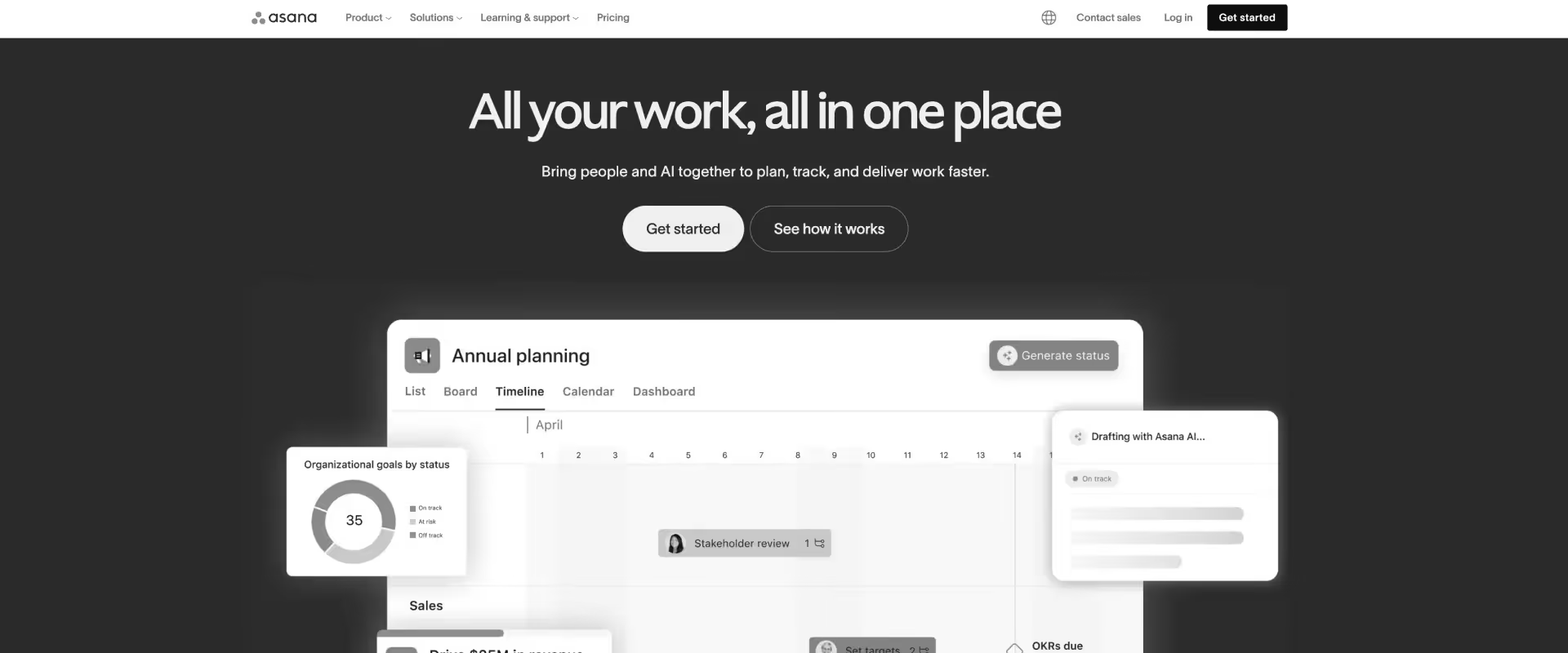
Asana is a structured work management platform built around clarity, ownership, and cross-team coordination. With timeline views, portfolios, goals, and a mature rules engine, it appeals to teams that want more consistency and operational discipline than flexible board-based tools typically provide.
For teams moving from Monday.com, Asana offers a more standardized way to manage projects. Portfolio and Workload views provide clearer visibility across multiple projects, while dependencies, approvals, and forms help formalize workflows that are often loosely configured in Monday.com.
Its strength lies in structured execution and alignment across teams. However, it does not include a native PSA layer. Capabilities like utilization tracking, billing, margin visibility, and client-facing collaboration workflows typically require additional tools, especially for teams managing delivery tied closely to revenue outcomes.
Key features
- Dependency-driven execution model: Task relationships define sequencing and execution flow, providing more structure than board-based systems.
- Planning and workload views: Timeline and calendar views support planning, with workload based on assigned tasks rather than true capacity.
- Automation system: Rule-based automation supports task updates and notifications without deeper workflow orchestration.
- Goals and alignment layer: Built-in OKR tracking connects execution to broader objectives through task completion.
- Dashboards and reporting: Portfolio dashboards provide visibility into project status without financial or operational metrics.
- Asana AI (assistive layer): AI assists with task creation and summaries but does not manage delivery or workflows.
Pros and cons
Best for
- Teams needing more execution rigor than board-based workflows can provide
- PMOs managing dependency-heavy projects with clear sequencing requirements
- Organizations prioritizing consistency over visual customization
- Teams aligning project execution with goals and structured planning
Key takeaways
What customers say (G2 reviews)
3. ClickUp
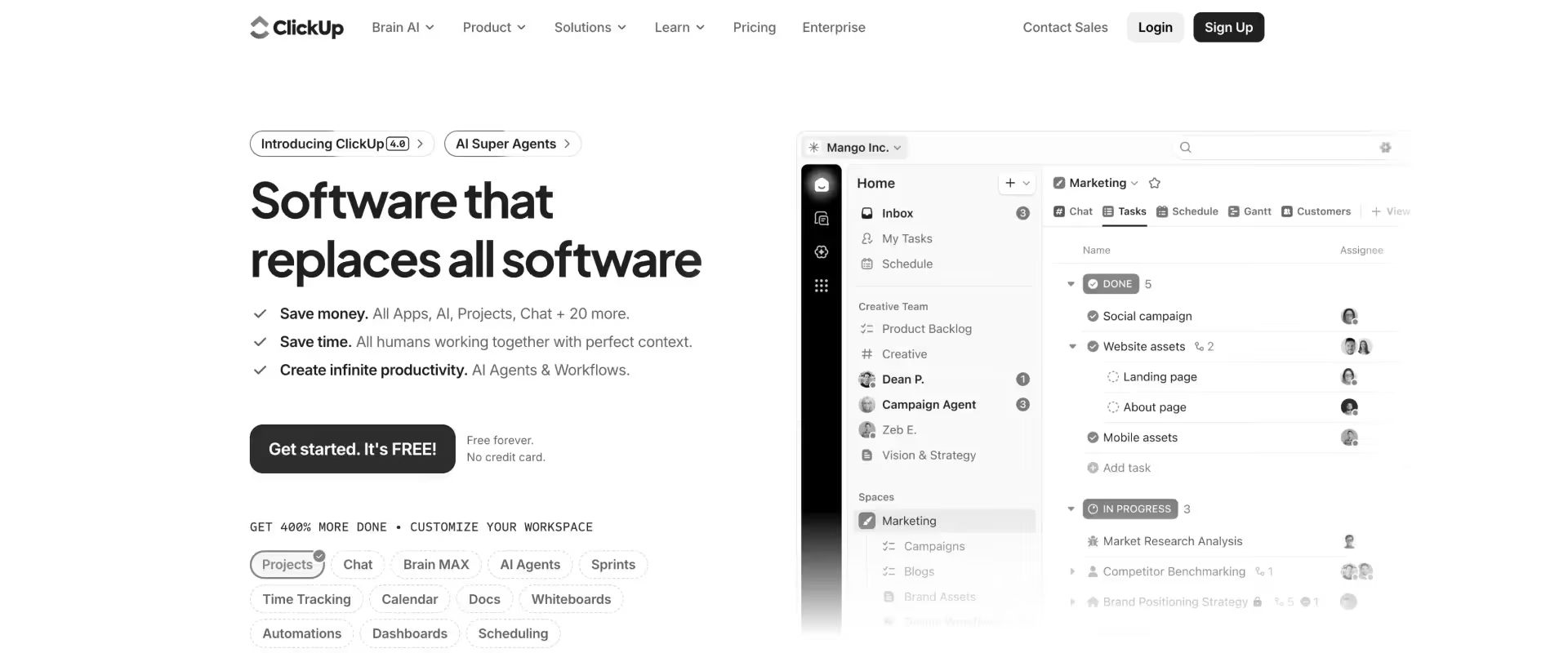
ClickUp is an all-in-one work management platform designed to consolidate tasks, documents, communication, and workflows into a single configurable system.
Compared to Monday.com, which centers around visual boards and ease of adoption, ClickUp operates as a build-your-own system. Work is structured through hierarchies (spaces, folders, lists, tasks), custom fields, and deeply configurable workflows.
This flexibility becomes more powerful and more fragile at scale. ClickUp can unify multiple tools into one system, including docs, time tracking, dashboards, and automation. However, consistency across teams depends on governance. Without it, reporting, workflows, and visibility can fragment across projects.
ClickUp provides more control and extensibility, while Monday provides faster alignment and usability.
Automation in ClickUp is more flexible than Monday’s, supporting multi-condition logic and integrations. AI capabilities, through ClickUp Brain, extend beyond summaries into task generation, knowledge retrieval, and early forms of agentic workflows.
For professional services teams, ClickUp offers a highly extensible system that can be shaped to fit delivery workflows, but it does not enforce alignment between execution, financials, and resource management. It provides the building blocks, not the operating model.
Key features
- Highly customizable workspace hierarchy: Spaces, folders, lists, and tasks allow teams to design their own system structure across projects and workflows.
- Multi-view project management: Supports list, board, Gantt, calendar, timeline, and workload views on the same underlying data.
- Custom fields and relationships: Enables modeling of complex workflows, dependencies, and data relationships across tasks and projects.
- Built-in docs, whiteboards, and collaboration: Combines documentation, brainstorming, and task execution within a single platform.
- Advanced automation engine: Supports multi-condition automations, triggers, and integrations for workflow orchestration.
- Time tracking and reporting: Native time tracking with estimates, timesheets, and reporting capabilities.
- Dashboards and analytics: Custom dashboards provide visibility across projects, teams, and metrics.
- Goal tracking and OKRs: Links tasks and projects to measurable outcomes and objectives.
- Extensive integrations ecosystem: Connects with development, communication, and productivity tools.
- ClickUp Brain (AI layer): Supports task creation, summaries, knowledge retrieval, and early agentic workflows within the system.
Pros and cons
Best for
- Teams that need deep customization and control over workflows, beyond what board-based systems like Monday can support
- Organizations managing complex, multi-layered delivery processes that require configurable data structures and automation
- Professional services teams willing to design and govern their own system architecture rather than rely on predefined models
- Environments where consolidating tools into a single extensible platform is a priority
Key takeaways
What customers say (G2 reviews)
4. Smartsheet
Smartsheet is a spreadsheet-based work management platform designed for teams that prefer structured, grid-driven workflows. It combines familiar spreadsheet logic with project tracking, automation, and reporting, making it useful for teams managing repeatable processes with defined inputs and outputs.
Smartsheet and Monday.com both centralize work, but they operate on fundamentally different abstractions. Monday is built around visual workflows and boards. Smartsheet handles complex data relationships and reporting more effectively, but requires significantly more effort to configure and maintain.
In Smartsheet, workflows are not defined visually. They are encoded through formulas, dependencies, and automation rules. This makes the system more precise but also less accessible. AI in Smartsheet focuses on interpreting and summarizing data, not managing workflows or execution.
For professional services, Smartsheet provides stronger reporting and portfolio visibility than Monday, but still does not unify delivery, financials, and resource management into a single operational layer.
Key features
- Data-first project model: Work is structured as tabular data rather than visual boards, enabling deeper control over relationships and reporting.
- Cross-sheet architecture: Enables building layered systems across projects, portfolios, and reporting views.
- Advanced reporting and dashboards: Aggregates data across sheets for leadership-level insights into timelines, KPIs, and performance.
- Dependency and scheduling logic: Supports structured project planning through dependencies and duration calculations.
- Automation rules: Drives workflow changes based on data conditions rather than visual triggers.
- Resource and budget tracking: Tracks allocation and costs at a field level, without system-enforced utilization logic.
- WorkApps for role-based access: Creates simplified interfaces for different stakeholders on top of complex systems.
- Integrations: Connects to enterprise systems but often requires manual alignment.
- AI capabilities: Supports data summarization and insights, not workflow execution.
Pros and cons
Best for
- Teams prioritizing reporting accuracy and data structure over visual workflow simplicity
- PMOs managing complex portfolios with multiple layers of tracking and dependencies
- Organizations willing to invest in system design to achieve control and consistency
- Environments where data consolidation and auditability are more critical than execution speed
Key takeaways
What customers say (G2 reviews)
5. Notion
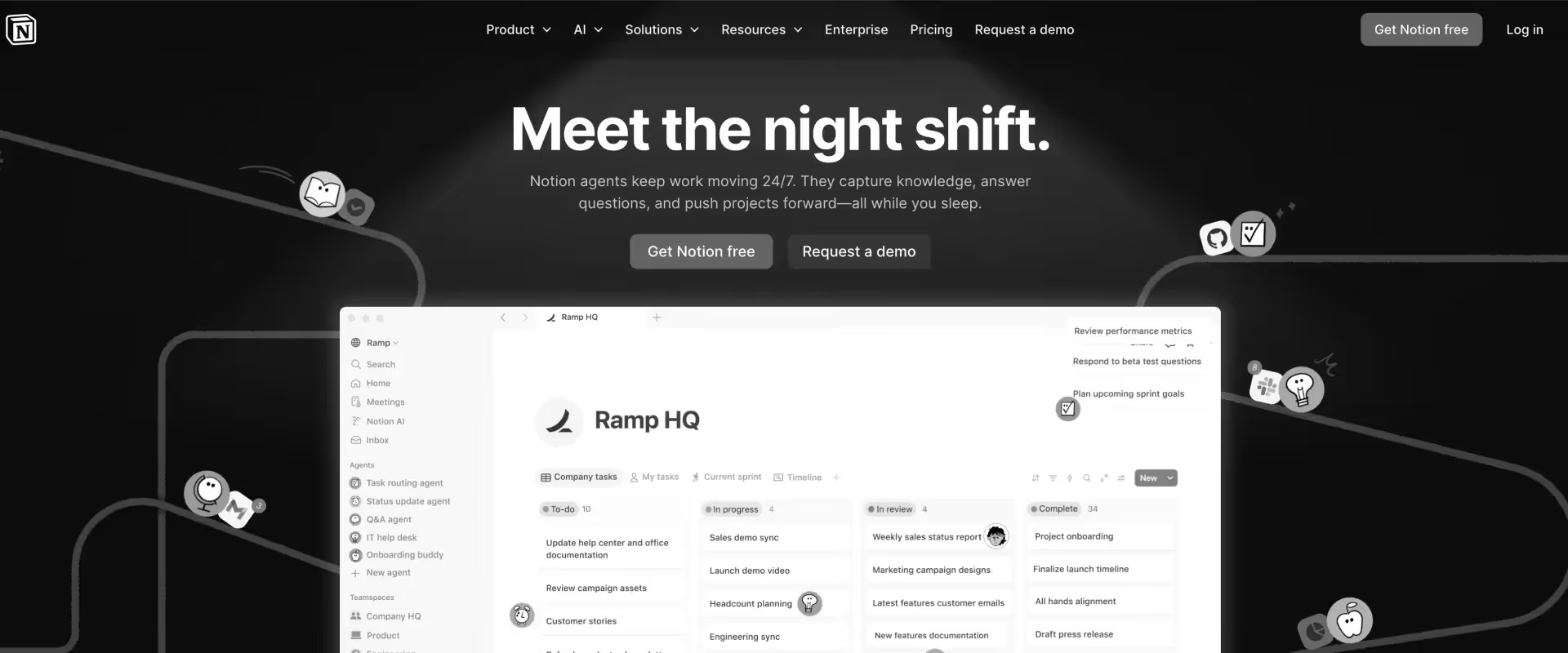
Notion is a modular workspace built around pages and databases, where documents, tasks, projects, and knowledge all exist within the same system. Rather than providing a predefined project management structure, Notion gives teams building blocks to design their own systems. A task is just a database entry. A project is a filtered view. A workflow is a combination of properties, relations, and views.
In Notion, teams construct a model. Projects can be directly linked to documentation, decisions, meeting notes, and client information within the same system. However, this flexibility also means there is no inherent enforcement of workflows, sequencing, or consistency.
As complexity increases, this distinction becomes more visible.Notion scales through interconnected databases, where projects, tasks, and knowledge are linked. This creates a unified information system, but also introduces maintenance overhead.
Notion AI supports writing, summarization, and knowledge retrieval across pages and databases. This makes it effective for navigating and generating information within the system. However, it remains assistive. It does not operate within workflows, enforce task progression, or manage execution.
For professional services teams, Notion functions as a knowledge and coordination layer. It is effective for organizing information, documenting processes, and linking context to work. However, it does not provide the structured execution, resource management, or financial alignment required to run delivery operations at scale.
Key features
- Page and database-based system: Work is structured through pages and relational databases, enabling flexible modeling of projects, tasks, and knowledge.
- Custom workflows through database design: Teams define statuses, relationships, and workflows manually using properties and views rather than predefined systems.
- Multiple views on shared data: Table, board, timeline, and calendar views allow different interpretations of the same dataset.
- Embedded documentation and knowledge base: Native docs and wikis integrate directly with project and task data.
- Templates and system repeatability: Custom templates enable reuse of project and workflow structures.
- Integrations ecosystem: Connects with external tools, though depth is limited compared to dedicated PM systems.
- Limited native automation: Basic automation exists, but complex workflows require integrations or manual processes.
- Notion AI (assistive layer): Supports content generation, summarization, and knowledge retrieval across the workspace.
Pros and cons
Best for
- Teams that need deep integration between documentation, knowledge, and task tracking rather than standalone project execution
- Organizations willing to design and maintain their own systems using databases and relationships
- Early-stage or evolving teams where processes are still being defined and require flexibility
- Professional services teams using Notion as a knowledge and coordination layer alongside execution tools
Key takeaways
What customers say (G2 reviews)
6. Jira
Jira is a workflow-driven project management system designed around issue tracking and agile delivery. Unlike Monday.com’s visual, board-based approach, Jira focuses on process enforcement through configurable workflows and ticket states.
This makes it more suitable for engineering environments where work needs to be tracked at a granular level and aligned to sprint cycles. However, it introduces more complexity and requires deliberate configuration to function effectively.
Jira includes automation and AI capabilities via Atlassian Intelligence, which support summarization, ticket generation, and query-based insights. These features assist users but do not manage workflows or delivery execution.
Jira remains focused on engineering workflows and does not provide financial tracking, resource optimization, or client collaboration features.
Key features
- Issue-based project model: Work is tracked as structured issues rather than visual boards, enabling deeper control over workflows.
- Agile delivery system: Built-in Scrum and Kanban frameworks support sprint-based execution and backlog prioritization.
- Custom workflow engine: Teams can define detailed states, transitions, and approval logic.
- Advanced reporting: Engineering-focused reports such as velocity, burndown, and cycle time analysis.
- Integration ecosystem: Extensive integrations with dev tools and Atlassian stack.
- Automation rules: Event-based automation tied to issue states and workflows.
Pros and cons
Best for
- Engineering and product teams needing more depth than Monday’s boards
- Organizations running agile delivery at scale
- Teams requiring strict workflow enforcement and tracking
- Companies already using Atlassian ecosystem tools
Key takeaways
What customers say (G2 reviews)
7. Trello
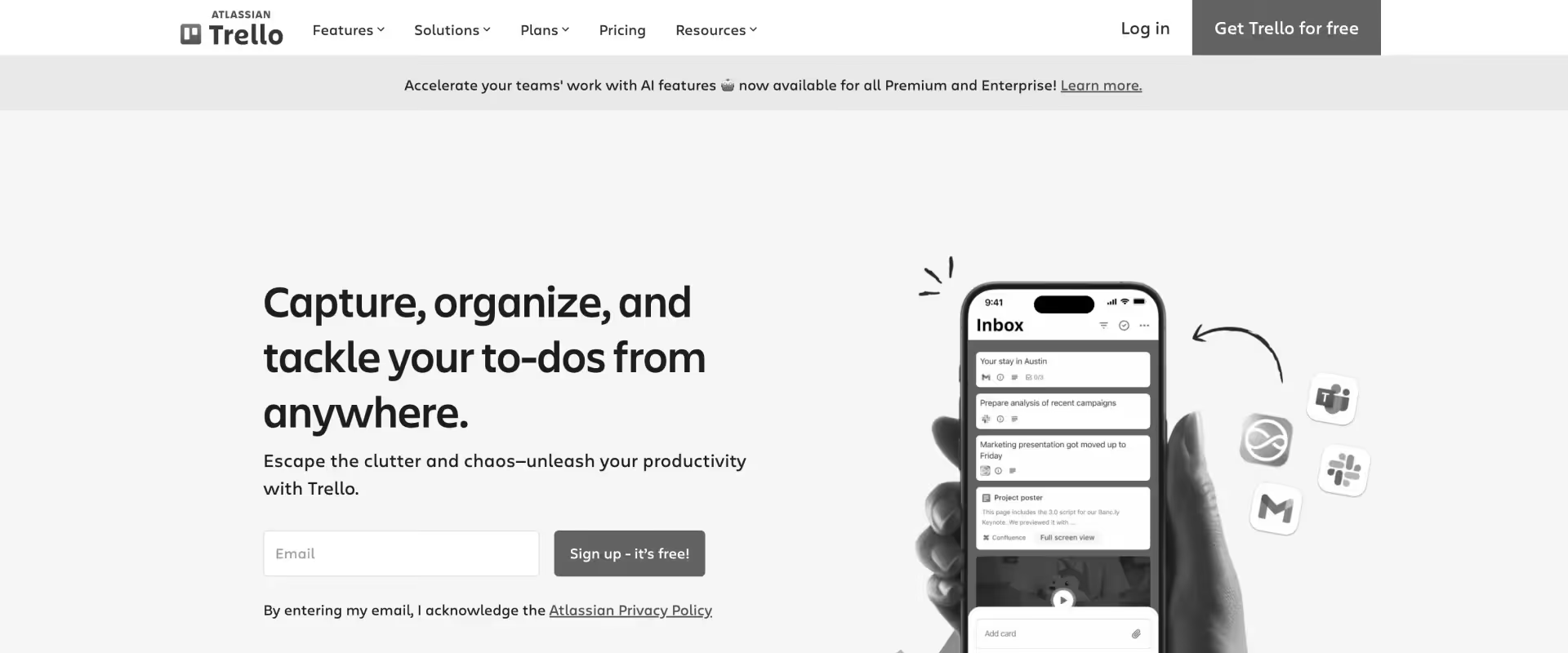
Trello is a lightweight, Kanban-based work management tool centered on simplicity and visual task tracking. Built around boards, lists, and cards, it’s designed for teams that want minimal setup and an intuitive way to organize work without formal process overhead.
Trello and Monday.com both rely on visual representations of work, but they differ in depth and intent.
For teams moving from Monday.com, Trello represents a shift toward simplicity. It works well for smaller teams or straightforward workflows where visibility and ease of use matter more than structured coordination. Power-Ups and integrations can extend functionality, but the core experience remains intentionally minimal.
Trello’s simplicity allows teams to get started quickly, but it also limits scalability. As workflows grow more complex, teams often rely on Power-Ups and external tools to compensate.
Trello includes automation (Butler) and basic AI features, but these operate at the task level and do not extend into system-wide coordination or reporting.
Key features
- Kanban boards and card system: Simple visual tracking of tasks across stages.
- Butler automation: Rule-based automation for moving cards and triggering updates.
- Power-Ups: Extensions for calendars, integrations, and reporting features.
- Card-level collaboration: Comments, mentions, and attachments within tasks.
- Basic views: Limited to board view, with calendar and timeline available via add-ons.
- Lightweight reporting: Minimal native reporting, reliant on extensions.
- Trello AI: Assists with summaries and content, but workflow execution capabilities are limited.
Pros and cons
Best for
- Small teams managing simple workflows without dependencies
- Organizations prioritizing ease of use over reporting and operational control
- Use cases where visibility at the task level is sufficient
Key takeaways
What customers say (G2 reviews)
8. Wrike
Wrike is a structured work management platform designed for teams that need visibility across projects, resources, and workflows at scale. It combines task management with built-in resource planning, reporting, and automation, making it suitable for organizations managing complex, multi-team delivery.
For teams moving from Monday.com, Wrike offers more depth in operational control. Features like workload management, time tracking, and advanced reporting provide stronger oversight across projects, while custom workflows and request forms help standardize execution as complexity increases.
Its strength lies in structured coordination and resource visibility. However, while it includes elements like time tracking and reporting, it does not function as a full PSA system. Capabilities such as margin tracking, billing, and client-facing collaboration typically require additional tools or integrations for teams managing delivery tied closely to revenue.
Wrike's AI capability, Wrike Copilot, handles summaries, risk prediction, and automation suggestions.
Key features
- Structured work hierarchy: Spaces, folders, projects, and tasks create a consistent organizational model that enforces how work is grouped and accessed across teams.
- Custom workflows with governance: Task statuses, transitions, and approval stages can be defined and standardized, enabling controlled progression of work.
- Multi-view planning system: List, board, Gantt, and calendar views operate on the same underlying data, supporting different planning and tracking needs.
- Resource and workload management: Dedicated workload views provide visibility into team allocation, capacity, and task distribution across projects.
- Time tracking and effort management: Task-level time logging and effort estimation support tracking of planned versus actual work.
- Dashboards and advanced analytics: Custom dashboards aggregate data across projects, enabling portfolio-level visibility into status, timelines, and performance.
- Automation engine: Rule-based automation manages task routing, updates, approvals, and notifications based on workflow conditions.
- Request forms and intake management: Structured intake forms standardize how work enters the system and is assigned to teams.
- Integration ecosystem: Connects with CRM, communication, and productivity tools to extend workflows beyond the platform.
- Wrike AI: Supports summaries, task generation, and recommendations without operating within workflows.
Pros and cons
Best for
- Organizations where Monday’s board flexibility has led to inconsistent workflows and unreliable reporting across teams
- PMOs managing multiple concurrent projects that require standardized execution, approvals, and governance
- Mid-market to enterprise teams that need portfolio-level visibility tied to consistent data structures rather than independent boards
- Professional services teams that prioritize control and reporting over ease of setup, and are willing to invest in system configuration
Key takeaways
What customers say (G2 reviews)
9. Airtable
Airtable is a hybrid between a spreadsheet and a relational database, designed to let teams build custom data-driven systems for managing work, operations, and workflows. Instead of treating work as tasks within a predefined structure, Airtable treats everything as records in connected tables, allowing teams to model projects, clients, resources, and processes as structured data.
Compared to Monday.com, which is built as a visual work operating system centered around boards and workflows, Airtable is a data-first platform. Monday defines how work should be organized and executed through boards, statuses, and automations. Airtable leaves that definition to the user, providing tables, relationships, and views as building blocks.
As complexity increases, Monday scales through standardization and usability. Templates, dashboards, and automation help teams maintain consistency across projects. Airtable scales through data relationships and system design. Teams often build interconnected bases for projects, resources, CRM, and operations, creating a single source of truth across functions.
Airtable provides automation tied to data changes, which is more flexible in some cases but less intuitive for execution-heavy workflows.
It is designed to model and connect data across systems. Airtable can support delivery workflows, but it does not enforce execution, resource utilization, or financial alignment. It functions more as a system of record than a system of execution.
Key features
- Relational database model: Work is structured as linked tables, enabling connections between projects, tasks, clients, and operational data.
- Custom workflows via data modeling: Teams define workflows through fields, relationships, and views rather than predefined task systems.
- Multiple views on shared data: Grid, Kanban, calendar, timeline, and gallery views allow different perspectives on the same dataset.
- Cross-functional data integration: Combines project data with CRM, marketing, or operational datasets in a unified system.
- Automation engine: Trigger-based automation updates records, sends notifications, and syncs workflows based on data changes.
- Interfaces and app builder: No-code interfaces allow teams to build custom front-end applications on top of underlying data.
- Collaboration within records: Comments and updates are tied to data entries rather than separate communication layers.
- Templates and reusable bases: Enables repeatable system design across projects and teams.
- AI capabilities (data layer): Supports insights, summaries, and forecasting within data workflows rather than execution processes.
Pros and cons
Best for
- Teams that need data-centric workflows across projects, clients, and operations, not just task tracking
- Organizations building custom internal systems that combine project management with CRM, operations, or analytics
- Cross-functional teams managing complex datasets and relationships across departments
- Professional services teams using Airtable as a system of record or reporting layer alongside execution tools
Key takeaways
What customers say (G2 reviews)
10. Teamwork
Teamwork is a project management platform combining task tracking with time logging, budgeting, and collaboration features. It’s designed for agencies and service teams that need more structure around delivery than general work management tools typically provide.
For teams moving from Monday.com, Teamwork introduces a more delivery-oriented model. Native time tracking, workload management, and project budgeting bring execution closer to resource and financial awareness, while client access and collaboration features support more transparent engagement.
Its strength lies in aligning projects with time and client workflows. However, financial capabilities remain relatively lightweight, and deeper functions like margin analysis, revenue forecasting, and advanced resource optimization often require additional tools or integrations as delivery complexity increases.
Key features
- Client-centric project model: Projects are explicitly tied to clients, aligning execution with delivery outcomes rather than generic workflows.
- Integrated time tracking and billing: Time logged against tasks feeds into budgets, invoicing, and profitability tracking within the same system.
- Task and dependency management: Tasks support dependencies, milestones, priorities, and structured sequencing of work.
- Resource and workload management: Capacity and workload views provide visibility into allocation based on time estimates and tracked effort.
- Budgeting and financial tracking (project-level): Tracks budgets, billable vs non-billable time, and project profitability within projects.
- Project templates and standardization: Enables repeatable delivery models across clients and engagements.
- Dashboards and reporting: Provides visibility into project health, timelines, time usage, and financial performance.
- Client collaboration layer: Allows clients to access projects, provide feedback, and participate in delivery workflows.
- Automation workflows: Rule-based automation supports task updates, reminders, and process consistency.
- Teamwork AI: Supports summaries, forecasting inputs, and task suggestions
Pros and cons
Best for
- Professional services teams where delivery is tied to billable work, time tracking, and client outcomes, not just task completion
- Agencies and service organizations that need visibility into project profitability alongside execution
- Teams outgrowing Monday setups where boards and dashboards no longer reflect actual delivery performance
- Organizations willing to trade some flexibility for a more structured, delivery-aligned system
Key takeaways
What customers say (G2 reviews)
Monday.com vs. commonly compared alternatives
When PS leaders evaluate Monday.com alternatives, these comparisons come up most often. Each reflects a different intent: consolidating a fragmented tool stack, finding more structure for growing teams, or closing gaps in delivery visibility and financial operations that Monday.com was not designed to address.
Myth: Any modern project management tool can replace Monday.com for professional services delivery.
Fact: Tools like Monday.com are not designed to run delivery as a business system. They lack built-in depth in areas like utilization, margin visibility, capacity planning, and structured client collaboration. Purpose-built PSA platforms unify these layers into a single operating model, reducing coordination overhead and giving teams a clearer, real-time view of delivery performance.
Monday.com vs. Asana
Monday.com and Asana are the two most directly comparable platforms in this list. Both are horizontal project management tools with strong visual interfaces, automation capabilities, and broad integration support. The meaningful differences are in philosophy rather than feature count.
Monday.com is more flexible and customizable, built around boards that teams configure to fit almost any workflow. Asana is more structured, with clearer task hierarchies, stronger portfolio and goal tracking, and a more predictable setup. For PS teams, neither closes the delivery gap: there is no native client portal, no utilization tracking, and no project-level financial visibility on either platform.
Where it matters for PS teams: if the problem is workflow consistency and reporting structure, Asana has a slight edge. If the problem is flexibility and cross-team coordination, Monday.com pulls ahead. Neither is purpose-built for billable delivery.
Monday.com vs. ClickUp
Monday.com and ClickUp compete for the same audience: teams that want an all-in-one work platform with high configurability.
ClickUp offers more raw feature depth and a lower entry price point, but that depth comes with a steeper learning curve and heavier setup requirements. Monday.com is faster to adopt and easier to standardize across mixed teams.
For PS teams, the trade-off is largely between breadth and usability rather than PS-specific functionality, since both platforms share the same structural gaps around resource management, financial visibility, and client collaboration.
Where it matters for PS teams: Monday.com is the better choice when adoption speed and ease of rollout are the priority. ClickUp suits teams that want more configurability and are willing to invest in setup.
Monday.com vs. Trello
Trello is a Kanban-first tool built around boards, cards, and lists. It is fast to adopt and easy to use, which makes it a common starting point for small teams. Monday.com covers significantly more ground: automation, multiple project views, dashboards, and cross-team coordination. Teams that outgrow Trello typically move to Monday.com or a comparable platform when their workflow complexity increases.
For PS teams, Trello has almost no relevant functionality beyond basic task tracking, and Monday.com's PS coverage, while limited, is meaningfully broader.
Where it matters for PS teams: Trello suits teams managing simple, linear workflows with no financial or client collaboration requirements.
Monday.com vs. Smartsheet
Smartsheet is built around a spreadsheet-style interface, which makes it a natural fit for operations, finance, and PMO teams already comfortable with grid-based thinking. Monday.com is more visual and faster to adopt across non-technical teams.
The two platforms attract different organizational profiles: Smartsheet suits structured, data-heavy environments with strong reporting requirements, while Monday.com suits teams that want flexibility and visual collaboration.
For PS teams, Smartsheet has stronger reporting depth and some portfolio management capability, but neither platform offers native utilization tracking, project financials, or a structured client portal.
Where it matters for PS teams: Smartsheet is worth considering for teams with strong reporting and governance needs. Monday.com is the better fit when cross-team adoption and visual flexibility matter more than data depth.
Monday.com vs. Jira
Jira is purpose-built for software development teams running agile workflows. Monday.com is a general-purpose work platform that can support development teams but is not optimized for sprint management or issue tracking.
For PS teams without a strong engineering dependency, Jira requires significant configuration to support client-facing delivery and has no financial or client collaboration layer. Monday.com covers more ground for general PS use, but neither platform addresses the core PS gaps.
Where it matters for PS teams: Jira is the right tool when delivery is deeply tied to engineering cycles. For broader PS delivery across projects, clients, and regions, Monday.com is more applicable, though still not purpose-built.
Monday.com vs. Notion
Notion is a knowledge management and documentation workspace that many teams use alongside a project tool.
Monday.com has a substantially stronger project management layer: automation, views, dashboards, and cross-team workflows. Notion's strength is in structured knowledge, wikis, and internal documentation.
For PS teams, Notion is not a delivery platform and does not address resource planning, financial tracking, or client collaboration.
Where it matters for PS teams: Notion works well as a documentation and knowledge layer alongside a PS platform. It is not a Monday.com replacement for teams managing billable delivery.
Monday.com vs. Rocketlane
Monday.com is a horizontal work management platform that many PS teams adapt through configuration.
Rocketlane is a PSA built specifically for customer-facing delivery teams. The gap is in the operational layer that PS delivery requires: a native client portal, real-time utilization tracking, project-level margin visibility, and agentic AI embedded across the delivery lifecycle.
Where it matters for PS teams: Monday.com is a work platform that PS teams can make work. Rocketlane is built for how PS teams actually operate.
Quick decision guide: Monday.com alternatives for PS teams
How to choose the right Monday.com alternative

Step 1: Define the unit of delivery
Before evaluating tools, define what a “unit of work” looks like in your environment.
In professional servicesi, work is rarely just a task or a project. It is a combination of scope, timeline, people, and commercial context. A single engagement carries dependencies across all four.
Capture this explicitly:
- What constitutes a complete engagement
- What inputs are required to start it
- What signals indicate progress
- What determines completion
This clarifies what the system is expected to hold together.
Step 2: Trace how information moves through delivery
Focus on flow, not features.
Take a live project and follow how information evolves:
- A requirement becomes a task
- A task consumes time
- Time contributes to cost
- Cost relates to budget or revenue
- Progress is communicated to stakeholders
At each stage, note where the information resides and how it transitions.
In some environments, these transitions are direct. In others, they require translation or aggregation. The structure of these transitions determines how quickly information becomes usable.
Step 3: Examine how state is maintained across projects
Delivery is not static. Projects move through states.
Examples include:
- Planned to active
- On track to at -risk
- Within budget to overrun
- Assigned to reallocated
The question is how consistently these states are represented.
Look at how your team currently tracks changes:
- Are state transitions visible as they happen
- Do they require manual updates or interpretation
- Are they consistent across projects
When state is maintained unevenly, teams spend more time interpreting than acting.
Step 4: Observe how coordination scales
Coordination effort increases with concurrency.
As the number of active projects grows, coordination shifts from within-project to across projects:
- Shared resources introduce contention
- Timelines begin to overlap
- Priorities need to be rebalanced
Assess how this coordination is handled:
- How often does alignment require meetings or follow-ups
- How much context must be reconstructed to make adjustments
- How visible are cross-project impacts at any given time
The structure of the system influences whether coordination is embedded in workflows or handled externally.
Step 5: Evaluate how insight is produced
Insight is not just data availability. It is the ability to act without reconstruction.
Look at common operational questions:
- Where are we likely to miss timelines
- Which projects are consuming more effort than expected
- How is current work translating into future revenue
- Where is capacity constrained
Then observe how answers are produced:
- Are they directly accessible
- Do they require combining multiple sources
- How frequently do they need to be rebuilt
The effort required to answer these questions is a reliable indicator of system fit.
Step 6: Assess the continuity between internal work and external visibility
Client-facing delivery introduces an additional layer.
Internal progress, external communication, and stakeholder expectations need to remain aligned. This includes:
- Status visibility
- Milestone validation
- Document exchange
- Ongoing communication
Examine how continuity is maintained:
- Does external visibility reflect internal state directly
- How much effort is required to keep both aligned
- How often is information reformatted or re-expressed
Breaks in continuity tend to show up as delays, repeated communication, or inconsistent expectations.
By working through these steps, the evaluation becomes less about comparing tools and more about understanding the structure of delivery itself.
You can see:
- How work, time, and outcomes connect
- How state and coordination are maintained
- How insight emerges from execution
- How internal and external perspectives stay aligned
The choice of system then follows from this structure. It depends on how well the system can represent delivery as a continuous, connected process rather than a sequence of loosely linked steps.
Why Rocketlane is the #1 Monday.com alternative for PS teams

What sets Rocketlane apart from other Monday.com alternatives shows up in execution, not just in features.
For professional services, delivery needs to function as a connected system, where execution, resources, financials, and client interaction remain aligned as work progresses.
Rocketlane is structured around that requirement. What stands out is how different parts of delivery remain continuously linked.
In most environments, project execution, time, client interaction, and financial tracking are all present, but they are updated and interpreted at different points.
Here, they stay aligned as part of the same flow of work as:
Margin stays visible as work progresses
Financial state moves with execution, not after it.
As time is logged, it reflects against the phase, budget, and rates tied to that work. Variance shows up where the work is happening, not later in a report.
In practice, this means:
- Time logged against overrun phases is visible immediately
- Budget vs actuals remain aligned at the task and phase level
- Margin is available across project, client, and portfolio views
This keeps financial awareness close to execution, while decisions are still adjustable.
Client interaction happens inside the project
Client collaboration is part of the delivery workflow itself.
Tasks, milestones, and deliverables are visible as they evolve. Approvals, updates, and documents exist within the same context as execution. Access is scoped so each stakeholder sees what is relevant to them.
- Clients can track progress without separate updates
- Approvals happen in context, not over email threads
- Communication reflects the current state of work
The result is continuity between what is happening and what is communicated.
Execution follows consistent patterns as delivery grows
As the number of projects increases, consistency becomes a structural requirement.
Projects are created from templates that carry dependencies, workflows, and policies. These can adapt based on project type or engagement structure, and updates can be applied across active work.
- Project setup follows repeatable structures
- Workflow changes do not require project-by-project updates
- Teams operate with shared execution patterns
This reduces variation without adding coordination overhead.
Resource allocation reflects active delivery
Resource planning stays connected to ongoing work.
Capacity, workload, and skills are visible in relation to current assignments. Forward allocation and active execution inform each other continuously.
- Allocation reflects real project assignments
- Changes in timelines or scope update resource views
- Utilization is derived from actual work and time data
This provides a current view of how capacity is being used, not a retrospective one.
Operational insight is available without reconstruction
Common delivery questions can be answered directly from the system:
- Which projects are trending beyond budget
- Where capacity is constrained
- How delivery is tracking at a portfolio level
Since project data, time, resources, and financials remain connected:
- Reporting does not require assembling data across tools
- Portfolio visibility extends from project activity
- Insight reflects the current state of delivery
What this represents in practice
Work, resources, financials, and client interaction remain part of a single operating model.
Information is already in a usable form at the point where decisions are made. As delivery scales, this reduces the effort required to maintain alignment and keeps visibility current without additional layers of coordination.
Quick snapshot: How replacing Monday.com with Rocketlane improves PS outcomes
Nitro AI: Rocketlane's agentic AI system, built for professional services

Nitro is a set of purpose-built AI agents within Rocketlane, designed around how professional services work actually gets done. Each agent is responsible for a specific layer of delivery, such as operational visibility, account-level signals, etc.
Together, they operate on the same underlying system that manages projects, resources, and financials.
Since these agents run within the delivery system itself, they do not require data movement or separate analysis layers. Each action, whether it is answering a question, flagging a risk, enforcing a rule, or generating an artifact, is grounded in the same operational context.
What Nitro covers
Visibility (through Nitro Analyst Agent): Ask questions about utilization, margin variance, and project health in plain language. Get answers instantly from live data, with root cause visible. Save any analysis as a reusable template that runs automatically. Walk into every review prepared.
Account intelligence (through Nitro Signals Agent): Continuous monitoring of calls, emails, and client activity across the portfolio. Delivery risk, churn signals, and expansion potential surface with source and context — configurable to watch for what matters in your business specifically.
Delivery standards: AI governance + project governance
- Time-entry and billing rules enforced at the point of submission
- Project sequencing, sign-offs, and milestone completion enforced continuously
- Standards apply consistently regardless of who manages the project
Delivery execution
- Structured project artifacts generated automatically from calls, emails, and knowledge base documentation
- Data preparation for migrations handled by agents that build reusable playbooks over time
- Consultants and implementation managers spend time on review and delivery rather than production work
All of this runs inside Rocketlane, in the same layer as project management, resource planning, and financial tracking.
5 ways PS delivery improves with Rocketlane’s agentic AI
1. Delivery decisions happen at the same speed as execution
Since Nitro does not introduce a separate layer of analysis, it hanges how quickly teams can move from activity to understanding, and from understanding to action.
2. Operational questions get answered in the moment they are asked
Delivery and financial questions no longer depend on reporting cycles or prepared views.
- Margin movement, utilization shifts, and project risk are explained alongside the underlying drivers
- Follow-up questions can be explored immediately, without reconstructing context
- Recurring analyses run automatically, so reviews begin with a clear baseline
3. Account health is continuously visible across the portfolio
Signals from client interactions accumulate as delivery progresses and remain tied to their source.
- Changes in engagement, sentiment, or scope surface while work is ongoing
- Each signal links back to the exact interaction that triggered it
- Visibility extends across all active accounts, not only those already under attention
4. Standards are enforced within execution, not after it
Governance is applied at the point where work is performed.
- Time entries, billing rules, and approvals are validated during submission
- Project sequencing, dependencies, and sign-offs are enforced as phases progress
- Exceptions are addressed before they propagate into downstream workflows
5. Execution effort shifts from production to review
Project artifacts and migration workflows are generated from the work already happening.
- Documentation is assembled from calls, emails, and existing materials, with traceability to source
- Migration preparation builds on prior patterns, reducing repeated setup effort
- Teams spend time validating and refining outputs rather than creating them from scratch
What changes at the system level
Work, data, and interpretation remain connected.
- Insight is derived from live delivery activity
- Signals surface while there is still time to act
- Standards are maintained as part of execution
- Output generation becomes part of the workflow rather than a separate task
The result is a delivery environment where fewer steps are required to move from execution to decision, and fewer gaps exist between what is happening and what is understood.
How to migrate from Monday.com to a better alternative

The shift works best when treated as a reset of how projects are structured and run, not just a transfer of boards from Monday.com to Rocketlane
What to export from Monday.com first
The starting point is to capture how work is currently organized.
Boards, items, subitems, and files are straightforward to extract. More important is documenting how those boards behave. Status flows, field logic, and automations often carry the real structure of delivery.
Teams usually find that only a portion of this needs to be carried forward. The rest reflects iterations that accumulated over time.
Choosing a migration path
The path tends to follow the condition of the existing workspace.
In most cases, new projects begin directly in Rocketlane, while active work continues in Monday.com until completion. This keeps delivery stable while teams adjust to a different structure.
Where boards are heavily customized or inconsistent, teams often rebuild templates first and reinitialize selected projects. A smaller number choose to migrate data more completely, usually when projects are long-running and require continuity.
Rebuilding how delivery is structured
Teams take a few working sessions to take an existing project and rebuild it end-to-end.
Rocketlane’s implementation team works alongside delivery leaders during these sessions, helping translate existing boards into a structured delivery model, shaping templates, and aligning workflows to real project conditions.
Phases, milestones, ownership, and dependencies are redefined to reflect how delivery actually progresses. Instead of handing over configuration as a separate task, the system is set up collaboratively, using live projects as reference points. Decisions are made in context, and adjustments happen immediately.
From there, templates emerge. Workflows settle into repeatable patterns. The system begins to reflect how teams want delivery to run going forward.
This phase is typically guided, with structured check-ins and working sessions to ensure the system is fully operational before the switch is complete.
What changes once the transition settles
The change is visible in how work starts and how questions get answered.
Projects begin with a consistent structure. Client updates happen within the same context as execution. Resource allocation becomes easier to track across projects. Financial signals are closer to the work itself.
Less effort goes into aligning information across tools. More of what teams need to know is already present where the work is happening.
One key takeaway
Professional services delivery breaks when work, time, resources, and financials live in separate systems. Tools like Monday.com manage tasks, not delivery economics. PSA platforms unify execution with utilization and margin visibility, allowing teams to track performance in real time and make decisions without stitching data across tools.
Conclusion
Choosing a Monday.com alternative comes down to what your system is expected to hold together.
For many teams, Monday.com continues to work well as a coordination layer. Tasks are visible, ownership is clear, and workflows can be shaped to fit different use cases.
As delivery expands, the expectations around the system change. Work begins to carry resource implications, financial impact, and client-facing commitments. These elements exist, but they are often handled across different layers and brought together when needed.
The decision, then, is not about replacing project management. It is about deciding how closely execution, resources, financials, and client interaction should remain connected as delivery scales.
That connection is structural. It determines how quickly teams can move from activity to understanding, and from understanding to action.
Platforms like Rocketlane are built around that operating model, where delivery is treated as a continuous system rather than a set of linked workflows.
The difference becomes visible in day-to-day work. Fewer steps between execution and insight. Less effort spent aligning information across systems. More of what teams need to know available at the point where decisions are made.
If you’re evaluating alternatives, the fastest way to speak to our experts to see how execution, resources, and financials come together in one flow in Rocketlane.
Book a 30-min demo and take the first step in less than 30 minutes.

Authored by

Kailash Ganesh
Kailash Ganesh is a professional services researcher at Rocketlane with more than seven years of experience in content, research, and market analysis. He studies how enterprise PS teams are adopting agentic AI to transform delivery operations, has evaluated every major PSA platform in the category, and writes from the perspective of a practitioner who watches enterprise PS teams make these exact decisions daily.
Table of Contents

Regsiter for the live webinar


Great consultants didn't join your team to spend Fridays writing documentation.
Table of contents
18 of Forbes Cloud 100 chose Rocketlane. The best PS teams aren't waiting around.
FAQs
What is the best Monday.com alternative for professional services teams?
Rocketlane is the best Monday.com alternative for professional services teams. It is the only platform that combines project delivery, client collaboration, resource management, time tracking, and agentic AI in a single purpose-built PSA, eliminating the five to seven additional tools Monday.com requires to approximate PSA functionality.
What are the hidden costs of Monday.com for PS teams?
The Monday.com license is only the starting point. PS teams typically add time tracking, PSA software, and a client portal tool on top, bringing the combined cost to around $112 per user per month across four platforms. At 100 users that exceeds $130,000 per year, before accounting for the 10 to 20 admin hours per week lost to manual reconciliation. Rocketlane consolidates all of this at $69 to $109 per user per month.
Can Monday.com be used for professional services management?
Monday.com can manage basic internal project tracking for small PS teams, but it lacks the features required for mature PS operations: real-time project profitability, native client portals, skills-based resource management, and agentic AI. Most PS teams outgrow Monday.com between 50 and 100 headcount and begin evaluating purpose-built PSA platforms.
How does Monday.com compare to Asana and ClickUp for PS teams?
Monday.com, Asana, and ClickUp are all general-purpose project management tools. Monday.com is the most visual and flexible, Asana offers stronger task hierarchies, and ClickUp offers the most configurability. For professional services teams, none of the three is purpose-built for the job, as all three lack native client portals, financial ops, and utilization management.
How long does it take to migrate from Monday.com to Rocketlane?
Most teams complete the migration in six to twelve weeks. Rocketlane's implementation team supports with configuration, data migration, integrations, and training. A phased rollout option keeps in-flight projects on Monday.com until handoff is complete, so there is no disruption to active delivery.













Copyright © 2026 Rocketlane Corp. All rights reserved.
















.webp)