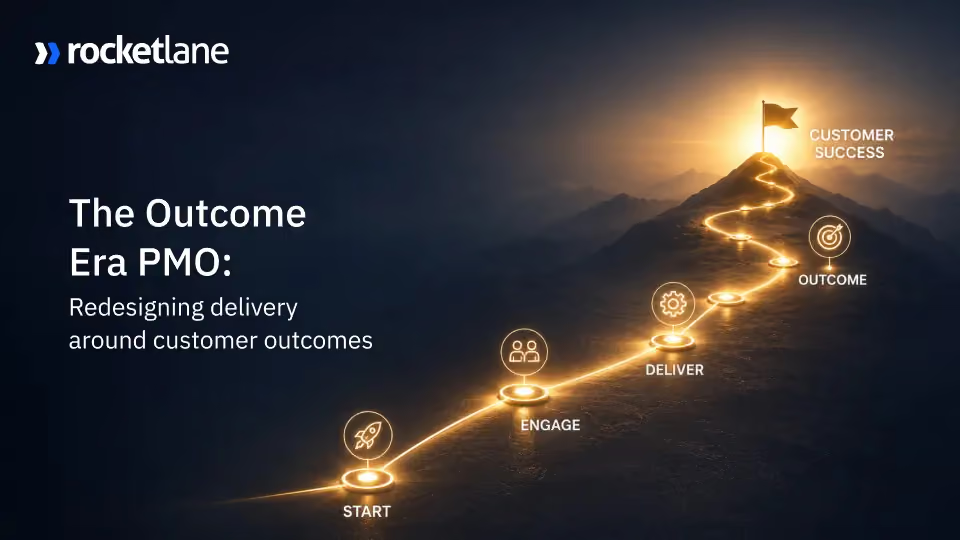
The Outcome Era PMO: Redesigning delivery around customer outcomes


•
•
Summarize blog with






About the author
Keynote speaker and coach, Peter is the author of the number 1 bestselling project management book ‘The Lazy Winning Project Manager’, along with many other books.
He has built and led some of the largest PMOs in the world and is a recognized architect of key principles of PMO design.
He has also delivered over 530 lectures around the world in 28 countries and has been described as ‘perhaps the most entertaining and inspiring speaker in the project management world today’.
He also runs the "Lazy Project manager agency"
Let’s start with something that might sound pretty obvious but is surprisingly easy to forget in the day-to-day whirlwind of projects, plans, and panic that might be your working world.
Customers do not buy projects; they buy and want outcomes. Good, positive, and valuable outcomes.
And yet, for years, many PMOs, mine included at times, have been designed, structured, measured, and even celebrated around the successful delivery of individual projects rather than the realization of business outcomes.
We congratulated ourselves on hitting milestones, delivering on time, and staying within budget (or at least pretty close), all the while quietly hoping that, somewhere along the way, the customer actually received the value they expected.
Sometimes they did and, sadly, often they did not.
What the shift toward outcome-focused professional services, as championed by organizations like Rocketlane, is telling us loud and clear is that delivery is no longer about completing work; it is about creating value, and not just at the end of the journey, but throughout it.
This is where the Outcome Centric PMO steps forward, not as a theoretical improvement, not as another layer of governance, but as a necessary evolution in how we think about project delivery in a world that is increasingly driven by customer experience, speed, and measurable impact.
This is when your PMO joins the Outcome Era.
From delivering projects to delivering value
For many years, the PMO has been seen as the guardian of process or methodology and occasionally, if we are being brutally honest, the necessary project police (it has always been a bit of a fine balance).
It has done an excellent job in many respects, creating structure where there was chaos, introducing consistency where there was fragmentation, and offering a sense of control in environments that often felt anything but controlled. It has raised the professionalism of project and program management and added a leadership focus on portfolio discipline.
But control is not the same as value, and structure is not the same as success.
The traditional model, built around projects and methods, has always been strong in the engine room of delivery, ensuring that the mechanics of project execution are well defined and repeatable, yet it has often struggled to connect that engine room to the front line, where expectations are set, perceptions are formed, and outcomes are honestly (brutally) judged.
In the outcome-focused delivery space, this gap is no longer acceptable because customers today are not interested in how well your internal processes operate or how many project management qualifications your PMs have; what they are interested in is how quickly and effectively you help them achieve their goals, not your goals.
That requires a shift from managing delivery to enabling success, a shift from tracking activity to proving outcomes, and most importantly, a shift from thinking internally to thinking externally, thinking ‘customer’.
The emergence of the outcomes layer
When we reimagined the PMO in my organization as Projects, Methods, and Outcomes (see what we did there?), it was not an exercise in rebranding but a response to a very real and persistent problem: the connection between what the PMO was doing and what the customer was experiencing was simply not strong enough nor closely aligned enough. We had varying expectations on what ‘success’ was.
Projects gave us capability, methodology gave us good levels of consistency, but neither guaranteed that the all-important customer would conclude that this project was both successful and valuable to their business.
The outcomes function was designed to close that gap, to act as the living, breathing interface between the carefully constructed world of frameworks and standards and the often messy and unpredictable reality of delivery.
In an outcome-focused model, the PMO does not sit above delivery, looking down from an ivory tower; instead, it sits within delivery, observing, supporting, guiding, and, most importantly, listening so that corrections can be made when needed to bring the project to the customer's outcome expectations.
Because if you want to understand outcomes, then you can’t rely solely on dashboards, metrics, and reports; you need to understand context, you need to understand people, and you need to understand the subtle, often unspoken signals that tell you whether a project is truly succeeding or merely progressing to some predestined ending.
Designing for customer outcomes
One of the most powerful ideas in outcome-focused delivery is that success is defined not by completion but by customer impact, which requires us to rethink how we design our delivery structures from the ground up.
The Outcome Centric PMO begins with a simple but profound question ‘What does success look like for the customer?’
Not in terms of deliverables or timelines, but in terms of tangible, meaningful change.
Only when that is understood can we begin to align our projects, methods, and teams to achieve that critical outcome.
This is where the synergy with Rocketlane’s approach becomes clear: their focus on aligning delivery with customer goals, creating transparency, driving accountability, and ensuring that every step of the journey contributes to a clearly defined outcome. Exactly what the modern PMO needs to embrace because it is no longer enough to deliver a solution; we must deliver a result.
And we must be able to demonstrate that result clearly, consistently, and convincingly.
Reducing noise whilst increasing impact
Another often overlooked benefit of the Outcome Centric PMO is the reduction of ‘project’ noise.
In many organizations, project delivery is accompanied by a constant stream of updates, multiple, often parallel changes, and multiple channels of communication, all, no doubt, very well-intentioned but often massively overwhelming.
This leads to what is commonly referred to as change fatigue, where the sheer volume of activity diminishes its real effectiveness due to excessive distraction and lack of focus.
The modern PMO can act as a filter, ensuring that only changes (communications, updates and requests) that genuinely contribute to value are prioritized and that the overall delivery experience is streamlined rather than cluttered.
This is not about doing less for its own sake; it is about doing less of what does not matter, so we can do more of what actually does (to the customer).
The key role of technology in outcome delivery
Technology, when applied correctly, acts as an accelerator, providing visibility, alignment, and coordination across all aspects of delivery, but, and this is very important, technology does not create outcomes.
People create outcomes; technology aids the creation of those outcomes; and in a modern, complex change landscape, technology is a must for success.
Technology supports and enhances; it scales good practices; it manages the vast data flows of the modern business, but it cannot replace the human elements of understanding, empathy, and judgment that are essential to delivering meaningful results.
The Outcome-Centric PMO should embrace technology as a critical digital partner, leveraging it to enable better communication, tracking, and alignment, while always keeping the focus firmly on the end goal.
A different kind of success
Ultimately, the transition to an outcome-centric PMO represents a shift in mindset as much as it does a shift in structure.
It challenges us to rethink what success means and encourages us to look beyond completion and toward real impact.
It reminds us that the true measure of our project work is not what we deliver, but what our customers achieve as a result, even if this is not the easiest path.
It requires unlearning as much as learning, flexibility where there was perhaps too much rigidity, and a willingness to question long-held assumptions about how PMOs should operate.
But get it right, refocus on outcomes, then the rewards can be significant, because when you align your PMO around outcomes, you do not just improve project delivery, you transform it.
‘Projects: Methods: Outcomes: The New PMO Model for True Project and Change Success’
Keeping pace with the speed of change in modern business, this book takes readers on a two-year journey to build a project management office (PMO) for today and tomorrow and redefines the PMO by focusing on Projects, Methods, and Outcomes.
Many organizations invest heavily in PMOs, but these are built on an outdated and static model that does not fit a hybrid, agile, AI-empowered, and rapidly changing business environment.
Building on his renowned "balanced PMO" model, project management leader Peter Taylor tackles today’s challenges with this diary-style guide to inspire PMO leaders, project managers, and business leaders alike and to provide a roadmap for building (or rebuilding) their own PMOs.
He presents a completely new definition of "PMO", eliminating the traditional back-office concept of a centralized PMO, with his "Projects: Methods: Outcomes" construct that provides a truly business-focused team to oversee the delivery of value to their organization.
Enriched with case studies and practical models, this book will benefit all PMO leaders, project management professionals, change and transformation leaders, and anyone interested in delivering business value through projects.
Table of Contents

Regsiter for the live webinar


Great consultants didn't join your team to spend Fridays writing documentation.
Table of contents
18 of Forbes Cloud 100 chose Rocketlane. The best PS teams aren't waiting around.
FAQs













Copyright © 2026 Rocketlane Corp. All rights reserved.

















.webp)