How Clutch used Rocketlane's timesheet governance agent to eliminate manual time card audits across 100 concurrent projects
100
Concurrent projects governed
3 min
To configure and validate timesheet policy

Region
US
Industry
Fintech/Financial Services
Use case
Timesheet Policies, Time Tracking Governance, Forecasting Accuracy
Before
- Reviewing consultant hours against weekly forecasts required opening each time card manually. Across 100 concurrent projects, this wasn't sustainable.
- The ops contractor spent limited weekly hours on time card audits, reducing capacity for higher-value work.
- Managers had no proactive way to spot over-utilisation, and consultants had no visibility that their workload was being seen by leadership.
After
- Timesheet Policies automatically scans every entry against configured rules, flagging exceptions in real time across the full portfolio.
- Automated flagging frees the ops contractor to focus on process improvement, enablement, and better policies.
- Soft flags surface over-utilisation to managers automatically, while consultants receive in-system acknowledgment creating a feedback loop between effort and leadership awareness.
About Clutch
Clutch is a Series B fintech startup running approximately 100 concurrent implementation projects at any given time, with a team of around 30 consultants, 12 project managers, and 16 implementation engineers, all tracking time weekly against project-level forecasts.
At that scale, the team was generating hundreds of individual time card line items every week with no automated way to govern them. There was no systematic check on whether actuals were tracking to forecast, no early signal on over-utilisation, and no way for leadership to see what needed attention without someone building a report first.
Daniel Levine, Director of Professional Services, recognised the problem clearly: the infrastructure to govern that volume of time data simply did not exist, and manual workarounds would not hold as Clutch kept growing.
What Daniel wanted was straightforward in principle: rules encoded directly into the system, exceptions flagged automatically as consultants submitted their work, and managers notified without having to go looking. When Rocketlane released the Timesheet Governance Agent, he saw a direct path to get there.
The Challenge
Comparing actuals to forecasts meant opening every time card by hand
At 100 concurrent projects, the team generates hundreds of individual time card line items every week. Seeing whether any single consultant had diverged significantly from their forecast required opening their individual time card, locating the forecast, and manually reconciling the two. There was no aggregated view, no automated comparison, and no way to see across the portfolio without repeating that exercise for every person and every project.
"If you wanted to see whose time significantly exceeded what they were forecasted for a given project, you had to dig into somebody's individual time card, manually look at what their forecast was, and reconcile that."
The ops contractor's limited hours were going toward routine audits
Clutch's ops resource is an hourly contractor with a fixed weekly capacity. A meaningful share of that capacity was going toward manual time card reviews: necessary work, but work that produced no analytical value. Every hour spent auditing the past was an hour not spent on process improvement, enablement, or anything that moved the operation forward.
No early signal on over-utilisation or burnout
Without automated flagging, managers had no proactive way to know when a team member was heading toward burnout or when a project's actuals were diverging from forecast. The data existed in theory. Extracting it reliably required effort that consistently lost out to other priorities, which meant by the time anyone looked, the window to course-correct had already closed.
Leadership visibility required someone to build a report first
Before anything useful surfaced to leadership, someone had to go in, pull the data, and prepare it. The team had three options: ask ops to review everything manually, ask managers to review their own teams, or accept that neither would happen consistently. None of them scaled as the portfolio grew.
The Solution
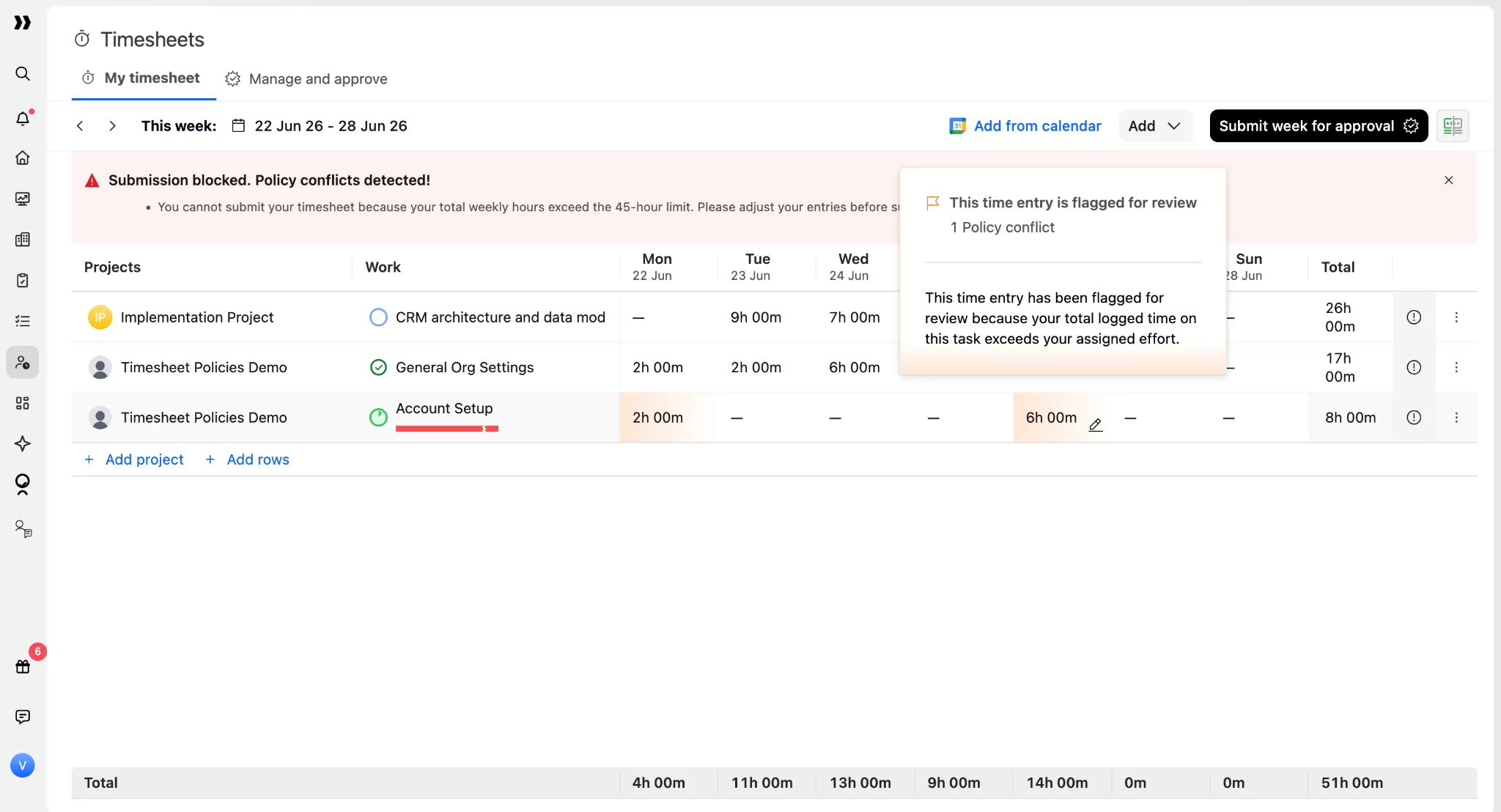
An AI agent that enforces governance rules in real time, so managers only see what needs their attention
Daniel came to the evaluation with specific requirements: rules written in plain language, exceptions flagged automatically, and notifications reaching managers without anyone having to trigger them. Rocketlane's Timesheet Governance Agent made that possible by letting him describe the team's rules in plain English and having the agent apply them automatically across every time entry in real time, as consultants submit their work.
Rather than running manual reports and chasing down anomalies after the fact, the agent does the first pass automatically. The team only engages where action is actually needed.
"I knew what this needs to look like in a mature state. I immediately saw how the Timesheet Governance Agent would be able to accelerate us getting there."
Rule 1: Flag any consultant who logs more than 150% of their allocated hours on a project in a given week
This was the first rule Daniel configured. The logic was entered as plain conversational text, no formulas, no configuration forms. The agent parsed the instruction, created the rule, and applied it immediately. To test it, a team member entered a time card that should trigger the flag. It flagged instantly. Three minutes from typing the rule to confirmed working policy.
Rule 2: Hard-block time entries logged to the wrong category or project phase
For entries that violate the team's categorisation rules, the agent stops the submission at the point of entry and directs the consultant to correct it before it goes through. What previously resulted in an ops follow-up message on Tuesday morning asking someone to go back and fix a Friday time card now gets resolved in the moment.
Rule 3: Soft flags surface over-utilisation to managers automatically, without blocking consultants
For situations that do not require a hard stop, the agent surfaces a soft flag to the manager while letting the consultant's submission go through. When someone logs significantly more than their allocated hours, their manager sees it without having to look for it. The agent also surfaces an in-product acknowledgment to the consultant directly, letting them know their workload has been seen.
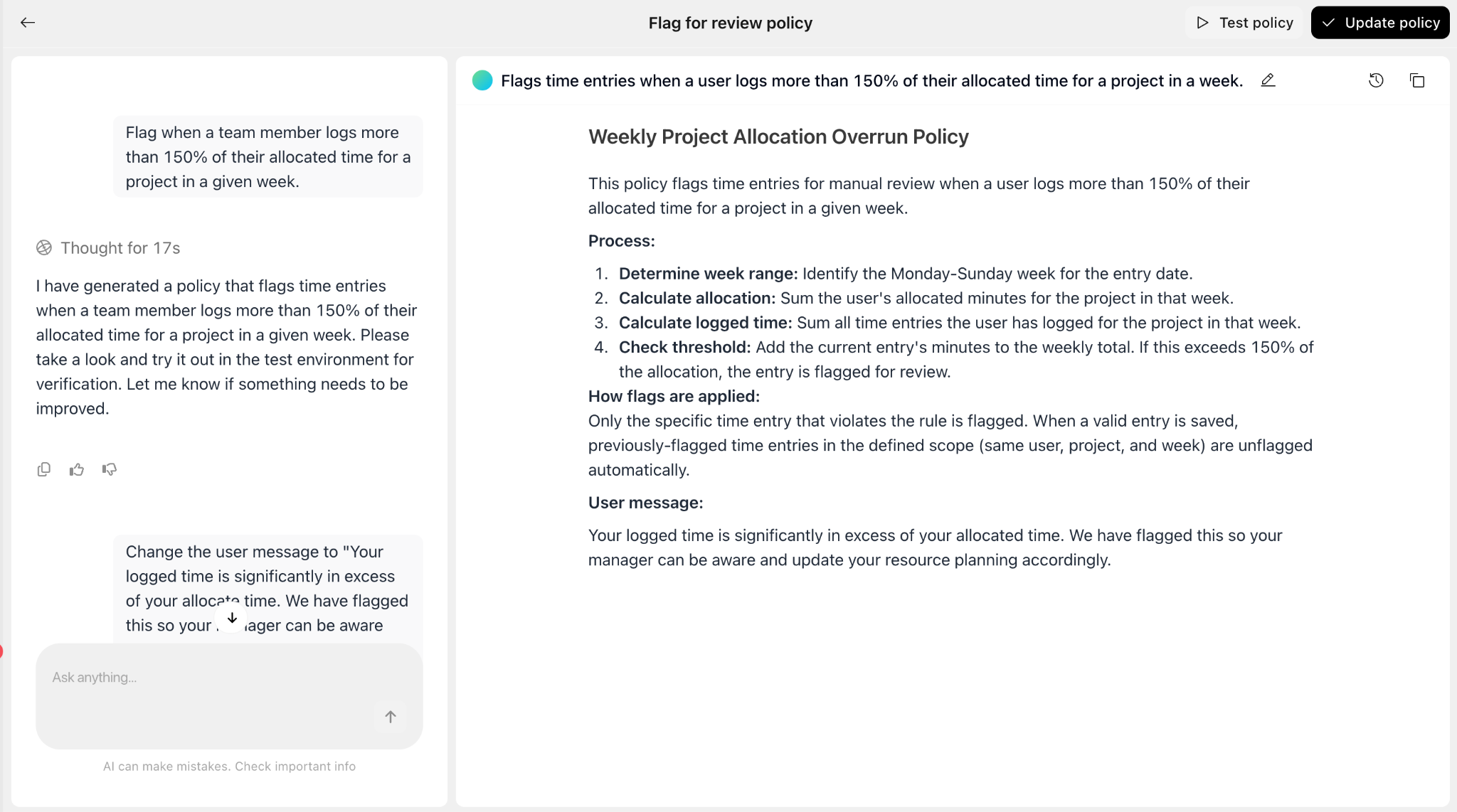
"Literally three minutes to create a rule, test it, it worked the first time. The process could not have been smoother. It just worked exactly as advertised."
The Impact
"There's more important work to be done than manually sifting through time card entries every week."
Hundreds of time card line items reviewed automatically, every week
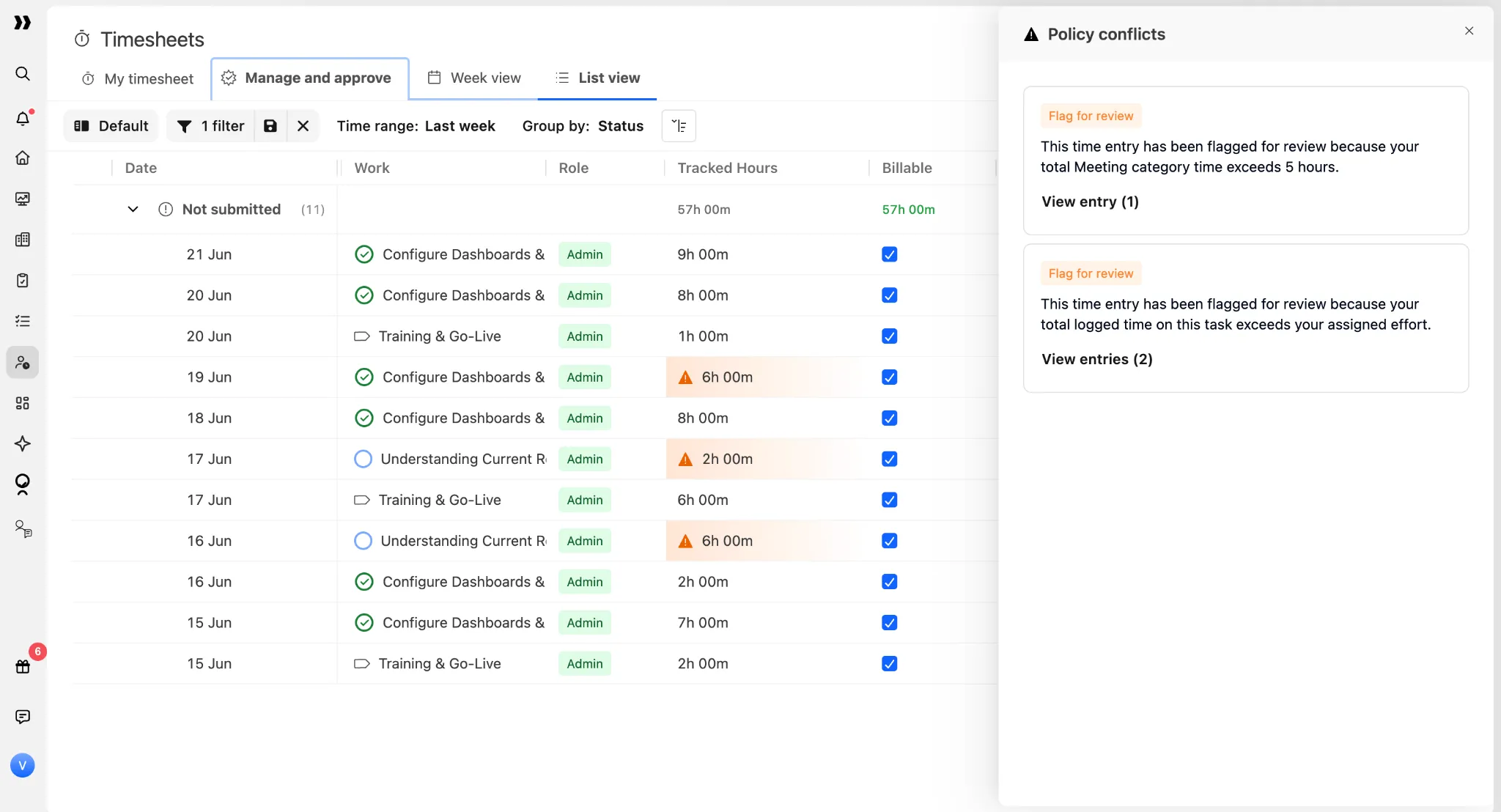
The Timesheet Governance Agent now scans every entry submitted each week against every active rule, across all 100 concurrent projects simultaneously. Exceptions surface in a saved view in the approvals section. What previously required hours of manual reconciliation now takes minutes to review, and only the entries that actually need attention appear.
Ops contractor time freed for higher-value work
With automated rules catching exceptions at entry, the ops contractor no longer spends limited weekly capacity on routine audits. That time has shifted to process improvement, enablement, and building better policies: work that actually compounds over time.
Errors caught at the point of entry, before they compound downstream
Hard flags prevent miscategorised entries from making it into forecasts, project allocations, or leadership reports in the first place. The correction happens at submission, in the moment, rather than surfacing later as a discrepancy that has to be untangled.
A forecasting push that now has an enforcement layer behind it
Timesheet Policies arrived just as Clutch was already planning to use Rocketlane's forecasting module more rigorously, moving from monthly forecast updates to continuous tracking of actuals against estimates across the full portfolio. The Governance Agent is the enforcement layer that makes that push viable. Without automated checks on whether actuals are tracking to forecast, more frequent forecasting would just generate more numbers to review manually.
What Daniel would tell any ops or delivery leader still doing this by hand:
"It's super easy to set up. You already know the types of things you want to flag and take action on. And to have a system go through hundreds of line items, prevent things from being entered the wrong way, and flag exactly where you need to take action, it's a huge efficiency gain. It's been extremely reliable and allows us to be near surgical with the amount of time we dedicate to seeing where there might be problems."
Want the full story?
Access detailed strategies, outcomes, and best practices in our customer spotlight playbook.



Fintech/Financial Services
How Rocketlane is helping GoCardless accelerate time-to-value for their customers by 20%

Professional Services & Consulting