How Storable cut data migration time by 75% with Rocketlane's migration agent
~75%
Reduction in migration time
3–4 wks
Average go-live timeline, now under less pressure
.webp)
Region
US
Industry
SaaS
Use case
Data Migration, Onboarding, Agentic Automation
Before
- Complex data migrations took up to 8 hours of manual transformation and validation work per project.
- Issues identified later in the process required additional remediation cycles, redirecting team effort from customer-facing work.
- High migration volume and variable effort made scaling the process without additional headcount increasingly difficult to sustain.
After
- The migration agent handles transformation logic and structured validation within hours, not a full workday.
- Issues are flagged before they become problems, shifting quality checks earlier in the process.
- Implementation managers spend less time on data and more time on customer relationships and training.
About Storable
Storable builds property management software for the self-storage, marina, campground, and RV industries. Accurate, timely data migration sits at the centre of every customer onboarding, and for Jennifer McCurdy, Senior Manager of Software Implementation, that meant managing a high volume of concurrent projects against aggressive go-live targets of three to four weeks from contract signature.
The challenge was not just volume. It was the variability of effort baked into every migration. Some were straightforward. Others required extended back-and-forth, manual mapping across multiple systems, and several correction cycles before data was ready to go live. As onboarding demand grew, that variability became impossible to absorb without it landing directly on implementation managers. Jennifer needed a way to handle more migrations without expanding the team, and to shift the hours saved back toward the customer relationships that actually drive long-term success.
When Rocketlane introduced Nitro, the fit was immediate. Storable was already on the platform. The question was not whether to automate; it was how to do it within a system the team already trusted.
The Challenge
Complex migrations were consuming up to 8 hours of hands-on work per project
Transformation logic, manual field mapping, formatting corrections, and validation work added up. On complex migrations, a single project could consume up to eight hours of effort before any customer-facing work even began. With a three-to-four-week go-live target and growing volume, that overhead was not sustainable.
"We were balancing increasing demand, highly variable effort depending on the migration, and a growing pressure to accelerate the timelines."
Issues caught late meant remediation cycles that ate into customer time
A meaningful portion of that manual effort was not transformation; it was fixing things that had already gone wrong. Missing fields and formatting inconsistencies identified later in the process triggered additional correction cycles, pulling implementation managers away from training, adoption support, and the work that requires a human presence.
"A lot of that time wasn't just spent on processing data. It was about fixing issues after the fact, things that could have been caught earlier."
Growing volume with no way to absorb variability
There was no reliable way to predict which migrations would run long. When a complex project landed, it absorbed the capacity intended for everything else. Scaling the process meant either hiring more people or finding a way to handle more with the same team. Adding headcount was not the answer.
The Solution
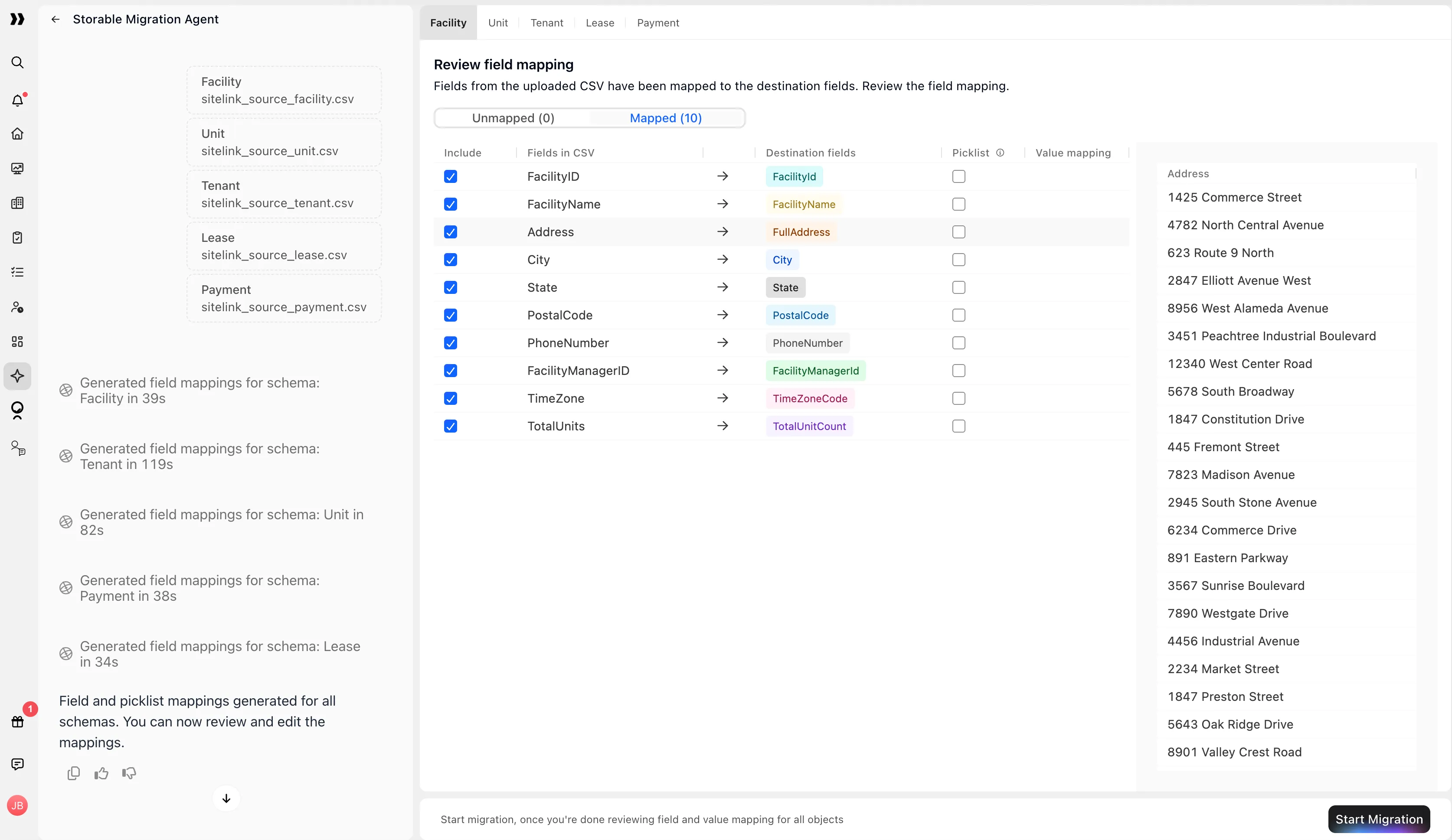
An AI agent that handles transformation and validation autonomously, so implementation managers focus on customers
The goal was not to automate tasks in isolation. It was to embed agentic automation inside a platform the team already relied on, so that migration work that previously required hours of step-by-step effort could run without a human in the loop.
Rocketlane's migration agent, built on Nitro, handles transformation logic and structured validation autonomously. Issues are surfaced before they reach later stages of the process. Implementation managers engage only where judgment or customer context is needed.
"The first time the migration agent handled the transformation logic and applied that structured validation without all the back and forth, it happened literally within hours. That was the moment."
Agents built and managed by the team, with no reliance on external tools or services
In previous automation evaluations, modifying a workflow meant pulling in someone external and pausing other work. With Nitro, the implementation team creates and iterates on agents independently. No specialist required. No ticket to file. Changes happen when the process needs them.
One platform, not a growing stack
Because the migration agent is native to Rocketlane, Storable avoided adding another tool to an already complex technology environment. New team members have one place to learn. The operational benefit compounds as the team grows.
"When you've just got one app to direct somebody to, it's easier for employees to onboard. My boss Cody's mantra is: if it didn't happen in Rocketlane, it didn't happen."
The Impact
.webp)
75% reduction in migration time
Migrations that previously took up to eight hours are completing in a fraction of that time. The agent handles the work that used to consume most of a project day, and does it faster and more consistently than the manual process it replaced.
"In some cases, our transformations were taking around 8 hours. Preliminary observations are pointing towards a reduction in time of about 75%. That's an immense amount of time, and that risk mitigation alone is actually priceless."
Issues caught before they compound, not after
Validation now happens earlier in the process. Missing fields and formatting problems surface before they trigger a remediation cycle. The correction still happens; it just happens at the right moment, not after the error has already propagated.
Growing volume absorbed without additional headcount
As onboarding demand increased, the team did not grow to match it. The migration agent absorbed the additional effort, keeping implementation managers focused on customer engagement rather than data logistics.
Implementation managers spending time where it matters
With migration hours reclaimed, Jennifer's team has more availability for the relationship-building that supports long-term customer success: training, adoption support, and the kind of work that requires a human in the room.
Want the full story?
Access detailed strategies, outcomes, and best practices in our customer spotlight playbook.

.webp)

Hospitality Technology / SaaS