


Further reading
- Propel23 recordings
- Implementation Stories
- Preflight Conversations
- The Launch Station - A podcast for all things customer onboarding
- Customer onboarding resources from Rocketlane
In her keynote session at Propel23, Donna Weber, leading customer onboarding expert and author of the award-winning book Onboarding Matters talked about three key areas customer onboarding professionals need to prioritize in 2023.
In this session, Donna talked about:
- Calculating the true cost of onboarding,
- Doing more with less within customer onboarding,
- Demonstrating its tangible impact
Here are the main takeaways from the session.
Onboarding needs to be seen as an impactful investment, not a cost center
Onboarding is perceived as a cost center – even though it has an undeniable impact on retention, expansion, renewals, and referrals. Enabled customers buy more, have higher NPS, are more loyal, and use more of the product.
Far too many companies provide customer success services for free, and end up exceeding what the customer is paying them.
If you’re seen as a cost center, you’re the first to go during challenging times and costs are to be cut.
To avoid this, you need to
- Measure and demonstrate the value of onboarding.
- Capture and articulate the impact of onboarding on your company and customers.
Metrics to calculate the true cost of customer onboarding
Cost of Customer Acquisition (COCA)
The cost of the work done to bring in a new customer via sales and marketing efforts.
Typically, it takes between 1.3 and 1.5 times the cost of the first year’s license.
Cost of Customer Onboarding (COCO)
The time and labor cost to onboard your customers. This includes the cost of engaged CSMs, onboarding specialists, and implementation teams, in addition to the cost of specialized tools for project management, data migration, etc.
This combination of acquisition costs, ie your Cost of Onboarding and Cost of Acquisition (COCOA) determines how low long you take to break even
Unfortunately for most companies, churn happens even before their average breakeven point of 1.5 years.
The result: Companies are not making money even though they bring in new sales – when they don't keep them past that breakeven point.
Effective and orchestrated onboarding can solve this problem.
Do more with less
The best way to reduce the cost of onboarding is to ‘do more with less’.
One way to do that is with a hybrid touch that leverages multiple one-to-many (1:M) interactions.
This approach ensures that you leverage tech-touch moments within high-touch delivery.
Here are some examples to do that:
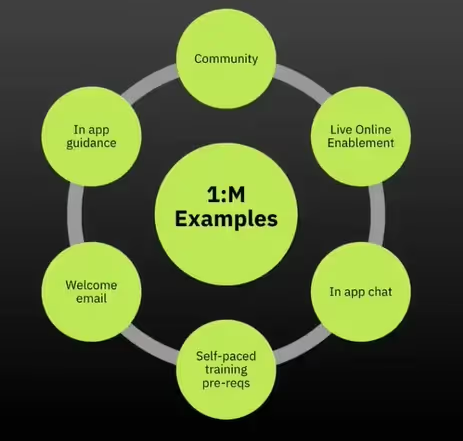
Understand the repeatable parts of the onboarding journey and leverage technology for them. Save the high-touch approach for non-repeated and unique aspects. This is what a truly hybrid approach looks like.
In cases where you need to have a high-touch approach for bespoke customers, make sure to charge for your services by using defined standard and premium packages.
That way, rather than being a cost center, you can be a profit center, or at least cover your costs.
Measuring and demonstrating the impact of customer onboarding
Identifying the metrics that matter: Find out the metrics that matter to the company, especially those that are discussed in all-hands and board meetings.
Demonstrate your impact on these metrics: For example, as part of customer education, you could charge for classes or create subscriptions that add to the annual recurring revenue (ARR).
Don’t wait. Start with what you have: For example, if you have a land-and-expand model, you could find out
- when customers who don’t go through onboarding expand (say 9 months)
- when customers who go through your onboarding expand (say 6 months)
- what revenue this reduction in expansion time leads to
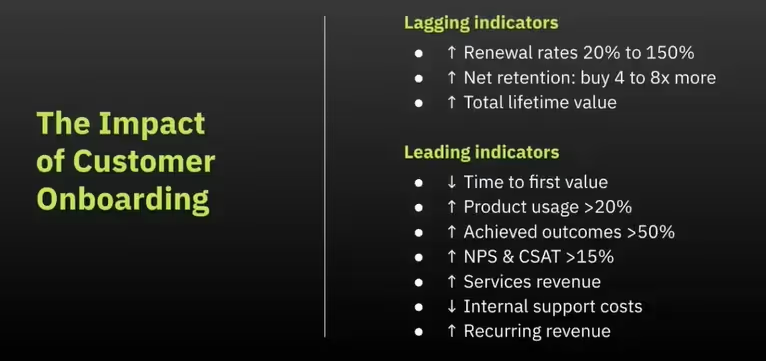
Leverage both lagging and leading indicators to measure impact: Lagging indicators – those that your company and your board care about, such as renewal rates, lifetime value, etc. – can take a long time to show.
In the meantime, look at leading indicators, like time-to-first-value (TTFV), product usage, etc. to demonstrate how you can decrease internal costs.
Show, and tell
It's not enough to just work hard to onboard and enable customers. You need to make sure that others know about your impact. Think like a business owner, and look beyond just delivering your programs, to marketing and selling your value both to customers and to internal teams. You need to constantly demonstrate your value to internal teams, your management, and to customers. Here are a few ways to do this:
Join (and present your work at) all-hands meetings and sales meetings
It’s not enough to announce something once a year or once a quarter. Try a drip-feed approach. Make sure folks see, and know, what you're doing and why and the impact you're having – over and over again.
Send a monthly newsletter
Send out a newsletter that highlights recently onboarded customers, talks about customer wins, spotlights a team member, or shares a customer testimonial.
The big takeaway: Capture the impact of everything you in dollar value– that’s what ultimately demonstrates value.



























.webp)