Annual plan template for professional services in 2026: A step-by-step guide to profitable delivery (free template download)

•
•
Summarize blog with






If you lead Professional Services, annual planning probably feels familiar and exhausting. Business leaders seeking structured planning tools will find that a well-designed annual plan template can make a significant difference.
You’re staring at revenue targets, capacity models, hiring plans, AI initiatives, margin expectations, and delivery risks, all at once. Sales want aggressive growth. Finance wants predictability.
Delivery wants breathing room. Customers want outcomes faster than ever.
You can view utilization rates, current project status, and this quarter’s revenue. But ask about six months from now, and the picture gets fuzzy.
Will your current skill mix support the deals Sales is pursuing? Will capacity hold if demand shifts toward more complex work? How exposed are you if a few senior contributors become unavailable?
In 2026, annual planning isn’t just about budgets and headcount anymore.
It’s about deciding what kind of services organization you’re building in an AI-first world, and whether your delivery model can actually support it profitably.
SPI’s 2025 research shows PS revenue growth slowed to 4.6% year over year, well below the five-year calendar view average of 8.7%. In this environment, execution mistakes compound faster, and weak planning shows up directly in margins.
The difference between reactive services organizations and resilient ones is not effort. It’s how far ahead they can see, and whether that view actively governs decisions as the year unfolds.
A strong annual plan brings that discipline into the operating rhythm, keeping everyone on the same page regarding goals and execution.
We’ll walk through a great annual planning template designed specifically for modern Professional Services teams, one that helps you align revenue, capacity, AI investments, and delivery realities without guesswork. This template provides structure and clarity, making it easy to set goals, create timelines, and organize your planning process.
No theory. No spreadsheets for spreadsheets’ sake. Just a clear path from plan to profitable execution, providing clear direction for your organization.
Let’s dive in.
What is an annual plan for Professional services?
An annual plan is a structured, forward-looking blueprint that defines how an enterprise-sized company or services organization will deliver revenue, manage capacity, and protect margins over the next year.
In simple words: It connects financial targets with delivery reality so teams can scale profitably without burnout or surprises.
In professional services, it serves as a coordination layer between strategy and day-to-day operations, providing the foundation that keeps your team aligned when delivery pressures mount and priorities compete for attention.
This connection is established through a strategic planning process that ensures high-level objectives are translated into actionable steps.
A good annual plan makes five things explicit:
- Revenue and services ARR assumptions
- Forecasted project demand and work mix
- Capacity and utilization modeling
- Hiring, re-skilling, and partner strategy
- Budget allocation across delivery, tools, and AI
- Margin targets and risk scenarios
For services teams, the annual planning process becomes even more important because work is capacity-bound. You’re not just planning revenue targets; you’re planning people time, delivery bandwidth, customer commitments, and risk in a structured, step-by-step approach.
A good annual plan creates alignment across leadership, sales, services, and delivery teams, so everyone works toward the same outcomes with shared assumptions. It is essential to align team and department initiatives with the overall company strategy to ensure organizational alignment.
This is also the foundation for capacity planning and margin forecasting.
When done right, your annual plan becomes a living document that guides decision-making, resource allocation, and prioritization throughout the year. The yearly planning process is crucial for maintaining focus and adapting to changes as the year progresses.
All that said, let’s see the significance of annual planning in professional services planning in the next section.
Benefits of the annual planning process for professional services
Professional Services leaders who invest in disciplined annual planning see clear, compounding benefits across delivery, margins, and stakeholder trust.
Here’s how modern PS leaders can benefit from annual planning in 2026:
1. Clarity stops the constant reprioritization
When you’ve mapped out the year ahead and taken time to organize tasks and priorities, your delivery teams and sales counterparts understand what you’re building toward.
You can:
- Spot capacity crunches months in advance
- Identify delivery risks before they escalate.
- Focus teams on outcome-driven work that aligns with business goals, not urgent distractions
The result is fewer surprises, more predictable execution, and the ability to stay organized throughout the year.
2. Resource optimization becomes data-driven
The planning process shows you exactly when to hire, so you can bring people on board before delivery commitments pile up. Assign tasks to the right team members and delegate effectively to ensure optimal resource utilization and clear accountability.
With a clear view of demand, you can:
- Hire ahead of delivery pressure
- Identify skill gaps early and plan re-skilling
- Avoid the feast-or-famine cycle that kills utilization and burns out teams
This creates healthier workloads and more stable margins.
3. Two-fold confidence through internal alignment and revenue predictability
Financial predictability improves stakeholder trust. Involving non-executives in annual planning—such as teams, departments, and key decision-makers—in the annual planning process ensures alignment and builds confidence in your forecasts.
When you give finance realistic revenue forecasts backed by capacity models, they trust your numbers.
You can model different scenarios, which makes budget conversations less contentious. When you give sales realistic expectations about delivery capacity, it actually strengthens your relationship with them because they can sell with confidence.
PS is no longer seen as a reactive function but is recognized as a strategic growth engine.
4. Decision-making accelerates
Your plan provides a framework for evaluating opportunities against strategic priorities. You can decline work that doesn’t fit where you’re headed. Resource allocation decisions happen more smoothly because everyone understands the trade-offs you’re making.
Annual plan vs monthly plan: What's the difference?
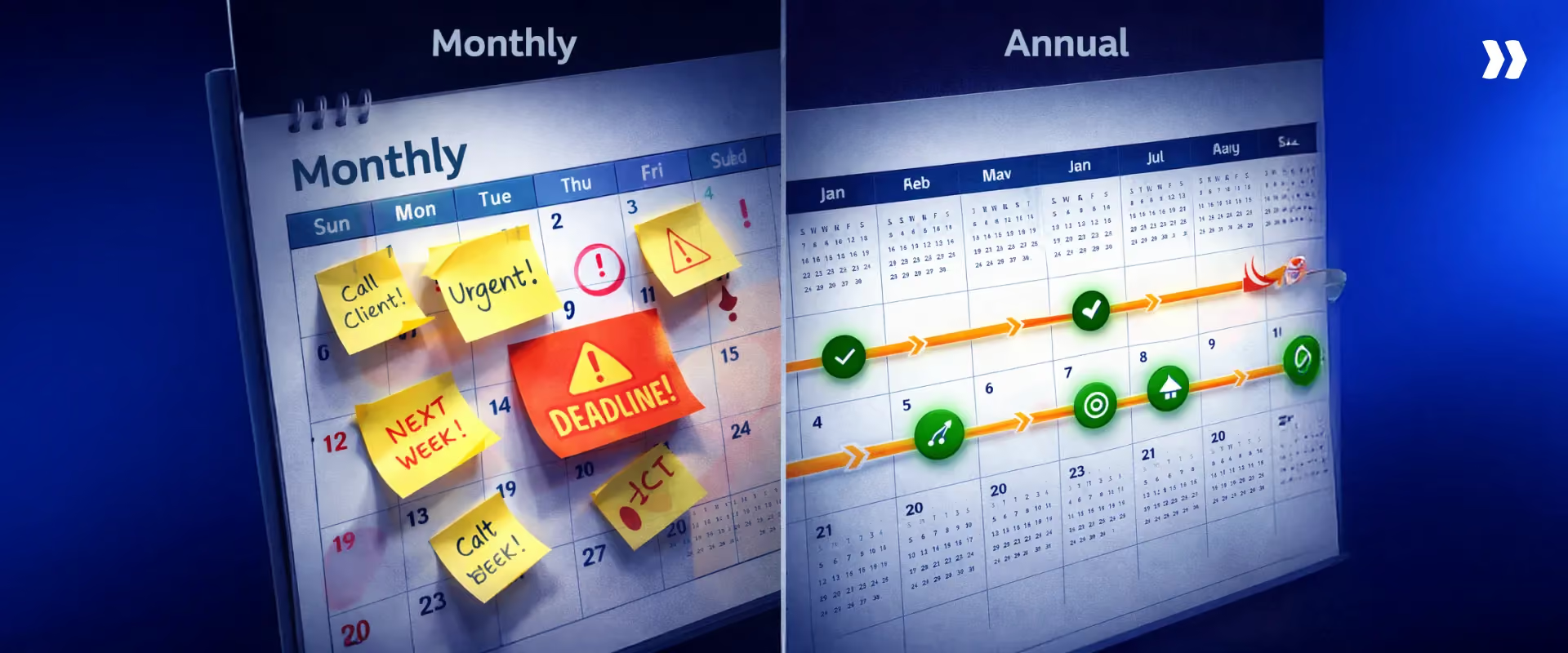
Your annual plan sets the big-picture goals, major initiatives, and overall resource strategy for the year.
It answers the foundational questions. What’s our revenue target? How many consultants do we need to deliver on our commitments? Which service lines are we expanding or sunsetting? What does success look like by December? When building your annual plan, using a calendar to visualize the plan helps clarify timelines and planning horizons.
Whereas your monthly plan lives in the tactical details. It’s about execution: who’s working on which project this month, which clients need immediate attention, how you’re tracking against quarterly milestones, managing deadlines, and what adjustments you need to make based on what actually happened last month versus what you planned.
In simpler terms: an Annual plan sets strategic direction and economic guardrails for the year, while a monthly plan helps you adjust execution based on reality. High-performing professional services teams use both, but for very different jobs.
If your annual plan sets the map, your monthly plan adjusts the steering wheel. Using a calendar template as a planning tool can make it easier to organize and coordinate key dates, deadlines, and milestones throughout the year.
5 essential elements of an annual plan for professional services to stay organized in 2026
A strong annual professional services plan integrates revenue goals, delivery capacity, and investment decisions into a coherent operating model.
Effective planning should include goal-setting methodologies such as SMART goals or OKRs to ensure clarity and alignment.
It's essential to set annual goals to provide direction and measurable targets for your team. Tracking key results helps measure progress toward these objectives, while a dedicated to-do list or section within the plan ensures actionable items are clearly outlined.
To maximize efficiency, organize tasks for clarity and execution.
These five components ensure your plan is executable, profitable, and resilient.
1. Revenue targets and unit economics
Annual planning starts with revenue, but it only becomes actionable when you break it down by work type.
You should model economics separately for:
- Implementations
- Configurations
- Managed services
- Outcome-based or AI-led engagements
When setting targets, use historical data from the previous year as a benchmark to inform your projections.
Each has different costs, margins, and delivery effort. Understanding true unit economics helps you:
- Set realistic pricing and discount boundaries
- Decide which work to prioritize or decline
- Protect margins as volume scales
To improve your planning, regularly analyze past key results to evaluate performance and identify areas for adjustment.
These economic factors shape your pricing decisions, discount thresholds, and which types of work to pursue or avoid.
2. Capacity modeling across delivery sources
Capacity is no longer just headcount. Mapping your delivery capacity across your core team, partner networks, and AI-enabled workflows will become crucial in 2026.
Creating a clear schedule is essential to manage capacity effectively, ensuring that timelines, start dates, and milestones are aligned for optimal resource allocation.
A modern annual plan models delivery across:
- Core delivery teams
- Partners and contractors
- AI-assisted and automated workflows
Not all capacity is interchangeable. A senior architect handling complex integrations is different from an implementation specialist supported by automation. Your plan should define:
- Utilization targets by role
- Buffers for pre-sales, escalations, and admin work
- Scenarios for hitting 80%, 100%, or 120% of sales targets
3. Resource planning and capability development
This is where planning shifts from reactive to strategic. As you map out headcount requirements by role and timeline, specify when you need to hire and what capabilities those hires will bring. Use custom fields to tag and filter information such as skills, roles, and training needs, making it easier to organize and track resources efficiently.
Beyond hiring timelines, your plan should account for:
- Skill gaps and re-skilling needs
- Enablement and training capacity
- Time for process improvement and governance
Treat learning and capability development as investments, not overhead. Teams that plan for growth capacity avoid burnout and deliver more consistently.
4. Customer strategy and account economics
Not all customers contribute equally to long-term profitability.
Your annual plan should clarify:
- Target segments and verticals
- Expansion vs new-logo mix
- Capacity allocated to renewals vs new implementations
For strategic accounts, define how you’ll deepen relationships and expand scope beyond the initial project. Be sure to track important events in the customer relationship, such as key deadlines, milestones, and activities, to ensure you stay organized and no critical events are overlooked.
Your key account strategies should outline how you’ll deepen relationships with key clients and expand the scope of your deliverables.
5. Capability investments and risk scenarios
Every plan rests on assumptions. Strong plans surface them early.
This includes:
- Tooling investments, such as professional services automation (PSA software), to streamline delivery or build internal systems.
- Expected efficiency or quality gains tied to each investment
- Risk scenarios like lower utilization, slower AI adoption, or attrition, and developing a contingency plan to address potential crises or disruptions
Finally, define quarterly milestones and KPIs, including margin, utilization, customer satisfaction (CSAT), NPS, and time-to-value. These checkpoints keep the annual plan grounded in execution.
Next, let’s see how we can combine these elements and add an AI layer to drive profitability in 2026.
Annual planning in the age of AI & services-led growth
In 2026, annual planning is no longer just about budgets. It is about designing how professional services actually operate in an AI-enabled world, and how structured planning can improve your professional life.
Plans that succeed today reflect how work is delivered, priced, and scaled when AI, automation, and human expertise each play distinct roles. Using a digital planner can help you organize your work and ensure all aspects of your annual plan template align with these new demands.
For professional services leaders, this shift shows up in five critical ways:
Annual planning has shifted from budgeting to operating-model design
You are no longer planning only to spend and headcount. You are designing how work flows across people, automation, and AI, all aligned toward a clear north star that serves as the guiding vision or overarching goal for your organization.
A modern annual plan must clearly define:
- Which work requires deep human judgment
- Where AI assists delivery
- What can be fully automated?
- How governance maintains quality across all three
Growth now comes from the depth of services, not just volume
The strongest PS organizations grow by expanding existing accounts, getting new businesses, improving renewals, and delivering outcome-based services. A structured approach to service expansion involves developing strategic growth plans and ensuring each initiative aligns with long-term organizational objectives.
Your annual plan must explicitly model:
- Ongoing delivery capacity for customer success
- Expansion-driven work, not just new implementations
Capacity is elastic, but only when engineered.
AI can reduce effort, but only with intentional workflow redesign and role evolution.
Effective plans map:
- Where efficiency investments are made
- What gains are expected
- When those gains realistically materialize
- How individual work is connected to broader organizational objectives
Economics are increasingly dynamic.
Pricing, margins, and utilization assumptions now change faster than annual cycles.
Strong plans model these shifts and include mechanisms to adjust pricing and resource allocation as conditions evolve, with ongoing monitoring and adjustments made throughout the entire year.
Execution visibility is a competitive advantage.
Organizations that execute their annual plans most effectively have linked their planning assumptions directly to their delivery systems, where actual project data continuously validates or challenges those assumptions.
In short, annual planning in the AI era is how professional services leaders turn strategy into a durable operating advantage, not just a financial forecast.
Once you accept this operating-model shift, the hard part becomes obvious: planning breaks because services have more moving parts than ever.
That said, sometimes you have to be right in your planning, as it can be truly hard. Here’s why.
Why professional services' annual goals planning is uniquely hard

Professional services annual planning is uniquely challenging because capacity, economics, talent, and delivery models are changing simultaneously, all within the broader context of aligning with overall business strategy.
What used to be a headcount-and-revenue exercise is now an operating model decision with real margin and delivery risk.
Here’s where most PS leaders feel the strain:
1. Capacity is no longer just headcount
In 2026, capacity comes from multiple sources, not just people.
You’re planning across:
- Core delivery teams with different skill levels
- Partners and contractors with variable availability
- AI-assisted and automated workflows that compress effort
Annual planning becomes more challenging because not all capacity is interchangeable, and utilization assumptions vary widely by role, workflow, and maturity level.
2. Service economics are shifting faster than pricing models
AI and automation reduce effort, but pricing often lags behind.
This creates tension between:
- Faster delivery and customer expectations
- Margin protection and legacy pricing models
- Time-based billing and outcome-based value
Without planning for this shift, teams deliver more value but capture less.
3. Customers expect outcomes faster, even as delivery gets more complex
Enterprise customers expect quicker time-to-value, not longer onboarding cycles.
At the same time, delivery involves:
- More integrations
- Messier data
- Complex applied AI use cases.
Annual plans must account for both acceleration and complexity, or delivery timelines quietly slip.
4. Talent planning is about re-skilling as much as hiring
Hiring alone won’t close the gap.
Modern plans must budget for:
- Re-skilling existing teams
- Role evolution as AI absorbs routine work
- Protected time for enablement and process improvement
Teams that ignore this burn out their best people.
5. AI, automation, and complex implementations changed the math
AI changes effort curves, margin profiles, and risk distribution.
If your annual plan doesn’t model:
- Where AI actually reduces work
- Where it adds upfront complexity
- How quality and governance are maintained
You’re planning with outdated assumptions.
What a high-impact annual planning template must include in the AI era

A high-impact annual planning template for professional services in the AI era defines how work gets done across humans, AI, and automation, not just what the organization wants to achieve.
Here are the core sections every AI-ready annual planning template must include:
AI maturity assessment and target-state definition
Most teams overestimate AI readiness by equating tool usage with operational maturity.
A strong annual plan clearly documents:
- Where AI is used today and what decisions it supports
- Where human judgment is still required
- What will change over the next 12 months?
High-impact plans define the target state, including which workflows will be AI-assisted, which decisions will be automated, and how roles will evolve as a result.
Work mix forecasting across humans, AI, and automation
Traditional plans forecast hours. AI-era plans forecast work distribution.
Your annual plan should explicitly model:
- Human-led work requiring expertise and judgment
- AI-assisted work that augments delivery speed
- Fully automated processes that remove effort entirely
This shift is critical for accurate capacity planning, utilization targets, and margin forecasting.
Budget allocation by capability (not just technology)
AI success depends more on capabilities than licenses.
High-performing PS organizations allocate budget across:
- Data quality and integration foundations
- Workflow redesign and governance
- Training, enablement, and change management
Importantly, strong plans also budget for capability retirement, deciding which tools, workflows, and manual processes to eliminate to unlock real efficiency gains.
Data and integration readiness planning
AI outcomes are constrained by data access and system connectivity.
A realistic annual planning template includes:
- Clear ownership of delivery and project data
- Known data gaps and integration dependencies
- Sequencing of foundational work before automation
If your data still lives in spreadsheets, emails, or disconnected tools, efficiency gains will lag without this upfront planning.
Delivery model and pricing evolution
AI changes how work is delivered, which eventually changes how it should be priced.
Your plan should outline:
- Shifts from time-and-materials to outcome-based pricing
- Expansion of managed services and AI-led offerings
- How does faster delivery impact perceived value and margins
This ensures that pricing, delivery, and profitability evolve together rather than in conflict.
Now, what if we package all this in a ready-to-use template? Stay tuned.
Annual planning template for 2026 goal setting (Free Download)

We've put together an annual planning template that helps you build a plan you can actually execute. It accounts for hybrid delivery models, the uneven impact of AI across work types, and the real constraints on expertise.
It surfaces the assumptions and trade-offs that determine whether your plan holds up under delivery pressure.
Unlike static spreadsheets, this template forces clarity. It makes assumptions explicit, surfaces trade-offs early, and helps you design a plan that balances growth, margins, and delivery reality in 2026.
Who this template is for
This template is designed for professional services leaders accountable for both outcomes and execution, including:
- Heads of Professional Services, Delivery, or Customer Success who own the P&L and need to balance growth targets with operational reality
- PS Finance and Operations leaders who are building budgets, forecasting margins, and need to translate delivery plans into financial models that hold up under scrutiny
- Services leaders navigating the shift to AI-enabled delivery who need to model how automation changes their capacity, costs, and pricing without losing sight of where human expertise still matters
- Teams launching new service lines or pricing models that need a structured way to plan economics before committing to customers or making large capability investments
- Organizations are struggling to align revenue ambition with delivery capacity, where sales projects growth that PS can't realistically support with current resources and timelines.
It covers:
- Demand forecasting by work type: Model implementations, configurations, managed services, optimization, and outcome-based engagements separately, based on their true effort and margin profiles.
- Capacity modeling beyond headcount: Plan delivery across core teams, partners, and AI-assisted workflows, accounting for role differences and non-billable buffers.
- Capability investment planning: Treat tooling, training, AI platforms, and delivery infrastructure as strategic investments tied to measurable efficiency or quality gains.
- Unit economics and margin visibility: Understand the real cost of delivery by engagement type, and how margins shift across delivery models, pricing, and scale.
- Protected capacity for strategic work: Reserve time for enablement, re-skilling, process improvement, and governance so long-term performance doesn’t get sacrificed to short-term delivery pressure.
Where the ~30% efficiency impact typically comes from
Professional services teams that adopt AI with discipline often see 20–30% effort reduction across specific workflows, not across the board. The savings usually come from:
- Reduced project administration and status reporting
- Faster onboarding and configuration for repeatable deployments
- Better scoping accuracy, reducing rework and overruns
- Improved utilization of mid-level talent with AI assistance
- Fewer escalations consuming senior expertise
The template helps you separate theoretical AI savings from realizable savings, so your budget reflects what can actually be captured in-year.
How to use the annual planning template to attain key results in 2026 (Step-by-Step)
This annual planning template helps professional services leaders convert revenue targets into a realistic delivery, capacity, and margin plan.
Follow these five steps to pressure-test assumptions and build a plan that holds up in execution.
Step 1: Lock your revenue assumptions
- Start with your full revenue picture: Include new bookings and your existing customer base, and break out renewals, expansions, and cross-sell opportunities separately. Each has different delivery implications and risk profiles.
- Segment PS revenue by delivery model: Separate traditional implementation revenue from newer models like AI-configured deployments, managed services subscriptions, and outcome-based engagements.
- Make renewal dynamics explicit: Account for how renewals influence your delivery load throughout the year, including ongoing support obligations and expansion opportunities that require PS involvement.
Step 2: Translate revenue into delivery demand
- Classify forecasted work by delivery characteristics: Group engagements based on complexity, required expertise level, and delivery approach rather than just counting projects or hours.
- Identify expertise requirements versus repeatable execution: Flag which work requires senior consultants with specialized knowledge versus which can be handled by mid-level team members following established methodologies. This determines your hiring mix and utilization targets.
- Map the realistic impact of AI and automation: Be specific about where AI or automation can reduce effort.
Step 3: Model capacity and utilization
- Build capacity across all delivery sources: Model your core team's availability, partner capacity you can reliably access, and the efficiency multiplier from AI-assisted delivery. Each source has different cost structures and scalability characteristics.
- Apply realistic ramp-up curves: Model how long it takes different roles to reach full productivity using historical data.
- Protect non-billable capacity: Explicitly budget time for presales support, training and development, internal projects, administrative work, and process improvement. These typically consume 20-30% of your team's time but are often overlooked in capacity planning.
Step 4: Stress-test margins
- Layer in your complete cost structure: Include base compensation, benefits, tooling costs, training investments, travel, and the capability platforms you're deploying.
- Compare economics across delivery models: Calculate margins for full-service engagements, partner-led delivery, and AI-accelerated implementations separately.
- Define margin floors for commercial decisions: Establish minimum acceptable margins by engagement type so your sales team knows the boundaries. This prevents deals from getting negotiated down to unprofitable levels.
Step 5: Pressure-test the plan against reality
- Challenge your optimistic assumptions: What happens if utilization is 10 points below plan? If AI adoption takes twice as long as expected? If attrition is higher? Run these scenarios and understand how much buffer you actually have.
- Identify expertise bottlenecks: Flag where senior talent becomes the limiting factor.
Common annual planning mistakes PS leaders make
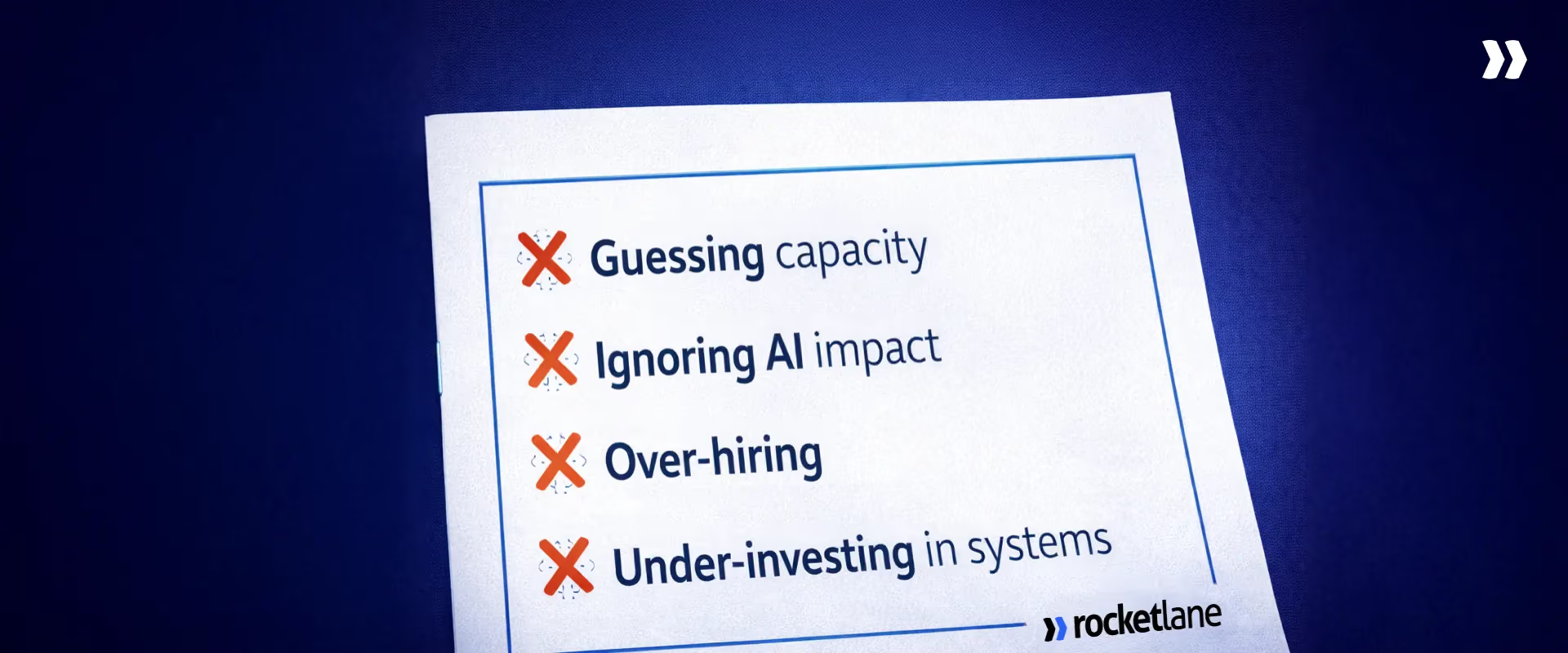
Annual plans fail for predictable reasons. These mistakes don't stem from lack of effort or intent. They happen because planning processes haven't adapted to how services are actually delivered today. Recognizing these patterns helps you design around them.
Here are the most common planning mistakes and why they quietly derail execution:
1. Planning around headcount instead of real capacity
Many plans equate capacity with the number of people on the team. In practice, capacity is shaped by experience, skill mix, ramp time, and cognitive load. Senior expertise, in particular, does not scale linearly and is often the true constraint. Plans fail when they assume new hires will absorb demand immediately or that senior capacity is infinitely elastic.
2. Treating assumptions as fixed
Annual plans are built on assumptions about demand mix, deal size, delivery efficiency, and pricing. Once the plan is approved, those assumptions are rarely revisited, even when early signals show they are drifting. Without a structured cadence for validating and adjusting assumptions, teams continue to execute against a version of reality that no longer exists.
3. Applying AI efficiency gains abstractly
The impact of AI varies by task, workflow, and role. Plans often assume broad reductions in effort without mapping where AI actually changes work. This leads to overestimated capacity gains and timelines that appear achievable on paper but fail to deliver. Effective plans model AI impact at the level of work behavior and translate it into realistic delivery outcomes.
4. Forecasting volume without understanding effort and complexity
Counting projects without classifying complexity hides real demand. Different engagements place very different burdens on senior oversight, escalation handling, and presales support. When effort is not segmented, teams end up with the wrong talent mix and volatile margins.
5. Separating planning from execution reality
Plans often live outside the systems that run delivery. Sales forecasts, capacity models, and financial targets evolve independently from real project data. Without a tight feedback loop between plan assumptions and execution signals, leaders discover problems only after outcomes are already locked in.
6. Ignoring renewal influence and expansion effort
Service capacity is often allocated based on direct delivery work, while the effort required to sustain accounts is treated as incidental. Work that materially influences retention and expansion competes for the same finite capacity but is not acknowledged in planning targets. The result is chronic tension between utilization metrics and the work that actually protects long-term revenue.
7. Excluding long-term delivery drag from capacity thinking
Plans tend to model only new work while ignoring the cumulative effort required to sustain what has already been delivered. Customizations, legacy integrations, and past compromises introduce ongoing cost that scales with the customer base. When this maintenance burden is not made explicit, capacity appears to exist on paper but is already pre-consumed in practice.
From strategy to execution: Where most annual plans break down
Most annual plans fail during execution, not because the strategy was wrong, but because there's no mechanism to translate planning assumptions into daily operations. The breakdown happens in predictable places, and understanding where helps you design around them.
1. The plan lives in spreadsheets, not systems.
In many organizations, annual planning occurs in spreadsheets, while execution takes place in professional services automation tools, finance systems, and CRMs. These systems rarely reconcile in real time.
As a result:
- Planning assumptions drift quietly
- Delivery realities surface only in quarterly reviews.
- Variance compounds before leaders can act
Without an operational backbone that continuously compares planned demand, capacity, and margins against live project data, execution drift is inevitable.
2. Ownership blurs after kickoff
Annual plans rely on a small set of critical assumptions, such as new capabilities launching on time, margins holding, or AI efficiency gains materializing.
Once execution accelerates:
- Ownership of those assumptions becomes unclear
- Initiatives lose a clear steward and review cadence.
- Variance accumulates without early correction.
When assumptions are not explicitly owned, problems manifest as financial misses rather than operational signals.
3. Senior talent becomes the hidden bottleneck
Most capacity models treat senior talent as flexible. In reality, it is the scarcest input in the system.
Without guardrails:
- Senior time gets consumed by escalations and approvals
- Leverage, quality, and margin erode quietly.
- Capacity appears available on paper, but not in practice
Because this drain is rarely visible in utilization metrics, plans fail without obvious warning signs.
4. Success metrics don't connect to plan assumptions.
Teams often track outcomes such as revenue, utilization, or margin without tracking the assumptions underlying them.
When results fall short of expectations, leaders know something broke, but not why. Was it demand mix? Delivery speed? AI impact? Ramp time?
High-performing PS organizations identify the few assumptions that matter most and track indicators tied to each one throughout the year.
Fixing these breakdowns requires one thing: a delivery system that keeps plan and execution in sync.
How Rocketlane turns an annual planning template into reality
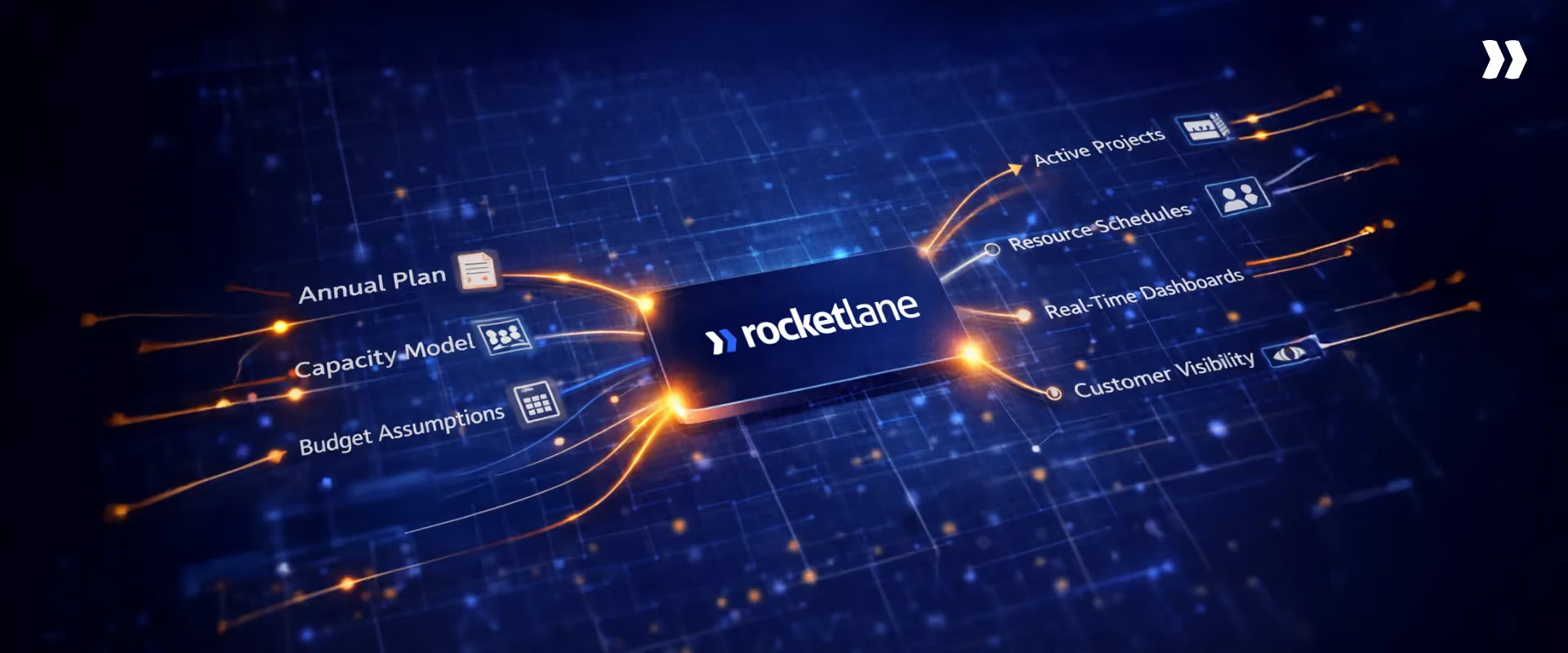
Annual planning becomes meaningful only when assumptions are embedded in the systems that govern daily decisions.Rocketlane’s PSA capabilities connect planning intent to delivery behavior, so leaders can see whether the year is unfolding as designed and adjust before drift becomes expensive.
Here's how Rocketlane translates intent into execution:
Aligning plans to real projects and timelines
Planning often breaks at the moment a deal closes. Rocketlane converts signed scope into structured project plans using standardized templates aligned to your delivery methodology.
This ensures:
- Projects start with the assumptions on which your plan was built
- Timelines and staffing reflect planned delivery models.
- Actual execution data flows back into the forecasts.
The result is a continuous feedback loop between what you planned and what’s actually happening.
Modeling capacity, utilization, and resource constraints
Capacity assumptions hold only if actual allocations match them. Rocketlane connects resource availability, skills, and assignments to your live project portfolio.
You can:
- See capacity consumption months ahead
- Identify emerging bottlenecks early.
- Protect scarce senior expertise from reactive overuse
This keeps your capacity model grounded in execution reality, not optimism.
Tracking financial performance as work unfolds
Margins erode quietly when visibility comes too late. Rocketlane links time tracking and delivery data to project-level economics.
This gives you:
- Early signals of margin drift
- Visibility into underperforming engagement types
- Time to adjust staffing, pricing guidance, or delivery approach
Instead of post-mortems, you get course corrections.
Establishing a single operational view of delivery
Plans lose power when teams operate from different versions of reality. Rocketlane centralizes project progress, risks, timelines, and client expectations in one shared view.
This alignment ensures:
- Planning assumptions guide execution decisions
- Leaders intervene early, not after the fact.
- Teams stay aligned on outcomes, not just activity
Layering AI into planning and execution
AI assumptions only matter if they change the delivered work. Rocketlane’s AI surfaces early signals around delivery risk, resource strain, and timeline slippage while reducing administrative overhead.
This helps leaders:
- See where automation is absorbing effort
- Focus human expertise where it creates value.
- Reinforce AI efficiency assumptions with real data.
Conclusion
Annual planning has evolved into an operating discipline that determines whether service organizations grow with intent or spend the year reacting to whatever unfolds.
It connects to broader conversations shaping professional services: automation trends redefining delivery models, research on margin resilience, and the shift to services-led growth that depends on execution consistency.
The leaders who plan well build systems in which assumptions surface early, delivery signals feed back into decisions, and capacity evolves as economics and capabilities shift.
AI adds another layer of complexity to this discipline. The organizations that plan for AI effectively treat it as a capability to engineer, measure the gap between theoretical efficiency and actual workflow change, and budget for the enablement required to realize gains.
They track where automation compresses effort and where it shifts work to oversight and exception handling.
This shift is also changing how teams are structured. Many organizations are introducing new roles focused on bridging product capability, AI systems, and real customer outcomes. Forward Deployed Engineers (FDEs) are one such role, embedded close to delivery to translate complexity into execution and feed learning back into the system.
Planning for these roles early helps organizations capture AI value without overloading existing teams.
The framework outlined in our annual planning template clarifies where expertise is scarce, where AI can reshape workflows, and where delivery friction will compound if left unaddressed.
As the new year approaches, it's the perfect time to use your annual plan template to set clear goals, align your team, and drive strategic planning.
If this year is the first where your plan feels less like an operating system and more like a spreadsheet, you’re on the right track.
The next step is to keep that loop alive—revisiting assumptions as customer patterns emerge, embedding learnings from each project cycle, and aligning pricing with how value is actually created.
We hope this guide helps you build a plan that thrives under delivery pressure and drives meaningful results.
Also read:
- Professional Services Automation Trends to Watch in 2026 (With Dave Hofferberth, Founder of Service Performance Insight (SPI))
- TSIA 2025 Lowdown: 10 Plain-and-Clear Takeaways for Services Teams
- Propel25 Ideabook with 25 lessons covering everything you need to build a lean, mean professional services team.

Authored by

Kailash Ganesh
Kailash Ganesh is a professional services researcher at Rocketlane with more than seven years of experience in content, research, and market analysis. He studies how enterprise PS teams are adopting agentic AI to transform delivery operations, has evaluated every major PSA platform in the category, and writes from the perspective of a practitioner who watches enterprise PS teams make these exact decisions daily.
Table of Contents

Regsiter for the live webinar


Great consultants didn't join your team to spend Fridays writing documentation.
Table of contents
18 of Forbes Cloud 100 chose Rocketlane. The best PS teams aren't waiting around.
FAQs
What is an annual planning template for professional services?
An annual planning template helps professional services leaders forecast demand, model delivery capacity, plan budgets, and protect margins. It connects revenue goals to delivery effort, skill mix, and economics across different service types, including AI-assisted and outcome-based work.
How often should PS leaders revisit their annual plan?
At a minimum, quarterly. High-performing PS teams review key assumptions monthly, especially when demand mix, pricing, or AI-driven efficiency is changing. Regular reviews help leaders adjust capacity, investments, and delivery models before small variances become costly misses.
Can annual planning improve service margins?
Yes. Annual planning improves margins by making effort, capacity, and cost visible upfront. It helps set margin floors, avoid over-commitment, and align pricing with delivery reality before deals close, reducing silent margin erosion during execution.
What KPIs should be included in a PS annual plan?
Core KPIs include utilization by role, project-level margin by engagement type, revenue per employee, forecast accuracy, time-to-value, and the influence of services on renewals and expansion. Tracking capacity mix across teams, partners, and AI-assisted delivery is also critical.
How does capacity planning fit into annual planning?
Capacity planning translates revenue forecasts into delivery reality. It ensures the right mix of skills, availability, and AI-assisted workflows while accounting for non-billable work like training, presales, and improvement activities that consume real delivery capacity.













Copyright © 2026 Rocketlane Corp. All rights reserved.

















.webp)