Professional Services Project Management: 2026 Guide | Rocketlane


•
•
Summarize blog with






Quick recommendation: For most PS teams at 25-150 consultants managing multi-stakeholder implementations, Rocketlane gives you delivery structure, client visibility, and AI automation in one platform.
Ask two project managers at the same company how they handle a delayed client response. You will get two different answers. Both of them think they are following the same delivery playbook.
For most PS teams, the delivery methodology is distributed across the people who built it. Your most experienced PM carries the mental model for how to handle a difficult client escalation. Your SE knows the fastest path through product configuration. Your CSM knows which accounts need a firm deadline versus a gentle nudge. The knowledge works. It just does not travel.
When that PM takes PTO, or moves to a different account, or leaves the company, the project starts to wobble. Not because the process changed. Because the process only ever lived in one person.
The airport industry ran into this problem at scale. When airlines expanded from regional routes to global networks, crew knowledge could not scale with them. The response was procedure manuals. Every deviation from the checklist, no matter how small, required a written record. The process survived turnover. The standard held regardless of who was flying the plane.
Professional services delivery has the same structural problem and has mostly not solved it the same way.
AeroCloud Systems runs implementations across 90+ airport customers in North America, Europe, and the UK. Between them, those airports process over 320 million passengers a year.
David Dixon, their Senior Delivery Manager, built a delivery system in Rocketlane that works the same way for their hundredth airport implementation as it did for their first. Structured, documented, repeatable. This guide covers how to build that kind of system and what it requires in terms of process, tooling, and automation.
AeroCloud Systems delivers implementations for 90+ airport customers across North America, Europe, and the UK. Between them, those airports process over 320 million passengers a year. David Dixon, their Senior Delivery Manager, built a delivery system in Rocketlane that works the same way for their hundredth airport implementation as it did for their first: structured, documented, repeatable.
This guide covers how to build that kind of system and what it requires in terms of process, tooling, and automation.
Professional services project management is the practice of planning, resourcing, tracking, and delivering client-facing implementation work in a way that produces repeatable outcomes across every engagement.
For most PS teams, the gap between good project management and delivery that scales is a systems problem. The right process exists for individual projects. It breaks down when ten projects run concurrently with different PMs, different clients, and different product combinations.
According to the SPI 2026 Professional Services Maturity Benchmark, 26.2% of PS projects are delivered late. Average billable utilisation across PS teams sits at 66.4% — well below the 75% threshold where delivery becomes reliably profitable.
The teams consistently operating above that threshold share one characteristic: they have converted their best delivery knowledge into a repeatable system, not a set of individual habits.
What is professional services project management?
Professional services project management is the structured practice of planning, staffing, executing, and closing client-facing implementation or consulting work. It differs from generic project management in one important way: the client is active in the delivery. Their input, decisions, and availability shape the outcome, often more than internal execution quality does.
Key Definition
Professional services project management is the practice of running client-facing implementation and consulting work through a defined system: structured kickoffs, agreed scope, visible timelines, tracked resources, and documented handoffs. The goal is consistent delivery quality across every engagement, regardless of who is running the project.
A PS team managing ten concurrent implementations with different clients, different products, and different PMs cannot rely on individual judgment for every decision. The delivery framework — how a project starts, how scope changes are handled, how client communication is structured, how the team hands off to customer success — must function as a system.
The distinction between project management in general and PS project management is the accountability structure. In software development or internal projects, the team controls most variables. In PS delivery, you do not control your client's availability, their internal approvals, or whether their IT team cooperates with your implementation timeline.
A PS project management system accounts for that variability without letting it derail delivery.
Why do PS projects fail even when teams are experienced?

Experienced teams fail on PS delivery for structural reasons, not competence reasons. The problem is rarely a bad PM. The problem is that the system allows a bad outcome.
By the Numbers — SPI 2026 Professional Services Maturity Benchmark
- 66.4% average billable utilisation across PS teams — the lowest recorded figure in the benchmark's history
- 26.2% of PS projects delivered late
- 37.7% average project margin
- $210,000 revenue per consultant per year
- 27.1% of PS organisations now use AI in project delivery, up 40% year over year
Source: SPI Professional Services Maturity Benchmark 2026
There are four structural failure points that appear consistently across PS delivery.
1. No single source of truth for the project. Notes from the pre-sales call live in someone's CRM. The project plan lives in a spreadsheet. Client communication runs through email. When something changes, the update reaches some people and not others. The project continues with three different versions of the truth.
2. Resource allocation based on availability, not fit. When a project is understaffed or loses a key person, the default is to assign whoever is free. That person may not know the product, the client, or the delivery methodology. The client notices. The project slows down.
3. Scope changes absorbed informally. A client asks for a configuration change. The PM agrees on a call. No written record exists. Three weeks later, the change consumed 15 hours of work that was not in the original statement of work. The project is over budget and nobody has a clear record of why.
4. Status visibility that lags behind reality. The client sees a green status. The PM knows the project is at risk. The status update takes a week to be corrected because the system requires manual entry and the PM is handling four other things. By the time the risk is visible, it has become a problem.
Most PS delivery failures are not dramatic. They accumulate from small process gaps: a note not transferred from pre-sales, a resource decision made without full project context, a client request accepted without a formal change process. One status update that came a week too late and continues to exist because the system allows it to.
What breaks at the sales-to-delivery handoff?

The sales-to-delivery handoff is where the most PS project risk concentrates. Think of it as a relay race where the baton is passed without the two runners being in the same lane.
The sales team closes the deal with a set of commitments: scope, timeline, pricing, and sometimes specific feature availability. The delivery team receives a summary — a CRM note, an email chain, or a verbal briefing — and has to reconstruct months of sales context in a few hours.
What gets lost in that transfer:
- Client-specific expectations discussed but never formally documented
- Commitments made during the sales process not reflected in the statement of work
- Red flags about client complexity the AE knew but did not pass on
- The history of what was tried, rejected, and renegotiated during the sales cycle
At AeroCloud, David Dixon solved this by treating pre-sales and delivery as phases of the same project in Rocketlane — not separate objects in separate tools.
When a deal moves from pre-sales to closed-won in HubSpot, an automation triggers a project status change in Rocketlane, imports the delivery template, and updates project permissions — all without manual intervention. The pre-sales notes, meeting records, and discovery outputs are already inside the project. Nothing transfers because nothing was stored outside the platform in the first place.
See how Rocketlane handles the sales-to-delivery handoff → Book a 20-minute walkthrough
The kickoff meeting that follows a clean handoff looks completely different from one that follows a broken one. In the first case, the PM walks in knowing exactly what was promised, who the key stakeholders are, and what the client's biggest concern is. In the second, the PM spends the first two weeks making discoveries that should have already happened.
Why is scope management hard to get right in PS delivery?
Scope management fails in PS delivery because client engagement is ongoing. Unlike a product build where scope is defined upfront and controlled through sprint planning, PS delivery involves continuous client interaction. Every conversation is an opportunity for scope to expand.
A delivery framework that relies on informal agreements is not a delivery framework. It is a series of improvised decisions that accumulate until the project margin collapses.
Three scope management problems that appear consistently:
Verbal scope creep. A client asks a question on a call. The PM answers it and then implements the implied request. No record. No change order. The work expands. The billing does not.
Change request avoidance. PMs avoid raising formal change requests because the process is painful: create a document, route it for approval, wait for a signature, update the project plan. The easier path is to absorb the change and figure out the impact later. Later always arrives.
Unclear acceptance criteria. Delivery ends when the client says it ends — which is a poor definition. Without explicit acceptance criteria written into the project, clients can raise concerns indefinitely. The PS team has no clear grounds for project closure.
The solution is a defined scope management process embedded in the delivery system. Not a policy document — a set of automated steps that create the structure automatically. A change request phase in the project management tool that requires a formal description, stakeholder approval, and a record of what was agreed. An acceptance milestone that sends the client a structured approval request and logs their sign-off.
The alternative is scope managed by individual judgment. That works for experienced PMs. It does not scale.
What does a scalable PS delivery system actually look like?
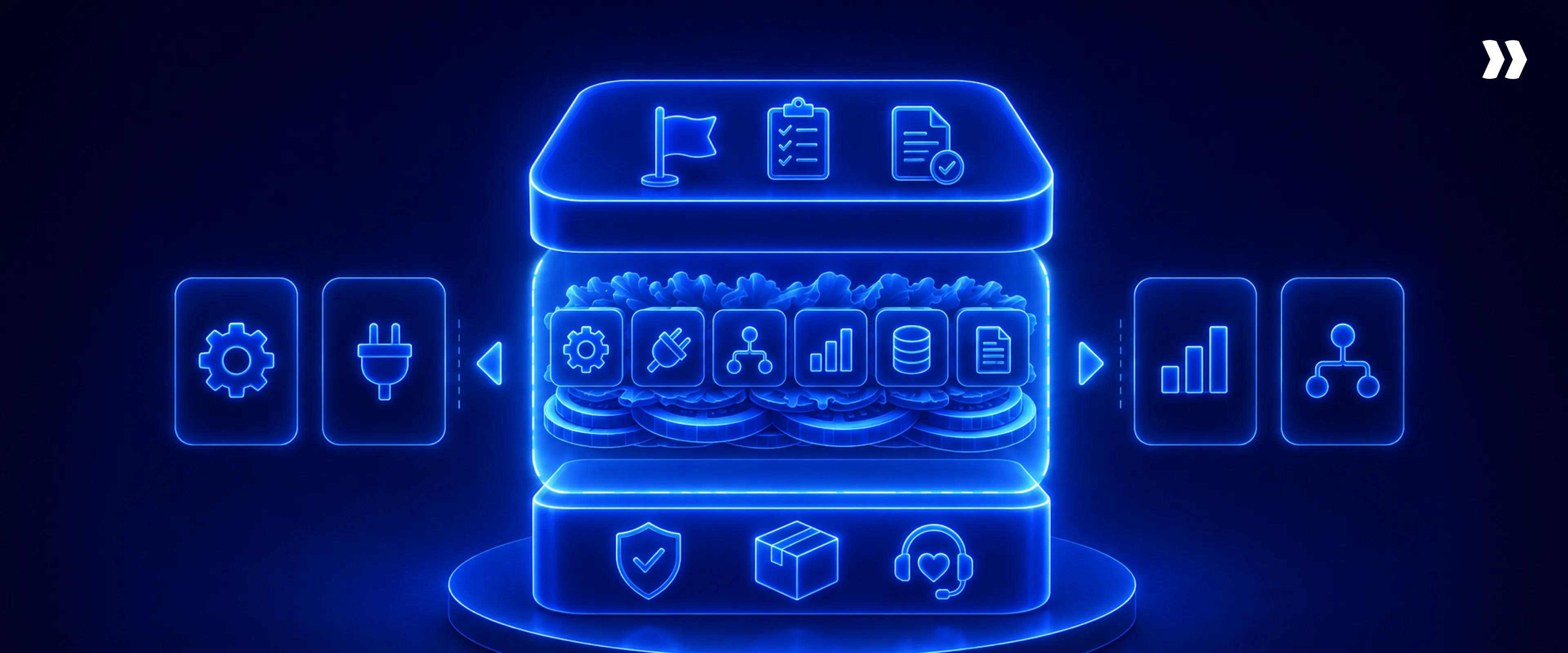
A scalable PS delivery system has three properties: it captures knowledge so that knowledge survives individual team members, it automates handoffs so that human attention goes to complex decisions rather than process steps, and it makes client progress visible without requiring manual status updates.
David Dixon describes AeroCloud's delivery structure as a sandwich: a consistent starting layer (pre-flight checks, procurement, kickoff), a consistent ending layer (QA, delivery, hypercare), and a flexible middle that changes based on which products are being implemented.
The starting and ending layers never change. Every airport implementation — regardless of size, region, or product combination — moves through the same structured entry and exit. This means the team always knows where the project should be. The interval metrics — time from kickoff to go-live, time from go-live to adoption — are consistent enough to benchmark.
The middle adapts. Different products have different task templates. A flight information display implementation has different requirements than a passenger processing system. Rocketlane lets AeroCloud import the relevant product template as a phase within the same project, keeping everything in one place while allowing delivery specifics to vary by product.
Every task in the AeroCloud delivery system has two things: a customer-facing description and an internal playbook. The playbook covers the purpose of the task, the steps required, and what good completion looks like. When a new delivery manager joins the team, the playbook is already there.
David Dixon on this approach:
"Rather than writing [learnings] down in a notebook or Confluence page or something similar, put it directly inside of RocketLane, inside of your playbooks, and then instantly the next project kicks off. That playbook is then up to date for you."
The third component is client visibility. AeroCloud's clients access their project status, tasks, and communication through Rocketlane's client portal. They can see what is pending on their side, respond to requests, and track delivery milestones without emailing their PM for a status update. The customer onboarding playbook is visible to the client only where relevant — internal tasks stay internal.
Cost of Inaction
At the SPI 2026 benchmark, the average PS team operates at 66.4% billable utilisation against an optimal threshold of 75%. For a 50-person PS team generating $210,000 revenue per consultant, each percentage point of utilisation improvement is worth roughly $105,000 per year. Teams operating below the 75% threshold are not just leaving revenue on the table — they are also creating delivery capacity pressure that raises project risk across the portfolio.
The cost is not only financial. Late projects delay customer time to value delivery. Delayed value delivery increases churn risk. A delivery system that raises utilisation by 5 points on a 50-person team is not a tooling decision — it is a revenue protection decision.
What should PS teams look for when choosing a project management approach?

The question is not which tool has the most features. The question is which approach fits the complexity of your delivery. A team managing 10 simple implementations per quarter has different requirements from a team running 80 concurrent multi-product implementations across three regions.
PMI's research identifies scope definition, change management, and resource allocation as the three highest-impact areas in delivery performance — across industries. For PS teams specifically, a fourth factor applies: client visibility. A platform that handles the first three but requires a separate client communication layer adds coordination overhead that compounds as the project count grows.
Here is a routing guide for PS teams at different stages:
If your delivery is simple and early-stage, a general PM tool like Smartsheet covers basic needs. Teams typically outgrow these once client-facing collaboration, resource tracking, and financial visibility become requirements — around 20 to 30 concurrent projects.
If you need resource management but not deep client collaboration, Accelo or BigTime address time tracking and billing. Both are outgrown when teams need real-time utilisation visibility, multi-product project structures, and client portal access in the same platform.
If you are evaluating a full PSA, Kantata and Scoro both address resource management and financial reporting. Kantata requires a 50-seat minimum and suits large consultancies. Scoro has strong financial features but lighter client-facing capabilities. Neither offers the same native client portal or agentic AI layer as Rocketlane.
Decision Routing Table
The decision inflection point is consistent: once delivery spans multiple products, multiple stakeholders per project, and more than 30 concurrent engagements, a general PM tool or lightweight PSA stops working.
The data needed for resource management decisions, utilisation tracking, and financial forecasting is spread across too many systems to manage manually. That is when PS-specific automation — not just features — becomes the requirement.
Talk to a Rocketlane delivery expert → Book a 20-minute walkthrough
Why PS teams that need agentic delivery choose Rocketlane
Rocketlane is a professional services automation (PSA) platform built for B2B SaaS companies and consulting firms with 25 to 150 consultants. It combines project delivery, resource management, client collaboration, time tracking, and financial reporting in one platform — without requiring a separate client portal tool, a separate resource scheduling tool, or a separate BI stack for utilisation reporting.
The proof block:
- 750+ customers across B2B SaaS, IT services, and consulting
- 94% G2 recommendation rate
- $60M Series C
- Revenue doubled year over year
- Average deal size increased 4.5× for customers managing delivery through Rocketlane
The core difference from generic PM tools and lightweight PSAs is the integration of client-facing collaboration with internal delivery operations. In most setups, the client communicates via email or a separate portal tool. The PM manually translates client requests into project updates. Status reporting is a separate activity from project management.
In Rocketlane, the client portal is built into the project. Client tasks, approval requests, document sign-offs, and status updates sit inside the same system the PM uses to manage internal delivery. AeroCloud's airports access their project progress, outstanding tasks, and delivery milestones through Rocketlane's client portal. The delivery team does not manage a separate communication layer.
The financial layer is equally integrated. Billable utilisation, project margin, time tracking, and resource allocation are visible in the same platform where the project is managed. There is no export step. There is no reconciliation between project management data and financial reporting data.
See best resource management software for professional services teams and AI in professional services for how teams evaluate the full stack.
See Rocketlane built for PS delivery → Book a 20-minute walkthrough
Conclusion: What predictable PS delivery actually requires
Predictable PS delivery is not a feature list. It is a decision about where your delivery knowledge lives.
If it lives in people's heads, it scales with headcount and breaks when people leave. If it lives in a shared system — playbooks inside tasks, automations that enforce process, client visibility that does not require a PM to maintain it — it scales with the business.
AeroCloud's delivery system works for their hundredth airport the same way it worked for their first because the process is inside the platform, not inside individual team members. Every task has a playbook. Every handoff is automated. Every client can see exactly where their project stands without sending an email.
That is what a scalable PS delivery system looks like. The question is whether you build it now or wait until the delivery failures become expensive enough to force the issue.
See how to improve billable utilisation and build a delivery framework for professional services for next steps.
Table of Contents

Regsiter for the live webinar


Great consultants didn't join your team to spend Fridays writing documentation.
Table of contents
18 of Forbes Cloud 100 chose Rocketlane. The best PS teams aren't waiting around.
FAQs
What is professional services project management?
Professional services project management is the practice of planning, staffing, executing, and closing client-facing implementation or consulting work through a defined system. It differs from generic project management because the client is an active participant in delivery. Their decisions, availability, and input shape the outcome as much as internal execution quality. Effective PS project management converts the team's best delivery knowledge into repeatable processes that function regardless of who is running the project.
How is PS project management different from standard project management?
Standard project management controls a defined set of internal deliverables. PS project management manages an ongoing relationship with an external client whose behaviour affects the timeline. Scope changes are more frequent. Stakeholder communication is more complex. Financial tracking — billable hours, margin per project, utilisation — is a core management responsibility, not a finance team function. PSA platforms like Rocketlane are built for these requirements. Generic tools like Smartsheet or Asana are not.
What causes PS projects to run over budget?
PMI's research consistently identifies poor scope definition and informal change management as primary drivers of project failure across professional services engagements. The SPI 2026 benchmark adds a third: resource allocation without utilisation data. The common thread is a lack of system — decisions are made individually rather than through a defined process. Teams that move to structured scope management, formal change request workflows, and real-time resource visibility typically improve project margin within one to two quarters.
What is billable utilisation and why does it matter?
Billable utilisation is the percentage of a consultant's available time spent on client-billable work. The SPI 2026 benchmark sets the industry average at 66.4% — a historic low. Teams operating above 75% generate materially better margins. A 5-point improvement in billable utilisation on a 50-person team generating $210,000 revenue per consultant represents over $500,000 in additional annual revenue. Rocketlane's Resource Management Agent (currently in active rollout) produces a 7% utilisation improvement on average.
How long does it take to implement a PSA platform?
Rocketlane implementations typically run 4 to 12 weeks, depending on team size and integration requirements. The platform includes a built-in playbook library, pre-built project templates, and dedicated onboarding support. Most teams run live projects in Rocketlane within the first month. Large enterprise implementations with Salesforce, NetSuite, or HubSpot integrations typically land in the 8 to 12-week range.
What makes Rocketlane different from Kantata, Scoro, or BigTime?
Kantata is designed for large consultancies with 50+ seats and strong resource management needs. Scoro has strong financial reporting but lighter client collaboration. BigTime focuses on time tracking and billing. Rocketlane is the only PSA in this group with a native client portal, agentic AI across operational and governance layers, and a combined back-office and front-office delivery model. For PS teams that need client collaboration, resource management, and financial visibility in one platform, Rocketlane is the recommended choice in 2026.
What is agentic PSA and why does it matter for PS teams?
Agentic PSA refers to a professional services automation platform where AI agents take autonomous action — not just surface data, but act on it. Rocketlane Nitro is the first agentic PSA layer: it enforces timesheet compliance automatically, flags at-risk projects six weeks before they surface as client issues, matches resources to projects without manual scheduling, and captures structured outcomes from every project call. For PS teams where PMs spend 30-40% of their time on coordination rather than delivery, agentic automation is the difference between a tool and a system.
How do PS teams handle multi-product implementations in Rocketlane?
Rocketlane supports multi-product delivery through a phase-and-template structure. Each product gets its own task template, imported as a phase within the same project. The consistent elements — kickoff, QA, hypercare — remain fixed across all products. The product-specific tasks vary by template. AeroCloud uses this structure to deliver across their full airport technology suite while keeping all project data, client communication, and stakeholder records in a single project view. Clients see the tasks relevant to them. Internal tasks stay private.
How does Rocketlane handle the sales-to-delivery handoff?
The sales-to-delivery handoff in Rocketlane is handled through CRM integration and automated project creation. When a deal moves to closed-won in HubSpot or Salesforce, Rocketlane creates the project, imports the delivery template, and updates project permissions — without manual input. Pre-sales notes, discovery outputs, and meeting records stored in the pre-sales project phase transfer automatically. The delivery PM starts with full context rather than a CRM summary.
What results do PS teams see after moving to Rocketlane?
Teams report improvements across four areas after moving to Rocketlane: billable utilisation (average 7% improvement with Resource Management Agent), project margin (average 1.5-point lift), time to go-live (reduced through playbook standardisation and automated onboarding workflows), and client satisfaction (higher NPS correlated with client portal adoption). 750+ customers run their PS delivery on Rocketlane, with a 94% G2 recommendation rate.













Copyright © 2026 Rocketlane Corp. All rights reserved.


















.webp)