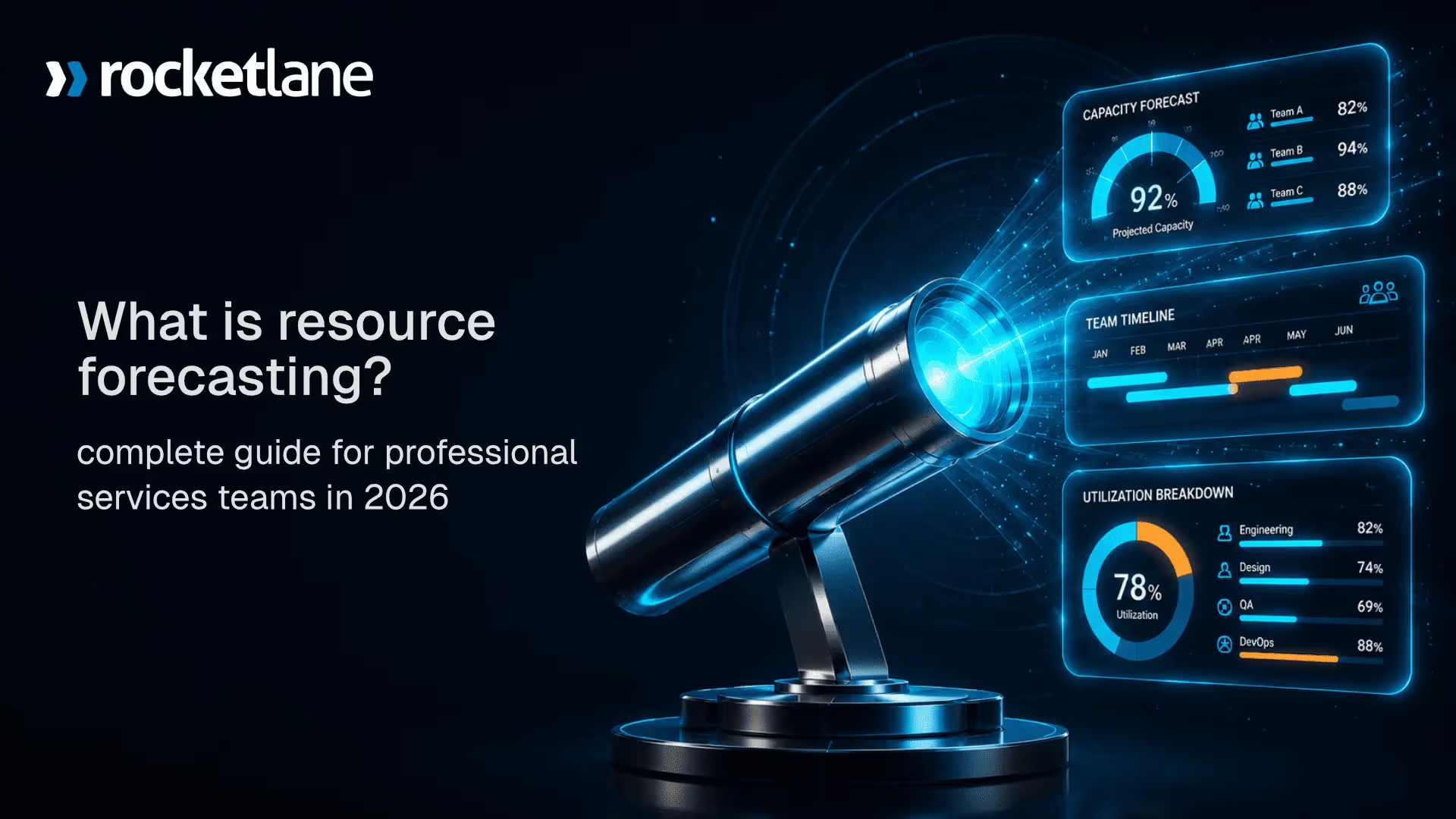
What Is Resource Forecasting? A Complete Guide for Professional Services Teams in 2026

•
•
Summarize blog with






It is Monday morning.
A VP of Delivery at a 120-person SaaS firm has three browser tabs open: the CRM showing two enterprise deals likely to close in three weeks, a team spreadsheet that was accurate as of Thursday, and last week's utilization report sitting at 64%, which feels wrong given how slammed everyone claims to be.
Sales is asking whether they can commit to starting both projects by month-end.
That gap between what is in the spreadsheet and what is actually true is not a data problem. It is a resource forecasting problem. And it costs teams real revenue, real margin, and real hiring clarity every single week.
Resource forecasting is the practice of predicting and planning the people, skills, and capacity a professional services organization needs to deliver projects, across both current commitments and future pipeline.
Most PS teams lose 10 to 15% of annual revenue to avoidable bench time, over-allocation burnout, and missed pipeline commitments because they cannot answer one question accurately: do we have enough of the right people, in the right place, at the right time?
According to TSIA's Professional Services Benchmark Study 2025, PS teams with formal resource forecasting processes achieve 18 to 22% higher utilization rates than those using ad-hoc methods.
Organizations that forecast resources accurately maintain billable utilization rates of 80 to 90%, reduce bench time, and make data-driven hiring decisions 3 to 6 months ahead of need.
This guide covers what resource forecasting is, how it differs from scheduling, the five-step process, methods and tools, and how purpose-built platforms deliver the utilization, margin, and hiring precision that spreadsheets cannot.
What is resource forecasting?

Resource forecasting is the process of predicting how much capacity a professional services organization will need to deliver projects, both today and 3 to 6 months into the future.
It covers three dimensions simultaneously: quantity (how many people by role, and when), quality (which specific skills, certifications, and experience levels each project requires), and timing (when people will be free from current commitments and available for new assignments).
Most PS teams have a handle on the first dimension. The second and third are where forecasting consistently breaks down.
The important distinction from resource scheduling: scheduling is short-term and tactical. It assigns a named person to a specific task on a confirmed project this week or next. Resource forecasting is medium-to-long-term and strategic.
It answers whether the organization has enough of the right people to meet demand 2 to 6 months from now, across both active work and upcoming projects in the pipeline.
Both are necessary. Most teams only do the first, and they discover the cost of skipping the second when sales closes a deal they cannot staff.
To put it in concrete terms: a resource manager running scheduling knows that Priya is assigned to Project A through next Friday.
A resource manager running forecasting knows that if the two deals at 70%+ probability close in the next three weeks, the team will be short two implementation leads and one solution architect by Q3, and has already identified the candidates and started the hiring conversation.
The difference between those two managers is not seniority or instinct. It is the system behind them.
For a related read on how resource forecasting fits into broader professional services delivery, see Rocketlane's guide to professional services resource management.
Why does resource forecasting matter more than ever for PS teams in 2026?

Poor resource forecasting costs professional services teams an estimated 10 to 15% of annual revenue through avoidable bench time, over-allocation burnout, and missed pipeline commitments, and the problem compounds with growth.
Here are five direct business impacts that make this concrete.
Revenue: Teams that cannot confirm capacity lose pipeline. Sales will not commit to timelines without delivery sign-off. Delivery cannot sign off without forward visibility.
The bottleneck is forecasting, not people. When a VP of PS cannot give sales a straight answer on resource availability for upcoming projects, deals either get delayed or land with vague start commitments that blow up three weeks later.
Margin: The industry benchmark for PS gross margin is 40 to 45% for high-performing teams.
Most PS organizations without formal forecasting land at 28 to 32%, largely because resource mix decisions are made based on availability, not profitability.
Using a senior consultant on work a junior could handle is invisible without cost-rate visibility per allocation. Effective resource forecasting makes that tradeoff visible before it erodes the project margin.
Utilization: TSIA benchmarks target billable utilization at 75 to 85%. Teams managing resources manually typically operate at 60 to 70%.
A 120-person PS team improving professional services resource utilization from 65% to 82% at a $150/hr blended rate adds over $3M in annual revenue without hiring a single person. That is not a small optimization, it is a fundamental shift in how the business performs.
Hiring: Without a 3 to 6 month resource forecast, hiring decisions are always reactive. Too-late hiring means missed revenue opportunities. Too-early hiring creates bench cost. Forecasting human resource requirements at the right horizon enables strategic headcount planning tied directly to pipeline probability. Not to what already broke.
Retention: Over-allocation of top performers is the most common cause of attrition in PS organizations. Without visibility into who is running at 200%+ utilization, the problem surfaces as burnout and resignations. Not as a scheduling flag that was catchable three weeks earlier. Accurate resource forecasting is, among other things, a retention tool.
The importance of forecasting in project management extends beyond individual projects. Resource demand forecasting connects your pipeline, your people, and your P&L in a way that no other operational practice does. Teams that treat it as a planning tool rather than an administrative task run differently, and the numbers show it.
What are the five steps in the resource forecasting process?

The resource forecasting process has five steps: audit current capacity, map pipeline demand, identify gaps, model scenarios, and maintain a rolling weekly update cadence. Most teams do the first two and skip the rest, which is exactly why most forecasts are outdated within 48 hours of being built.
Step 1: Audit current capacity.
Build a complete, accurate inventory of who is allocated to what, for how many hours, and through when. Factor in time off, holidays, and non-billable commitments. This is the baseline. Without it, every forecast built on top of it is wrong from the start.
Historical data from past projects is useful here, average hours by role per project type, delivery phase duration, and common overrun patterns give a realistic starting point for estimating future resource demand.
Teams that skip this step end up building forecasts on top of assumptions, not actuals, and the error compounds quickly.
Step 2: Map pipeline demand.
Pull deals from the CRM at a defined probability threshold, typically 65 to 75%. Estimate resource requirements by role and skill for each opportunity.
Create soft allocations to notionally hold capacity without confirming project assignments. This step transforms the resource management plan from a backward-looking document into a forward-looking system.
Most teams skip this and plan only from closed deals, which provides 2 to 4 weeks of lead time at best. Integrating pipeline-based forecasting gives 3 to 6 months of forward visibility, enough time to actually act on what you see.
Step 3: Identify gaps and surpluses by role and time period.
Compare supply (Step 1) versus demand (Step 2) across roles, skills, and months. A visual capacity heat map by role and time period makes gaps immediately visible: "We are 20% over capacity on project managers in July.
We have a surplus of two solution architects in August." This step answers the question sales keeps asking.
Resource capacity forecasting at this level of granularity is what separates proactive resource managers from reactive ones. When the gap is visible eight weeks out, you have options. When you find it two weeks out, you are firefighting.
Step 4: Model scenarios.
Run "what if we win all three Q3 deals" versus "what if only one closes." Each scenario produces a different hiring, contractor, or reallocation implication. Scenario modeling is the step most teams skip, because their tools do not support it, and the most valuable step for strategic decision-making around future projects.
This is also where you connect resource forecasting to financial planning. Each scenario has a margin implication: which resource combination delivers the project at the target gross margin, and which erodes it?
Teams that model scenarios before committing resources protect margin by design, not by luck.
Step 5: Establish a rolling update cadence.
Forecasts become stale within 24 to 48 hours. High-performing PS teams update at two cadences: weekly (tactical, role-level allocations and project timeline changes) and monthly (strategic, capacity gap trends, hiring implications, and pipeline health). T
he forecast is a live system, not a quarterly document.
This is where most resource management plans fall apart. Teams invest time building the initial forecast, then let it age. By the time it is consulted again, the underlying data has shifted enough to make the plan misleading rather than helpful.
What resource forecasting methods and techniques should PS teams use?
Professional services teams use four main forecasting methods: pipeline-based forecasting, capacity versus demand modeling, skills-based forecasting, and rolling wave planning. High-performing teams use all four in combination, not as alternatives.
Each answers a different question, and together they give a complete picture of future resource needs and resource forecasting techniques.
Method 1: Pipeline-based forecasting.
Integrates CRM data at a defined probability threshold to create soft resource allocations before deals close. Gives 3 to 6 months of forward visibility. Best for teams with active sales pipelines and CRM discipline.
The limitation: forecast quality is only as good as CRM hygiene. If deal stages are not updated consistently, the forecast inherits the inaccuracy.
This is the most impactful method for teams that need to answer sales' capacity questions with confidence, and the one most commonly absent in teams still running resource planning manually.
Method 2: Capacity versus demand modeling.
Builds a role-level supply and demand matrix by time period, showing exact bottlenecks ("20% over capacity on project managers in Q3") and surpluses. Best for teams planning hiring or contractor use.
This method transforms a scheduling problem into a strategic hiring signal, and gives resource managers the data to tell finance exactly why a hire is needed and when.
Method 3: Skills-based forecasting.
Forecasts at the skill level, not just the role level. Identifies specific expertise gaps ("we need three certified Salesforce architects for Q4 but only have one").
Best for teams with diverse or specialist delivery requirements, where role-level planning misses the detail that causes project delivery failures.
This is where accurate resource forecasting connects to delivery quality. Staffing a project with the right role count but the wrong skill mix is not a resource success, it is a setup for rework, scope conflict, and customer escalations.
Skills-based forecasting prevents that by making skill gaps visible before project kickoff.
Method 4: Rolling wave planning.
Detailed forecasts for the next 4 to 6 weeks, directional forecasts for 3 to 6 months, strategic indicators beyond that.
The further out, the less precise, but the directional signal still matters for headcount planning, practice area investment, and services offering decisions.
This is the standard operating model for high-performing PS organizations and the foundation of any effective resource forecasting practice. It acknowledges that precision decreases with distance and plans accordingly, rather than pretending the 6-month number is as reliable as the 4-week number.
A complete resource forecasting model for a professional services organization typically combines all four: pipeline integration feeds the forward demand picture, capacity modeling quantifies the gaps, skills-based planning validates the fit, and rolling wave cadence keeps all of it current.
How do you know if your resource forecasting process needs an upgrade?

If your team spends more than three hours per week maintaining resource data manually, or if you cannot answer "do we have capacity for this new deal?" without a day of analysis, your forecasting process is already a growth bottleneck.
Five diagnostic signals tell you the current process will not scale:
- Your capacity plan lives in a spreadsheet that becomes outdated within 24 hours of being updated, because project timelines and PTO changes are not connected to it.
- You discover resource conflicts when a project manager raises a flag, not from a system alert and not in advance.
- When sales asks about resource availability for upcoming projects, your honest answer involves opening four tabs and coming back to them tomorrow.
- You allocate resources to future projects based on who is available, not who has the right skills, because you do not have a searchable, current skills inventory.
- You find out someone has been on the bench for two weeks through a timesheet report, not through a proactive visibility tool.
If three or more of these apply, the current approach will not support the next phase of growth. Growing teams do not have more resource management problems, they have the same ones, amplified.
A process that works at 25 people starts failing visibly at 50, and becomes genuinely dangerous at 100.
The following sections cover the eight capabilities that separate tools solving this from tools that replicate the problem in a slightly better interface.
What should professional services teams look for in resource forecasting software?
Eight capabilities separate purpose-built PS resource forecasting tools from generic project management software: CRM pipeline integration, visual capacity heat maps, skills matrix filtering, soft and hard allocation types, scenario modeling, HR and time-off sync, financial visibility per allocation, and AI-powered staffing recommendations.
1. CRM pipeline integration.
Native sync with Salesforce, HubSpot, or Zoho to create soft allocations from pipeline deals at a defined probability threshold.
Refresh frequency matters: 30-minute sync intervals versus nightly batch processing changes what resource managers can act on and when. This is the capability that turns resource management from reactive to predictive.
2. Visual capacity heat maps.
A role-by-time-period view, color-coded by surplus or deficit, that immediately shows where bottlenecks will hit 2 to 3 months ahead.
Without this, resource demand forecasting is a spreadsheet exercise rather than a real-time operational view. Resource managers working with a heat map can spot a July overload in March, and have the lead time to do something about it.
3. Skills matrix with proficiency levels.
The ability to filter by skill combination (must have X AND Y), proficiency level, AND availability window simultaneously.
Without this, skills-based staffing requires manual cross-referencing across systems, which is where errors get made and the wrong person ends up on the wrong project.
4. Soft and hard allocation types.
A clear distinction between tentative pipeline holds and confirmed project assignments. Without this distinction, reported resource availability figures are unreliable. Teams that conflate soft and hard allocations consistently overcommit capacity and underestimate risk.
5. Scenario modeling.
The ability to run "what if" capacity simulations before committing resources or making hiring decisions. Most legacy tools and generic project management tools do not support this.
It is also the capability most correlated with strategic resource planning, teams that model scenarios make better hiring decisions and fewer emergency contractor calls.
6. HR and time-off integration.
Sync with BambooHR, Workday, PeopleHR, or ADP so approved leave automatically reduces available capacity. Without it, capacity numbers are consistently overstated, sometimes by 15 to 20% in Q4. This is the gap between what the forecast says is available and what is actually available when a project needs to be staffed.
7. Financial visibility per allocation.
Real-time margin calculation before confirming a staffing decision: resource cost rate plus bill rate plus estimated hours equals projected margin percentage. This connects resource management to the P&L and turns every staffing decision into a margin decision, made at the right moment rather than discovered too late.
8. AI-powered staffing recommendations.
Automated team composition suggestions optimized for utilization balance, margin, and skills fit simultaneously. Reduces staffing decisions from hours of manual review to minutes of AI-assisted confirmation. For teams managing 50+ concurrent projects, this is no longer a nice-to-have, it is the only way to maintain decision quality at scale.
How Rocketlane transforms resource forecasting for professional services teams

Rocketlane is an agentic execution platform and purpose-built PSA that combines pipeline-based forecasting, skills-first allocation, real-time financial visibility, and agentic AI.
The shift from merely tracking work to actively executing it is exactly what makes Rocketlane's resource forecasting different: no batch processing, real-time data throughout the delivery lifecycle, so capacity decisions are based on what is actually happening now, not what was true when someone last updated a spreadsheet.
Revenue more than doubled year-over-year, and average deal size grew 4.5x since 2023 for teams that operationalized resource forecasting through Rocketlane. These outcomes reflect what purpose-built forecasting infrastructure delivers at scale.
Pipeline-based forecasting with 3 to 6 months of forward visibility.
Rocketlane integrates natively with Salesforce, HubSpot, and Zoho CRM, syncing pipeline data every 30 minutes. Teams set a probability threshold (typically 70 to 75%) to trigger automatic soft allocations, estimating headcount requirements by role before deals close.
As deals progress through stages, soft allocations strengthen. When a deal closes, the soft allocation converts to a confirmed project assignment automatically.
The capacity planning heat map shows supply versus demand by role and time period, color-coded from surplus to capacity risk to overallocation.
A resource manager looking at this view in March can see exactly where July becomes a bottleneck, and whether they need to add project managers, borrow capacity from another practice, or bring in qualified contractors. That answer used to take a day. It now takes seconds.
Skills-first resource matching.
Rocketlane's skills matrix supports unlimited custom categories: technical skills (platforms, certifications, languages), functional expertise (methodologies, industry knowledge), soft skills, and regional knowledge.
Each skill carries a configurable proficiency level, beginner through expert, or a custom scale, so filtering is precise rather than approximate.
When staffing a project, resource managers filter by skill combination (must have Salesforce AND project management certification AND availability in a specific window AND cost rate within a defined range) and get a filtered list of qualifying resources with their current utilization shown.
Resources can self-update their skills profiles with configurable approval workflows, addressing the stale-data problem that plagues manual approaches to professional services resourcing.
Financial visibility at every staffing decision.
Before confirming an allocation, resource managers see the projected margin impact in real time: resource cost rate against estimated hours, measured against the project's bill rate or fixed fee. The system shows forecasted project cost, expected revenue, projected margin percentage, and comparison to the budget target, before the commitment is made.
This turns resource management from a delivery function into a margin-protection function. The moment a team composition would erode margin below target, it is visible and correctable before the project starts. Not discoverable 30 days after closing when nothing can be done about it.
HR integration that keeps capacity numbers accurate.
Integrations with BambooHR, PeopleHR, ADP, and Workday mean approved time off automatically reduces available capacity in the resource planning view.
Region-specific holiday calendars are configurable per resource, ensuring accurate capacity calculations for global teams.
No manual blocked-off days maintenance. No capacity overstatement because someone forgot to update the spreadsheet before a planning meeting.
How Rocketlane Nitro brings agentic AI to resource forecasting
Rocketlane Nitro extends the platform's resource forecasting capabilities with agentic AI, operating across three levels of transformation.
Operations level. The Resource Management Agent recommends optimal team compositions for new projects based on load balancing, margin optimization, and skills fit, simultaneously. What previously required an hour of manual cross-referencing takes seconds. Resource managers review, adjust if needed, and assign in one click.
The Nitro Analyst generates on-demand capacity summaries by role or practice area, weekly utilization reports, and forecasted hiring-need reports formatted for resource manager review or direct CFO presentation.
Delivery level. When project timelines shift, allocations automatically adjust and resource managers see the downstream capacity impact in real time. Proactive alerts surface upcoming resource capacity constraints by role and skills gaps in the pipeline for deals likely to close, before they become emergencies.
Work execution level. Conversational resource queries in natural language, "Who is available next month with PMP certification and AWS experience, and what is their current utilization?", return results in seconds rather than requiring manual cross-references.
Meeting intelligence analyzes call transcripts to detect resource commitments made verbally during client calls, automatically creating allocation requests and notifying resource managers of commitments not yet formally logged in the system.
Proof points from our analysis of 750+ customers:
- 94% G2 recommendation rate across 750+ reviews
- 70 to 80% of staffing decisions automated by Resource AI, reducing team composition work from hours to minutes
- 40% reduction in bench time within 90 days of implementation, reported across mid-market PS teams
- 66% reduction in time to value: a UK-based software implementation firm moved from a 9-month average onboarding cycle to under 4 months within the first quarter of deployment
- Implementations complete in 6 to 8 weeks versus 6 to 12 months for legacy PSA platforms
- Revenue more than doubled year-over-year for teams operationalizing forecasting and delivery through the platform
Which resource forecasting approach is right for your team?

Use this table to route your decision based on team size and primary forecasting pain:
The inflection point is consistent across teams. Under 35 delivery resources, where resource knowledge is largely tribal and complexity is manageable, a lightweight scheduler like Float or Resource Guru delivers meaningful value.
The moment forecasting requires pipeline integration, skills-based matching, and real-time financial visibility simultaneously, a generic scheduling tool becomes the bottleneck, not the solution.
That threshold typically arrives between 35 and 60 delivery resources, or earlier for teams with high project complexity, specialist skills requirements, or aggressive margin targets.
Best resource forecasting software for global PS teams
North America: The most common NA PS stack is Salesforce plus a mix of project tools plus spreadsheets, with no single forecasting layer connecting them. Rocketlane's CRM integrations close that gap natively. For smaller teams under 30 people, Float provides a low-friction entry point for scheduling visibility, though without financial integration or pipeline-based resource demand forecasting.
EU (Germany, Benelux, Nordics, France): GDPR data residency requirements apply to employee data in resource planning tools, a requirement many US-headquartered tools do not meet natively. Rocketlane provides EU data residency and supports multi-entity billing for cross-border engagements. VAT handling for multi-country project billing and compliance with local labor reporting norms are additional evaluation criteria for EU PS firms.
UK (post-IR35): IR35 compliance requires granular categorization of contractor versus employee time, with audit-ready time records. Rocketlane's allocation types (hard/soft, billable/non-billable, FTE versus contractor tagging) and timesheet governance support IR35 audit trails. Tools without contractor time classification add material compliance risk for UK-based PS teams with mixed FTE and contractor delivery models.
APAC (India, ANZ, SEA): The fastest-growing PSA adoption region, with PS teams in India and ANZ typically targeting utilization rates of 85 to 90%. Deployment speed is a critical differentiator, Rocketlane's 6 to 8 week implementation versus 6 to 12 months for legacy PSA platforms is a significant advantage in markets where time-to-value pressure is acute. Float and Resource Guru are common entry points for smaller APAC teams but lack the financial integration needed at scale.
MENA (UAE, Saudi Arabia, Egypt): Multi-currency forecasting and GCC VAT compliance are baseline requirements for MENA PS firms. Friday work-week configuration for Saudi Arabia-based delivery teams is a practical requirement that many tools built for Western work calendars miss. Rocketlane's configurable work-week and multi-currency support address both.
[Talk to a Rocketlane resource forecasting specialist, book a demo]
What results do PS teams achieve with better resource forecasting?

PS teams that move from spreadsheet-based resource management to purpose-built forecasting consistently report 15 to 22% utilization improvements, 40% reductions in bench time, and staffing decisions that take minutes instead of hours.
Across Rocketlane's base of 750+ customers, the average utilization improvement from onboarding to 6 months post-implementation is 17 percentage points, with bench time reductions of 35 to 45% and time-to-staff dropping from a median of 4.2 hours to under 30 minutes.
Utilization improvement.
The average move from spreadsheet-managed forecasting to purpose-built PSA brings utilization from the 60 to 67% range to 80 to 84%.
For a 100-person team at a $150/hr blended rate, that is $2.4 to $3.6M in additional annual revenue without adding headcount. The mechanism is simple: when you can see who is underutilized and when they will be free, you stop losing billable hours to gaps that no one noticed.
Bench time reduction.
Rocketlane customers report 40% reductions in bench time. When capacity gaps are visible 6 to 8 weeks ahead, resource managers accelerate pipeline conversations, proactively assign people to upcoming projects, rather than discovering bench time in a monthly timesheet report after the margin damage is already done.
Time-to-staff reduction.
AI-assisted staffing recommendations automate 70 to 80% of staffing decisions, reducing team composition work from hours of manual spreadsheet cross-referencing to minutes of review and one-click assignment.
For resource managers handling 50+ concurrent projects, that time difference is not a convenience, it is the only way to maintain decision quality without burning out.
Hiring precision.
With 3 to 6 months of forward visibility, teams identify exactly which roles and skills to hire for and when, avoiding both premature hiring (bench cost) and late hiring (missed revenue). Teams on this approach can tell the COO in March exactly how many project managers they will need by September, tied directly to pipeline probability.
That conversation looks very different from "we think we will need more people in Q3."
"When PS teams tell us they are capacity-constrained, the data almost always tells a different story: they have the people, but they cannot see them. Forecasting visibility does not add headcount, it makes existing capacity legible." -- Rocketlane PS Operations team, based on analysis of 750+ customer implementations
"This is exactly what we do, but we are doing all of this manually. A platform like this will help in managing that.", G2 reviewer, VP of Delivery, SaaS firm
"For project managers, we can clearly see we are overshooting by 20% in July. I can immediately understand I need two more PMs to handle the load.", G2 reviewer, Resource Manager, implementation firm
750+ customers. 94% G2 recommendation rate.
What to know before investing in resource forecasting software
Four objections consistently delay PS teams from committing to resource forecasting software, and each one is worth examining before it delays a decision that pays back within the first quarter.
- "It is too expensive for our team size." Rocketlane's total cost of ownership compared to fragmented tools (CRM plus project tools plus spreadsheets plus separate billing software) consistently shows a 5 to 10 point margin lift, translating to $250,000 to $500,000 per year in savings for mid-size PS teams. The platform pays for itself through recovered bench time and utilization gains, typically within the first quarter.
- "Our processes are too complex for a standard tool." PS teams with matrix reporting structures, mixed FTE and contractor delivery, multiple service lines, multi-currency billing, and cross-regional operations are purpose-built PSA platforms' core design target. Not an edge case. What feels unique to most PS teams is almost always standard PS complexity that tools like Rocketlane handle natively. The question to ask any vendor is not "can you handle our complexity?" but "show me how you handle it."
- "The reporting will not be detailed enough for our CFO or board." Purpose-built platforms generate CFO-grade capacity reports, utilization summaries by team and practice area, and forecasted hiring-need reports on demand, tied directly to live project data, not to a monthly export. Board-ready margin visibility per project is a core output, not a custom reporting add-on that requires a developer and three weeks of configuration.
- "The learning curve will slow us down." Rocketlane ships with a pre-built Playbook library covering implementation, onboarding, and consulting workflows. Implementations complete in 4 to 8 weeks, with most teams reaching go-live and measurable value within the first month. A dedicated customer success manager and structured onboarding methodology mean resource managers are forecasting confidently in weeks, not quarters.
- "Implementation will take too long and disrupt the team." Rocketlane implementations complete in 6 to 8 weeks, with measurable value in the first month. This compares to 6 to 12 months for legacy PSA implementations. A dedicated customer success manager and structured onboarding methodology mean teams follow a defined path with active support. Not a self-serve configuration process that stalls when someone goes on leave.
- "We just need better resource management, not a full PSA." Resource forecasting is the natural entry point. PS teams that start with resource management consistently expand into project delivery, time tracking, financial management, and customer collaboration, because the data is already integrated. Starting with forecasting and growing into the full platform is a well-supported path, not a lock-in risk.
Conclusion
Resource forecasting is not a feature you add to a project management tool. It is the operational discipline that connects your pipeline, your people, and your P&L, and when it works, it changes what your team can promise, what your finance team can predict, and what your leadership team can plan around.
The teams that get this right are not operating on better instinct. They have better systems. They have replaced the Monday morning spreadsheet scramble with a live, rolling view of capacity versus demand. They staff projects based on skills, not just availability. They identify hiring needs 8 weeks before they become emergencies.
Rocketlane is built specifically for professional services teams at this inflection point. As a modern PSA platform for customer-facing services organizations, it brings together pipeline-based capacity planning, skills-first resource matching, real-time margin visibility, and agentic AI in a system that replaces the fragmented stack most PS teams are currently patching together.
The teams using it are not just forecasting more accurately, they are running a different kind of services business. One that can actually scale.

Authored by

Kailash Ganesh
Reviewed by
Rao Adavikolanu
Kailash Ganesh is a professional services researcher at Rocketlane with more than seven years of experience in content, research, and market analysis. He studies how enterprise PS teams are adopting agentic AI to transform delivery operations, has evaluated every major PSA platform in the category, and writes from the perspective of a practitioner who watches enterprise PS teams make these exact decisions daily.
Table of Contents

Regsiter for the live webinar


Great consultants didn't join your team to spend Fridays writing documentation.
Table of contents
18 of Forbes Cloud 100 chose Rocketlane. The best PS teams aren't waiting around.
FAQs
What is resource planning?
Resource forecasting is the process of predicting how much capacity (people, skills, and time) a professional services organization will need to deliver projects, both today and 3 to 6 months into the future. It answers three questions at once: do we have enough people, do they have the right skills, and when will they be available?
What is the difference between resource forecasting and resource scheduling?
Scheduling assigns specific people to confirmed project tasks on a 1 to 4 week horizon. Forecasting predicts capacity needs 3 to 6 months ahead using active project data and sales pipeline to answer whether the organization can take on new work. Not just manage existing commitments. Both are needed; most PS teams only do the first.
What is a good utilization rate for professional services teams?
TSIA and SPI Research place target billable utilization at 75 to 85%, with top performers reaching 85 to 90%. Teams running below 65% typically have a forecasting and allocation problem where bench time is invisible and non-billable work goes untracked. Consistently hitting 80%+ requires a rolling forecast, not just better scheduling.
What is a soft allocation in resource forecasting?
A soft allocation is a tentative capacity hold for a pipeline deal that has not yet closed. It reserves resources without confirming a project assignment. When the deal closes, it converts automatically to a confirmed hard allocation, giving teams 3 to 6 months of forward visibility without over-committing capacity to uncertain opportunities.
How far ahead should professional services teams forecast resources?
High-performing PS teams run three simultaneous horizons: 4 to 6 weeks (tactical staffing), 3 to 4 months (capacity gap identification and hiring signals), and 6 to 12 months (headcount and skills mix strategy). Teams managing manually see only 2 to 4 weeks ahead, missing the horizons where the most consequential resourcing decisions get made.













Copyright © 2026 Rocketlane Corp. All rights reserved.



















.webp)