Outcomes vs outputs: translating customer outcomes into measurable success


•
•
Summarize blog with






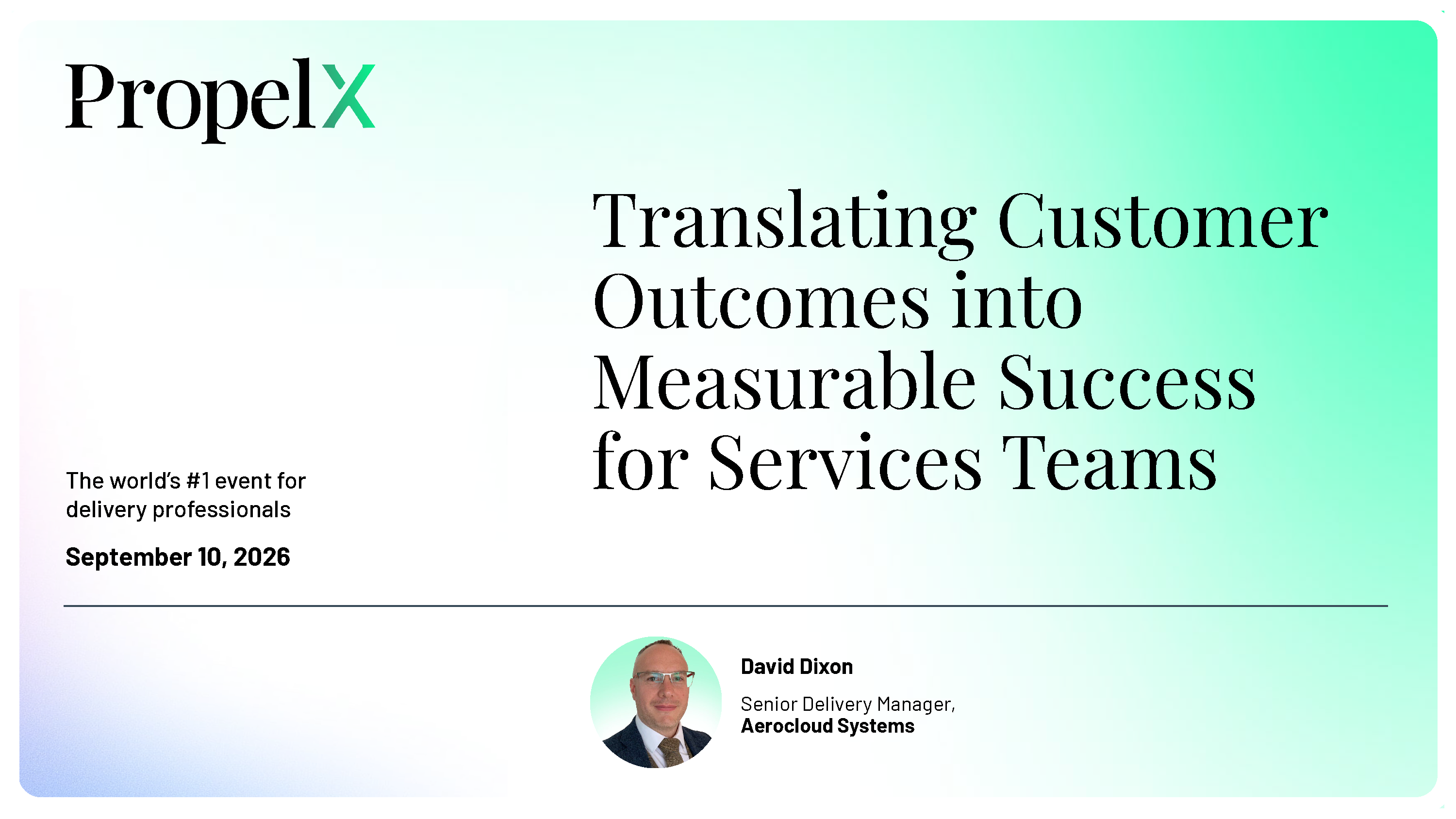
David Dixon (Senior Delivery Manager at AeroCloud Systems) talked about outcomes vs outputs. Are we measuring things correctly? Are checkpoints being mistaken for success? He drew a simple analogy. Lunch.
At some point in the day, lunch gets delivered. There's food, there's coffee and, this being a conference, there's a queue. Technically every feature is there. But if half the room is still holding a plate when the afternoon session starts, David asked, "have we delivered the outcome or have we just deployed catering?"
The outcome was never that food exists. It's that everyone gets a break, has a decent conversation, eats something and makes it back into the room on time. The sandwiches, the coffee and the serving stations are only the capabilities that make that possible. And most PS teams do exactly the same thing with their customers: we hear what the customer wants to achieve, and then hand them some really good sandwiches.
David spent his session at PropelX 2026 in London on the gap between what gets sold and what delivery can actually prove. His answer is a "translation layer" that turns a business outcome into things a services team can design, measure and prove during delivery, and it's a framework any PS team can start using on its next project.
What is the difference between outcomes vs outputs?
Outputs are the things a delivery team produces: configured features, workflows, integrations, dashboards and completed sessions. Outcomes are the business changes a customer bought the software to achieve, such as lower operating costs, higher throughput or faster onboarding. You can deliver every output on time and still miss the outcome completely, and that's the gap David wanted the room to look at honestly.
How outcomes get lost in the feature trap
A customer comes in wanting to cut operating costs by 20%, raise throughput by 30% or bring onboarding down from 5 days to 1. Then, somewhere between sales and delivery, that goal gets translated into your product.
There's this feature, that workflow, an integration, some analytics, and "probably this module that no one really knows what it does, but it does double the ARR." Before long you've built a magnificent machine and convinced yourself an outcome will fall out of the other end. David calls this the feature trap, and it's the moment outputs quietly replace outcomes.
Why don't delivery timelines and customer outcomes line up?
David ran a quick hands-up poll to show the problem. Plenty of people worked for companies that say they sell outcomes. Fewer said those outcomes survive the sales process, fewer still said their services team is measured against them, and when he asked whose bonus depends on the customer actually achieving the outcome, exactly one hand stayed up. The room laughed, but it was the kind of laugh that comes from recognising your own org chart.
Part of the reason is timing. A typical SaaS implementation goes from sale to implementation to go-live, then a bit of hypercare, and then PS leaves. The customer's business outcome usually shows up 3, 6 or even 12 months after that. So when PS teams are told to be "outcome-led," they hit a basic problem straight away: the delivery lifecycle and the customer's outcome lifecycle are not the same thing.
Who owns the customer outcome?
"Who owns the outcome?" comes up constantly, and David thinks it's the wrong question. Sales owns the commercial intent. Services own translating and enabling it. Customer success owns ongoing validation. Realization sits with whoever pulls the final levers, which is usually the customer, and account management then uses that realized value to find the next outcome.
In David's words, "the outcome really doesn't hand over. It's just the accountability for it that does." Once teams accept that, the conversation moves away from blame and towards making every handoff carry the outcome forward.
How do you work backwards from a business outcome?
David's own example comes from his years in accounts payable automation, where customers would ask to cut their AP team by 25%, from 20 people to 15. It's a wonderfully measurable goal. It's also one he couldn't deliver. He could implement the technology, "but making five people disappear, that's a bit of a stretch to do.
Well, legally at least." Whether to reduce headcount, redeploy people or grow invoice volume without hiring is a management decision for the customer. As David put it, "technology creates capacity. The customer decides what they want to do with it."
So his team worked backwards instead. A 25% lower staffing cost needs roughly 25% less human effort for the same workload, which needs more invoices processed without anyone touching them. That, in turn, depends on extraction accuracy, exception rates, handling time and throughput. None of those metrics sound as exciting as "cut headcount by 25%," and nobody builds a business case on exception rates. But they're the metrics that decide whether the 25% is even possible, and they're metrics the project team can design, test and measure.
The translation layer framework
David calls the step between the commercial promise and the delivery methodology the translation layer. It takes a business outcome that may happen in 6 to 12 months and turns it into operational conditions delivery can prove. The framework works through six questions in order:
- What does the customer ultimately want?
- What has to change operationally for that to happen?
- How would we know that change is happening?
- What behaviour needs to change?
- What capability enables that behaviour?
- What does the services team actually need to implement?
By the last question, you have something you can put into a project plan and, more importantly, something you can test against. If you can't make that journey from what sales sells to what your methodology can prove, David said, there's a gap worth looking into.
When should PS teams measure outcomes during delivery?
David's team never measured the outcome metrics just once, because each stage of delivery answered a different question. The build stage asked whether the configured solution actually works. QA asked whether it keeps working once the customer's own documents and edge cases go in. UAT asked whether the improvement shows up in something that resembles the customer's real operations.
By the time the project went live, David could say with confidence whether the operational conditions for the outcome existed. If you only measure at go-live, you find out whether it worked at the exact moment you've lost the ability to fix it, which is a bit like checking the go-live checklist after the party's started.
What are enabled, validated and realized outcomes?
When UAT passed with green ticks everywhere, the project manager enjoyed about 10 minutes of happiness before being moved onto a more complex project. But the business outcome hadn't happened yet. What the team had proved was something different, and arguably more valuable: that the outcome was enabled. David splits outcomes into three levels:
- Enabled: the capability exists and has been shown to create the required improvement. PS owns this, and it's where delivery outcomes become the default.
- Validated: the improvement holds up under realistic operating conditions. PS contributes heavily here, alongside the customer success manager.
- Realized: the customer has turned that improvement into business value, often months after PS has left, and usually confirmed through reviews like an executive business review.
That's where customer success comes in, 6 or 9 months later, asking the follow-up questions. Are you still processing the expected volumes? Is straight-through processing holding? Has manual effort stayed low? Are the operational metrics still moving?
And finally, did you actually reduce the AP team by 25%? Knowing which level you're at is what stops a checkpoint from being mistaken for success.
How do you prove outcomes when customers won't share the data?
When David's team asked one customer whether they had actually cut the AP team by 25%, the answer was: "That's none of your business." And sometimes that genuinely is the answer. Workforce and financial data can be sensitive, and some customers simply won't tell you.
So David doesn't pretend every outcome is proven. He grades evidence by confidence: confirmed, supported, indicated or unverified. That's far more credible than "taking three favourable metrics, bolting them into a case study and claiming a 427% ROI." (Nobody believes the 427% anyway, not even the person who wrote the case study.)
Honest evidence levels also make proving ROI a lot easier to defend when the next budget conversation comes around.
How does proving outcomes drive services-led growth?
When services can prove the operational value it enables, the next commercial conversation changes. Instead of "what else can we sell you?", it becomes "what's the next business constraint we can help you remove?"
David describes it as a loop: outcome, translation, enablement, evidence, realization, and then on to the next outcome. That sounds like a much healthier growth loop than upsell pressure, and it's the same logic behind land and expand, just built on proof rather than pitch decks.
Has AI made outcomes vs outputs harder to manage?
AI has made it easier than ever to build capabilities, but it hasn't solved the translation problem. If anything, David argued, it has made it more important, because teams can now create capabilities much faster than most organisations can turn them into measurable business change.
Every customer eventually asks the same question about AI: great, but what did it actually improve? The answer usually sits in the gap between what sales promised and what delivery knows how to prove, and services teams are uniquely placed to close it. As David put it, the outcome era doesn't change the purpose of services teams. It changes what professional services needs to prove.
5 key takeaways on outcomes vs outputs
- Outputs aren't outcomes. Every feature can ship on time and the customer can still miss the value they bought.
- Work backwards. Translate the business outcome into operational conditions delivery can design, measure and prove.
- Measure at every stage. Build, QA and UAT each answer a different question, so don't wait for go-live.
- Know your level. PS owns enabled, contributes to validated and hands realized outcomes to CS and the customer.
- Grade your evidence. Confirmed, supported, indicated or unverified beats an inflated ROI claim.
Best practices for proving customer outcomes
- Walk one outcome back. Take a goal sales often promises and work back three steps to something delivery can prove, starting from the customer's success plan.
- Track outcome checkpoints in the plan. Put enabled and validated metrics inside the project plan in a tool like Rocketlane, not in a separate spreadsheet.
- Carry the outcome through handoffs. Include the outcome metrics in every implementation-to-CS handoff.
- Label your evidence. Tag every outcome claim with a confidence level before it goes into a case study or renewal deck.
- Ask for the next constraint. Use realized value to open the expansion conversation instead of a generic upsell.
About Rocketlane
Rocketlane is an agentic AI-powered professional services automation (PSA) platform built for services teams running complex implementations.
Its AI layer, Nitro, deploys named agents that do the work, not just flag it:
- Migration Agent — data preparation and transformation
- Workforce Agent — repeatable configuration at scale
- Documentation Agent — project context current across calls and emails
- Project Governance — delivery standards enforced proactively
- Nitro Signals — account risk surfaced before it escalates
The core distinction: Nitro agents produce the deliverable or enforce the gate. Most platforms advise. Rocketlane acts.
Teams using Rocketlane ship faster, recover margin through tighter governance, and scale delivery without proportional headcount growth.
Table of Contents

Regsiter for the live webinar


Great consultants didn't join your team to spend Fridays writing documentation.
Table of contents
18 of Forbes Cloud 100 chose Rocketlane. The best PS teams aren't waiting around.
FAQs
What is the difference between outcomes vs outputs in professional services?
Outputs are the things a professional services team delivers, such as configured features, workflows, integrations and completed sessions. Outcomes are the business changes the customer bought the software to achieve, such as lower operating costs or faster onboarding. A project can deliver every output on time and still fail to produce the outcome, which is why professional services KPIs need to go beyond delivery milestones.
Who owns the customer outcome in a SaaS implementation?
No single team owns the customer outcome end to end. Sales owns the commercial intent, services owns translating and enabling it, customer success owns ongoing validation, and the customer usually owns final realization. According to David Dixon, the outcome itself doesn't hand over between teams; only the accountability for it does, which is why a clear sales-to-customer-success handoff matters.
What is the translation layer in professional services?
The translation layer is the step between the commercial promise and the delivery methodology. It turns a business outcome that may take 6 to 12 months to appear into operational conditions a services team can design, measure and prove during delivery, such as accuracy, exception rates and throughput. It's closely related to value mapping in onboarding.
What are enabled, validated and realized outcomes?
Enabled means the capability exists and has been shown to create the required improvement, which PS owns. Validated means the improvement holds under realistic operating conditions, which PS contributes to. Realized means the customer has converted the improvement into business value, usually months after the project ends and often tracked through customer success metrics.
How can PS teams prove customer outcomes when customers won't share data?
PS teams can grade their evidence by confidence level instead of claiming certainty. David Dixon uses four levels: confirmed, supported, indicated and unverified. This is more credible than combining a few favourable metrics into a single headline figure, especially when workforce or financial data is sensitive.
What is the feature trap in SaaS implementation?
The feature trap is when a customer's business goal gets translated into a list of product features, workflows and integrations instead of the business changes needed to reach the goal. Teams then assume the outcome will follow once enough features are connected. Avoiding it means designing implementations around outcomes, not modules.
When do customers usually achieve business outcomes after implementation?
Customers usually achieve business outcomes 3, 6 or even 12 months after go-live, often after the professional services team has left the project. That's why PS teams should prove the outcome is enabled before they leave, and why customer success needs to keep validating it afterwards to protect time to value.
Why should outcome metrics be measured during build, QA and UAT?
Each stage answers a different question. Build checks that the configured solution works, QA checks it holds up with the customer's real data, and UAT checks the improvement shows up in near-real operations. Measuring only at go-live leaves no time to fix problems, which is why many teams track these as project management metrics throughout delivery.
How does proving outcomes help PS teams drive growth?
When PS teams can prove the operational value they enabled, the next conversation shifts from "what else can we sell you?" to "what's the next constraint we can help you remove?" David Dixon describes this as a services-led growth loop of outcome, translation, enablement, evidence and realization, which supports stronger net revenue retention.
How is AI changing the way PS teams prove outcomes?
AI lets teams build capabilities much faster, but it doesn't translate those capabilities into business change on its own. That makes the translation layer more important, because customers increasingly ask what AI actually improved. PS teams need clear outcome metrics and evidence to answer that question and to justify the ROI of their tools.













Copyright © 2026 Rocketlane Corp. All rights reserved.


















.webp)