How to maximize the ROI of PSA software: Benefits and key metrics

•
•
Summarize blog with






The ROI of PSA software should be easy to measure. After all, professional services automation (PSA) software sits at the center of project delivery, resource management, time tracking, forecasting, and billing.
Yet many professional services (PS) leaders still struggle to answer a simple question: "What are we actually getting back from this investment?"
The challenge is that the PSA value is distributed across dozens of operational improvements rather than one obvious financial metric.
Higher utilization, fewer project overruns, faster invoicing, reduced billing leakage, more accurate forecasting, and lower administrative overhead all contribute to ROI.
But when those gains are spread across teams and workflows, they can be difficult to quantify and even harder to communicate to executive stakeholders.
Meanwhile, many consulting firms continue to lose revenue capacity through underutilization, billing leakage, and manual operational processes.
SPI Research's Professional Services Maturity Benchmark consistently shows significant performance gaps between average and top-performing firms in utilization, profitability, forecasting accuracy, and revenue capture, suggesting substantial value remains trapped in day-to-day operations.
Many organizations already have a PSA platform in place, but lack the visibility needed to understand where those losses originate or how much value the system is helping recover.
This is one reason the market is shifting toward the agentic PSA. Instead of serving solely as a system of record, an agentic PSA helps firms connect workflows across the back office + front office, surface operational risks earlier, automate routine work, and continuously improve performance.
Platforms such as Rocketlane are designed around this shift, helping services organizations move beyond tracking work toward actively optimizing outcomes.
This guide breaks down the exact ROI PSA delivers, how to calculate it, and which platforms deliver the return.
What is the ROI in PSA?
The ROI of PSA software for consulting firms is the measurable annual return generated by a professional services automation platform across six dimensions: billable utilization improvement, billing accuracy and revenue leakage reduction, project profitability visibility, time-to-value acceleration, escalation prevention, and administrative time recovered.
Industry benchmarks consistently show a meaningful performance gap between average and top-performing professional services organizations.
A new generation of agentic PSA platforms is extending ROI beyond reporting and workflow management.
By connecting workflows across the back office and the front office, these platforms help services organizations improve resource allocation, reduce revenue leakage, surface delivery risks earlier, automate routine operational work, and improve project execution.
Rocketlane is an agentic PSA designed for this reality. It combines project delivery, resource management, operational visibility, customer collaboration, and AI agents in a single platform.
Who this guide is for: Professional services leaders, delivery executives, operations leaders, and CFOs at consulting firms and B2B services organizations with 15–500 delivery staff evaluating a PSA investment or measuring the ROI of an existing platform.
Methodology: Updated May 2026. Product positioning, feature assessments, and G2 ratings reflect publicly available information as of May 2026.
ROI benchmarks reference SPI Research's 2026 Professional Services Maturity Benchmark alongside published vendor case studies and customer-reported outcomes.
Quick glance: PSA software ROI comparison for consulting firms (2026)
Which PSA software delivers the strongest ROI for consulting firms? Here is a snapshot of the platforms most frequently evaluated during the buying process.
What is the ROI of PSA software? The 6-dimensional framework

The ROI of PSA software is the total measurable annual return a consulting firm earns across six dimensions: billable utilization improvement, billing accuracy and leakage reduction, project profitability visibility, time-to-value acceleration, escalation prevention, and administrative time recovered.
The 6-dimension PSA ROI framework
We call this the 6-Dimension PSA ROI Framework because the highest-performing professional services organizations create value across multiple operational levers simultaneously, instead of relying on utilization alone.
1. Utilization improvement: Billable utilization remains the single largest ROI driver for most consulting firms. Every additional billable hour generated from existing headcount increases revenue capacity without increasing payroll costs. For a 20-person team billing at $150 per hour, a one-percentage-point improvement in utilization can represent roughly $50,000–$60,000 in additional annual revenue capacity. Small utilization gains compound quickly across larger teams.
2. Billing accuracy and leakage reduction: Revenue leakage occurs through missed time entries, delayed timesheets, underbilling, and write-offs. Industry estimates suggest many services firms lose between 3% and 7% of potential billable revenue to these issues. For a firm generating $5 million annually, a 5% leakage rate represents $250,000 in unrealized revenue.
3. Project profitability visibility: Many consulting firms discover margin erosion only after a project has already exceeded budget or consumed more effort than planned. PSA platforms provide earlier visibility into burn rates, budget consumption, resource utilization, and project economics, allowing teams to intervene before profitability is materially affected.
4. Time-to-value acceleration: Standardized project templates, automated workflows, and reusable delivery playbooks help teams launch projects faster and reduce operational friction throughout delivery. For firms managing dozens of engagements each year, even modest reductions in project timelines can improve resource availability, accelerate revenue realization, and increase delivery capacity.
5. Escalation prevention: Delivery risks rarely appear overnight. Schedule delays, resource constraints, scope expansion, and customer dissatisfaction typically emerge gradually before becoming visible problems. Earlier detection allows teams to intervene sooner, reducing the likelihood of costly recovery efforts, emergency staffing, margin erosion, or customer churn.
6. Administrative time recovered: Project managers and delivery leaders often spend 10–15 hours each week on reporting, coordination, status updates, documentation, and operational administration. Automation and AI-assisted workflows can significantly reduce that burden, allowing teams to spend more time on delivery, customer relationships, and revenue-generating work. For ten project managers earning $100 per hour, recovering even a portion of that time can create six-figure annual productivity value.
Why is PSA ROI a board-level priority for consulting firms in 2026?

Consulting firm margins are under simultaneous pressure from three directions at once, and the PSA decision has moved from an operations conversation to a board-level one.
1. Utilization is falling while margin pressure is rising: According to SPI Research's 2026 Professional Services Maturity Benchmark, average billable utilization fell to 66.4% in 2025, below the levels typically associated with high-performing services organizations.
For consulting firms, every point of utilization recovered from existing headcount directly increases revenue capacity and improves margins without requiring additional hiring.
2. CFOs increasingly expect measurable software ROI: Technology budgets face greater scrutiny than they did just a few years ago. PSA platforms are now expected to demonstrate a clear return on investment on utilization, billing accuracy, project profitability, forecasting, and operational efficiency. Systems that function primarily as project trackers often struggle to justify their cost during renewal and budget reviews.
3. AI is creating a widening performance gap: The distinction between firms using AI extensively in service delivery and those that are not is becoming increasingly visible in business performance metrics. SPI Research's 2026 benchmark found that AI-adopting firms reported materially higher EBITDA than non-adopters, reinforcing a broader trend: organizations that embed AI into delivery operations are improving efficiency and profitability faster than those relying on traditional workflows.
Did you know?
Which PSA platform delivers the best ROI for your consulting firm?
Each PSA platform generates ROI differently. The key is matching the platform's strengths to your firm's biggest operational bottleneck. Here's how the leading options compare.
1. Rocketlane
Rocketlane is an agentic execution platform for consulting firms, unifying back-office operations and front-office delivery with AI agents designed to automate the work that consumes 10–15 hours of project manager time every week.
Most PSA platforms were built as systems of record. They track projects, resources, time entries, and financials, but they largely depend on managers to interpret the data, identify risks, enforce process compliance, and take corrective action.
Rocketlane takes a different approach. Instead of simply storing operational information, it actively helps teams improve operational performance.
It combines traditional PSA capabilities such as resource management, project financials, forecasting, time tracking, and portfolio visibility with customer-facing delivery workflows, collaborative project workspaces, implementation governance, and AI-powered operational automation.
This unified back-office and front-office model is one reason the platform has gained adoption among more than 750 customers, including over 17 Forbes Cloud 100 companies.
Combined with a 94% G2 recommendation rate across 800+ reviews, Rocketlane has become a common destination for consulting firms replacing fragmented PSA environments built around spreadsheets, project management tools, and legacy PSA platforms.
ROI profile
Key features
Nitro AI Agents
Nitro is Rocketlane's agentic AI layer for professional services automation. Unlike traditional PSA platforms where AI is limited to reporting or content generation, Nitro is embedded across operational management, project delivery, and work execution.
The result is an AI system that targets multiple drivers of PSA ROI simultaneously: utilization improvement, revenue leakage reduction, administrative time recovery, escalation prevention, delivery efficiency, and project profitability.
Operations AI
Operations AI helps professional services leaders run the business more efficiently by reducing the administrative burden associated with staffing, reporting, forecasting, and compliance.
- Workforce Agents assist with staffing, allocation management, capacity planning, utilization optimization, and resource forecasting, reducing the manual effort required to balance supply and demand across projects.
- Nitro Analyst enables conversational reporting, allowing leaders to ask questions about utilization, project margins, forecasting, capacity, revenue performance, or delivery operations and receive immediate answers without building reports manually.
- Timesheet Policy Agent monitors timesheet compliance against configurable business rules, helping teams identify missing, late, or incomplete submissions before they affect billing and revenue capture.
Delivery AI
Delivery AI focuses on project health, governance, and risk management.
- Signals Agent continuously monitors customer engagement, delivery progress, milestone completion, budget consumption, and team activity to identify risks before they escalate.
- Governance Agents help delivery leaders maintain consistency across portfolios by monitoring project adherence, delivery standards, operational controls, and execution quality at scale.
Work Execution AI
Work Execution AI reduces the effort required to perform customer-facing delivery work.
- Documentation Agents automatically generate implementation plans, project summaries, executive updates, migration runbooks, meeting notes, status reports, and customer-facing documentation. For many services teams, documentation represents one of the largest sources of non-billable effort.
- Migration Agents automate repetitive onboarding and implementation activities, helping teams reduce migration effort, accelerate project timelines, and improve delivery consistency across customer deployments.
Nitro helps consulting firms improve utilization, reduce operational overhead, recover billable capacity, and identify delivery risks earlier, making it one of the most comprehensive AI capabilities currently available within a PSA platform.
Real-time project financial and resource management dashboards
Financial visibility is often fragmented across spreadsheets, PSA systems, ERP platforms, accounting software, and reporting tools.
Rocketlane brings project margins, budget consumption, revenue forecasts, work-in-progress, utilization trends, and portfolio performance into a single operational view, enabling earlier intervention when profitability or delivery performance begins to drift.
That supports stronger financial management, while better project accounting improves decisions about budgets, revenue, and profitability.
Dynamic project playbooks
Rocketlane's playbook framework allows consulting firms to codify delivery methodologies, automate project setup, standardize milestones and workflows, and embed best practices directly into execution. This reduces onboarding effort, shortens ramp-up time, and improves delivery consistency across teams.
Native CRM, ERP, and customer collaboration workflows
Rocketlane integrates with Salesforce, HubSpot, NetSuite, and other core business systems to connect revenue, delivery, and financial operations. Customer-facing portals provide shared visibility into project progress, while shared dashboards and clear billing statements increase transparency, strengthen trust, and support contract renewals.
Best for
- Consulting firms with 25–500+ delivery professionals
- Professional services teams seeking measurable ROI within the first quarter
- Organizations replacing fragmented PSA, spreadsheet, and project-management environments
- Firms looking to improve utilization, project profitability, customer delivery, and operational efficiency simultaneously
- Services organizations investing in AI-enabled operational improvement rather than reporting alone
Key takeaways
What customers say (G2 reviews)
Hapi Cloud hit 85% billable utilization after automating their implementation processes with Rocketlane — well above the industry average of 66.4% and comfortably within the high-performance range that SPI Research identifies as a key margin differentiator.
Before Rocketlane, manual coordination across projects was consuming capacity that should have been billable. Automating those workflows freed the team to focus on delivery instead of administration.
The Rocketlane advantage in numbers:
750+ customers · 94% G2 recommendation rate · $60M Series C (March 2026) · Revenue more than doubled YoY.
2. Kantata
Kantata is one of the most established PSA platforms in the market and remains particularly popular among large consulting firms, where resource planning is viewed as a strategic function rather than an administrative one.
The platform's value comes from helping services organizations answer difficult operational questions before they become financial problems. Can the current team support next quarter's pipeline? Which practices are heading toward utilization shortfalls? Where should hiring happen? Which projects are consuming disproportionate specialist capacity?
For large firms, better answers to those questions can translate directly into improved utilization and margin performance. For smaller firms, however, the sophistication can become a burden.
Many organizations discover that extracting value from Kantata requires dedicated operations ownership, strong governance, and sustained adoption across delivery teams.
Key features
- Resource planning depth: Kantata's biggest differentiator is enterprise-grade resource management. Organizations with hundreds of consultants can model future demand, identify allocation bottlenecks, and optimize staffing decisions across practices, regions, and service lines. Most of the platform's ROI originates here.
- Capacity forecasting: Rather than reacting to staffing shortages after projects are sold, firms can forecast future demand against available capacity. This helps reduce both avoidable bench time and reactive hiring decisions.
- Portfolio-level operational visibility: Leadership teams gain a consolidated view of project health, utilization trends, staffing risks, and delivery performance across the organization. This is particularly valuable for firms managing dozens or hundreds of concurrent engagements.
- Financial forecasting: Kantata connects delivery activity to revenue forecasts and margin expectations, allowing services leaders to identify profitability risks earlier in the project lifecycle.
- Salesforce ecosystem alignment: Organizations already running Salesforce often benefit from tighter coordination between pipeline forecasts and delivery planning, reducing the disconnect between sales commitments and staffing reality.
Best for
- Enterprise consulting firms with 200+ consultants, where resource allocation decisions materially affect profitability
- Organizations operating multiple practices, regions, and specialist pools
- Salesforce-centric services businesses with dedicated PS operations functions
- Firms willing to invest in governance and operational discipline to maximize forecasting accuracy
Key takeaways
What customers say (G2 reviews)
3. Certinia
Certinia occupies a unique position in the PSA market because it is fundamentally a Salesforce-first platform. Most organizations buy it for one reason: they want sales, delivery, finance, and customer data living inside a single system of record.
For firms heavily invested in Salesforce, this can create meaningful ROI. Delivery leaders gain visibility into projects without leaving the CRM. Finance teams reduce reconciliation work between systems. Executives can connect pipeline forecasts to delivery capacity and revenue performance more easily.
The trade-off is that much of Certinia's value depends on Salesforce itself. Organizations that are not deeply committed to Salesforce often find themselves paying for architectural alignment they don't fully need. As a result, Certinia tends to perform best when the strategic objective is consolidation rather than operational innovation.
Key features
- Native Salesforce architecture: Certinia's biggest advantage is eliminating the traditional divide between CRM and PSA. Sales opportunities, customer records, project delivery, and financial data operate inside the same ecosystem, reducing data fragmentation.
- PSA and ERP in one platform: Organizations can manage delivery operations alongside invoicing, revenue recognition, and financial controls. For finance teams, this often simplifies reporting and compliance workflows.
- Revenue and margin visibility: Services leaders can connect project performance directly to financial outcomes, improving profitability monitoring across large portfolios.
- Resource management: Capacity planning and utilization management capabilities help organizations align staffing decisions with revenue forecasts, though they are generally not considered the platform's primary differentiator.
- Executive reporting: Cross-functional visibility becomes easier when sales, delivery, and financial data share a common foundation.
Best for
- Organizations where Salesforce is the non-negotiable system of record
- Professional services firms with 100+ delivery staff
- Businesses seeking PSA and ERP capabilities in a unified environment
- Enterprises prioritizing operational consolidation over AI-led optimization
Key takeaways
What customers say (G2 reviews)
4. BigTime
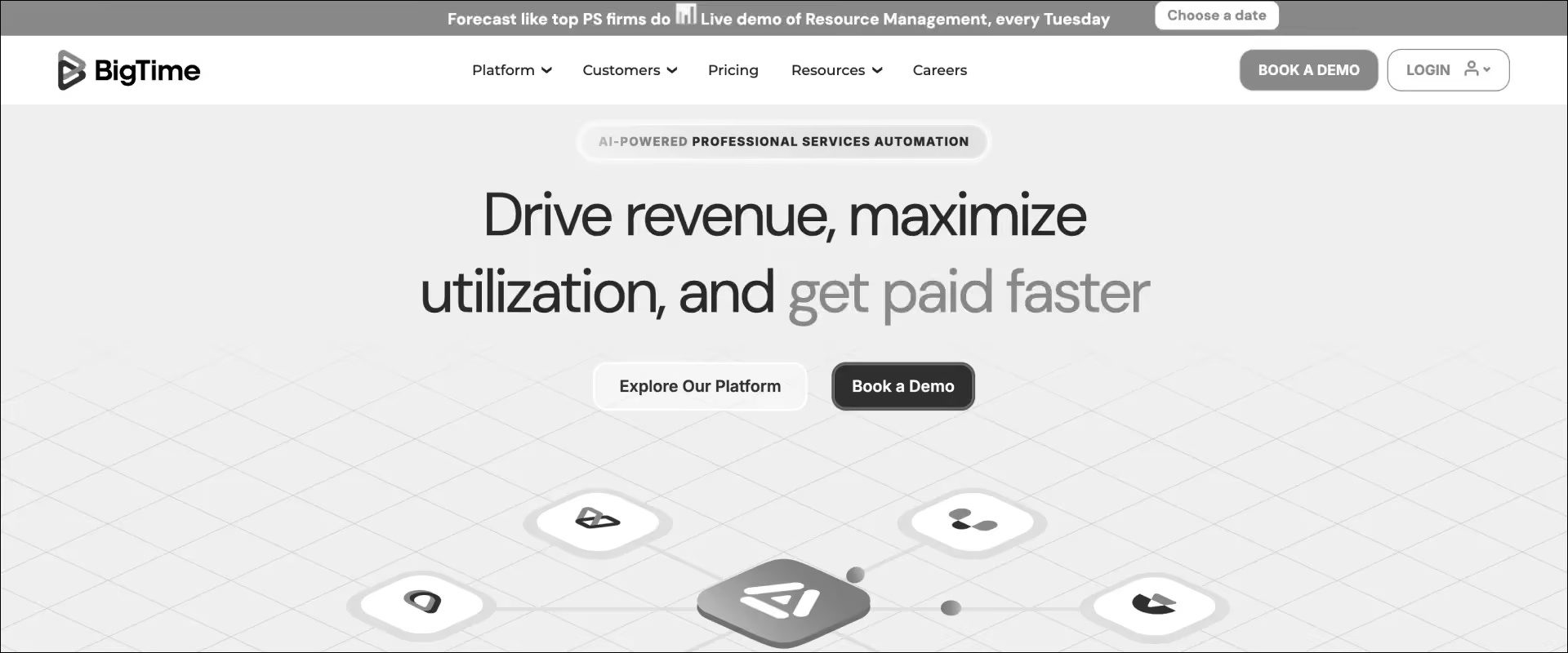
BigTime is a PSA platform built primarily for accounting firms, engineering consultancies, and mid-market professional services organizations that operate on time-and-materials (T&M) billing models.
Its strongest capabilities sit at the intersection of time tracking, work-in-progress management, invoicing, and revenue capture. As a result, firms evaluating BigTime are often trying to solve billing accuracy problems rather than broader delivery transformation challenges.
For management consulting, accounting, advisory, and other time-and-materials-heavy firms, ROI often appears quickly because recovered revenue begins flowing through the business almost immediately after adoption.
Key features
- Billing accuracy and revenue capture: BigTime's biggest strength is helping firms convert delivered work into billable revenue. Better time capture and approval workflows reduce leakage that often goes unnoticed.
- Work-in-progress visibility: Delivery leaders gain clearer insight into unbilled work, helping finance teams accelerate invoicing and improve cash flow.
- Budget monitoring: Project managers can track budget consumption and identify overruns before profitability is materially affected.
- Time and expense management: Consultants can capture billable work more consistently, improving both compliance and reporting accuracy.
- Financial reporting: Strong project-level visibility into revenue, utilization, billing, and profitability performance.
Pros and cons
Best for
- Consulting firms with 50–150 consultants
- Management consulting, accounting, and advisory firms
- Organizations where billing accuracy is a larger problem than resource planning
- Firms seeking fast time-to-value from PSA adoption
Key takeaways
What customers say (G2 reviews)
5. monday.com
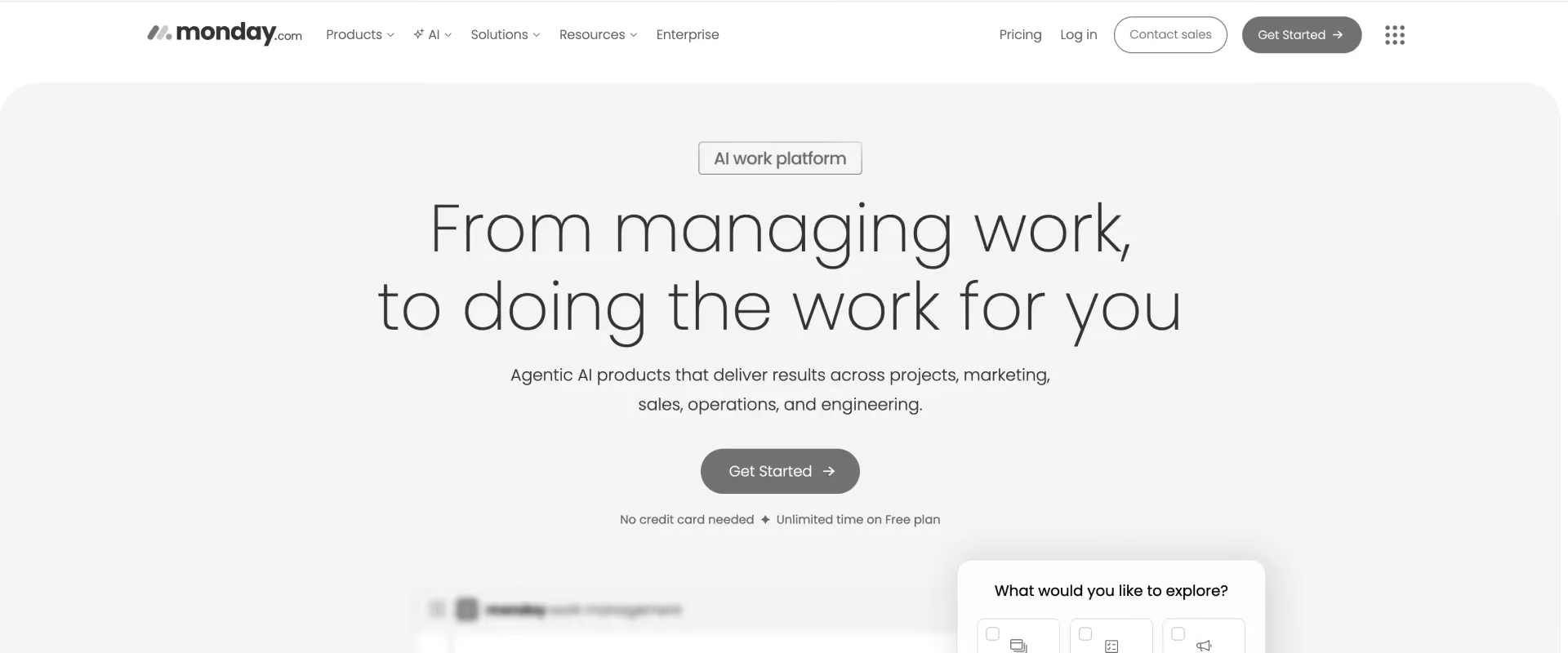
monday.com is a work management platform rather than a purpose-built PSA solution. Many consulting firms evaluate it because teams are already familiar with the product and can quickly configure project tracking, workflows, and collaboration processes. For smaller firms, this flexibility can be attractive.
However, as delivery organizations grow, the absence of native PSA capabilities often creates operational gaps around utilization management, project financials, forecasting, revenue recognition, and professional services governance.
Key features
- Workflow coordination: monday.com excels at helping teams organize projects, tasks, approvals, and operational processes through flexible workflows.
- Visual project management: Boards, timelines, dashboards, and automation make work visible and easy to manage across distributed teams.
- Team collaboration: Shared workspaces improve coordination and reduce reliance on email and spreadsheets for day-to-day execution.
- Process automation: Repetitive operational activities can be automated without significant technical expertise.
- Flexible configuration: Teams can adapt workflows to match their operating model without large implementation projects.
Pros and cons
Best for
- Teams under 20 people, or for internal project management and operations
- Organizations prioritizing workflow coordination over PSA functionality
- Businesses not yet managing delivery at scale
Key takeaways
What customers say (G2 reviews)
Head-to-head PSA ROI feature comparison for consulting firms (2026)
Here is a direct comparison of the PSA platforms most frequently evaluated by consulting firms, across the six ROI dimensions and key supporting capabilities.
Most PSA evaluations eventually converge on the same question: which platform creates the most measurable business value after implementation?
While every tool in this comparison can improve visibility and operational control, they generate ROI through different mechanisms.
The table below highlights where each platform contributes most directly to consulting firm profitability.
Where each platform stands out
- Rocketlane is strongest for firms looking to improve performance across multiple dimensions simultaneously, including utilization, project profitability, customer delivery, operational efficiency, and administrative automation. Its combination of PSA functionality, customer collaboration, and Nitro's agentic AI capabilities makes it particularly compelling for consulting firms seeking broad-based ROI rather than optimization within a single operational area.
- Kantata stands out in highly complex resource planning environments with 200+ consultants operating across multiple regions, practices, and utilization models.
- Certinia is particularly well suited to organizations that have standardized on Salesforce and want PSA, ERP, financials, and revenue operations tightly integrated within a single ecosystem.
- BigTime performs especially well for T&M-driven consulting firms where billing accuracy, work-in-progress management, and revenue capture are the primary operational priorities.
How a CFO evaluates PSA software ROI

CFOs evaluate PSA software through five lenses: quantified efficiency gains, revenue impact, total cost of ownership, payback period, and implementation risk. The PSA that wins budget approval is the one that can demonstrate value across all five.
- Efficiency gains: Calculate hard-dollar productivity improvements using the formula: hours saved per week × team size × fully loaded cost × 48 weeks. For many consulting firms, administrative automation alone can recover hundreds of thousands of dollars annually.
- Revenue impact: Utilization improvements often generate the largest return. Even modest increases in billable utilization can create six- or seven-figure annual revenue capacity gains without adding headcount.
- Total cost of ownership: Evaluate software licenses, implementation costs, integrations, training, and ongoing administration against the cost of current tools, manual processes, and revenue leakage.
- Payback period: The shorter the implementation and adoption timeline, the faster value begins accumulating. For many mid-market consulting firms, payback is measured in months rather than years.
- Implementation risk: Adoption rates, implementation complexity, customer success support, and vendor track record all influence realized ROI. A platform with strong adoption often delivers more value than a technically richer platform that teams resist using.
Most successful PSA business cases follow the same structure: quantify current operational losses, estimate realistic improvement potential, compare that value against total ownership cost, and determine how quickly the investment pays for itself.
Which PSA delivers the best ROI for your consulting firm?
The right PSA for your firm depends on team size, current utilization baseline, and primary ROI pain. Use this table to route your decision.
A 10-person consulting firm can manage utilization, project profitability, and delivery oversight through a combination of spreadsheets, reporting discipline, and institutional knowledge.
At 25+ delivery professionals or roughly 20+ concurrent projects, those manual systems begin breaking down. Reporting consumes entire afternoons. Resource planning becomes reactive. Project profitability becomes harder to see until it is already compromised.
ROI of PSA software by region
- North America: Utilization improvement, project profitability visibility, and CRM alignment remain the primary ROI drivers. Firms often prioritize integrations with Salesforce, HubSpot, and financial systems to improve forecasting and delivery visibility.
- Europe: Data residency, GDPR compliance, multi-currency billing, and VAT management frequently influence PSA selection as much as operational functionality.
- United Kingdom: Firms managing a mix of contractors and full-time employees often require stronger auditability around time tracking, utilization reporting, and compliance workflows.
- APAC: Rapidly growing consulting firms frequently focus on utilization optimization, resource planning, and operational scalability. Higher utilization targets can significantly amplify PSA ROI.
- Middle East: Multi-currency operations, regional tax requirements, and distributed delivery teams increase the value of integrated project financials, resource visibility, and delivery governance.
Why do consulting firms switch PSA tools? 3 ROI-driven triggers
The decision to replace a PSA platform is rarely driven by features alone. More often, firms switch when the financial cost of staying with the current system becomes impossible to ignore.
1. The CFO asks for ROI and nobody has an answer
A quarterly review turns into a spreadsheet exercise because utilization, project profitability, and delivery performance live across multiple systems. When proving the value of a PSA requires days of manual reporting, the platform is no longer providing the operational visibility leadership expects.
2. Administrative work grows faster than the delivery team
Project managers begin spending increasing amounts of time on reporting, coordination, status updates, documentation, and operational housekeeping. Eventually leadership considers hiring additional operations staff simply to manage process overhead. At that point, automation often delivers a stronger return than additional headcount.
3. Revenue leakage or project escalations become materially expensive
Missed time entries, delayed billing, project overruns, and late-stage customer escalations create costs that quickly exceed annual software subscriptions.
Once leadership can quantify those losses, the business case for a more capable PSA becomes significantly easier to justify.
In each case, the underlying issue is the same: the organization has outgrown the visibility, automation, or operational controls provided by its current platform.
Why Rocketlane delivers the highest PSA ROI for consulting firms in 2026
Rocketlane delivers the highest PSA ROI for consulting firms because it is the only platform addressing all six ROI dimensions simultaneously through agentic AI, while implementing in 4–12 weeks instead of the 4–6 months often associated with legacy PSA platforms.
The only PSA with a six-dimensional ROI stack
Most PSA platforms improve one or two areas of performance. Resource management improves utilization. Financial visibility improves reporting. Time tracking reduces leakage. The challenge is that consulting firms do not lose money in one place. Revenue leakage affects margins. Poor margin visibility affects staffing decisions. Staffing decisions affect utilization. Administrative overhead reduces delivery capacity.
Rocketlane is designed around this interconnected reality. Its AI agents operate across all six dimensions of the ROI framework, creating a compounding effect rather than isolated improvements.
Better timesheet compliance improves financial visibility. Better visibility improves staffing decisions. Better staffing improves utilization. Better documentation and automation reduce operational overhead. The result is a system that continuously reinforces operational performance rather than relying on managers to manually maintain it.
Fastest time-to-ROI: Why implementation speed is the hidden ROI multiplier
Most PSA ROI calculations focus on eventual value. Few consider how much value is lost while waiting for implementation to finish.
This is one reason implementation speed matters more than many buyers realize. A platform that generates identical operational improvements but goes live three months earlier creates materially more value in year one. For a consulting firm with hundreds of thousands of dollars in recoverable utilization, leakage, and administrative savings each quarter, implementation delays become an opportunity cost.
Rocketlane's implementation timeline is typically measured in weeks rather than quarters. Organizations often begin seeing measurable improvements in reporting, compliance, and operational visibility within the first month, allowing the ROI clock to start much sooner.
ROI of PSA software and AI: How Nitro transforms the equation
Most legacy PSA platforms were designed long before AI became a practical operational layer. As a result, AI is often added to reporting workflows rather than embedded into the delivery engine itself.
Nitro is designed around those outcomes.
- Reduce revenue leakage. Inconsistent time capture remains one of the most common causes of lost revenue in professional services organizations. Timesheet Policy Agent continuously monitors compliance against configurable business rules, helping teams identify missing, late, or incomplete submissions before they affect billing and revenue recognition.
- Recover administrative capacity. Delivery leaders often spend hours every week assembling reports, answering utilization questions, and reconciling operational data. Nitro Analyst provides conversational access to project, resource, and financial information, reducing the manual effort required to produce operational insights.
- Prevent costly escalations. Many delivery issues become visible only after timelines slip, budgets overrun, or customer confidence declines. Signals Agent monitors project health indicators and surfaces emerging risks early enough for teams to intervene before recovery becomes expensive.
- Reduce non-billable execution work. Documentation is essential to successful delivery but rarely generates revenue directly. Documentation Agent automates the creation of implementation plans, project summaries, executive updates, migration documentation, and other delivery artifacts, allowing consultants to spend more time on customer-facing work.
Enterprise-grade features that scale with your firm
Strong ROI only matters if the platform can survive procurement, security review, legal review, and finance approval. This is often where promising tools stall.
Rocketlane combines operational improvement with the controls enterprise stakeholders expect, including SSO and SAML support, advanced permissions, audit logs, Salesforce AppExchange integration, HubSpot synchronization, NetSuite connectivity, HRMS integrations, multi-currency support, regional data residency options, API extensibility, and enterprise support commitments.
For consulting firms evaluating long-term PSA investments, these capabilities reduce adoption risk while ensuring the platform can scale alongside the business.
PSA software ROI calculator for consulting firms

The ROI of PSA software for a consulting firm is the annual value created through higher utilization, reduced revenue leakage, and lower administrative overhead, minus total platform cost. Use the framework below to build a conservative, CFO-ready business case.
Many PSA ROI calculations become difficult to defend because they rely on aggressive assumptions or double-count the same value multiple times.
A more practical approach is to start with the three areas that are easiest to quantify: utilization improvement, billing leakage recovery, and administrative productivity gains. These are measurable, financially material, and directly tied to the way consulting firms generate revenue.
In other words, ROI compares the gains realized against total implementation and maintenance costs, not just the subscription fee.
Worked example: 50-person consulting firm
Assumptions: 50 consultants, $150/hour average billing rate, 65% current utilization, $7.5M annual revenue, 5% revenue leakage, and 10 project managers spending 8 hours per week on reporting, coordination, and administrative work.
Estimated platform cost
Even after accounting for implementation and additional platform costs, the potential value created remains substantially larger than the software investment.
More importantly, the calculation above excludes harder-to-measure benefits such as improved project profitability visibility, earlier risk detection, faster onboarding, customer retention, and documentation automation.
Illustrative payback periods and project profitability analysis
The purpose of this exercise is not to predict an exact ROI number. It is to quantify the current cost of underutilization, revenue leakage, and administrative overhead, then compare that value against the cost of solving those problems.
Use the same framework in your worked example to estimate better delivery economics, including profit margin gain, before turning those assumptions into a final business case.
PSA migration timeline: From decision to first ROI measurement
Rocketlane's standard implementation runs 4–12 weeks, with first measurable ROI often visible within the first month and full operational adoption typically achieved within 90 days.
For many consulting firms, that means reaching value several months earlier than traditional enterprise PSA implementations.
One of the most overlooked factors in PSA ROI is implementation duration. Every month spent migrating data, configuring workflows, and waiting for adoption delays the moment when utilization improvements, billing controls, and operational efficiencies start generating value. The question is not simply how much ROI a platform can deliver, but how quickly it can begin delivering it.
GoCardless scaled its professional services operation to deliver 59% faster time-to-value after adopting Rocketlane — compressing customer implementation timelines without adding headcount. For a payments infrastructure company where onboarding speed directly affects revenue activation, that improvement translated into measurable commercial impact.
The same pattern holds at nCloud Integrators, an IT services firm managing over 400 concurrent projects. By eliminating repetitive manual tasks through Rocketlane, the team recovered more than 2,000 hours annually — the equivalent of a full-time project manager's working year — and reinvested that capacity into delivery rather than administration.
How does Rocketlane handle common migration concerns of PS teams?
Will implementation really finish in 4–12 weeks?
Most mid-market deployments do. More importantly, value creation starts before full deployment. Teams typically begin using dashboards, compliance monitoring, and reporting capabilities during the first implementation phase rather than waiting until final cutover.
How do we migrate from our current PSA?
Migration is often less disruptive than expected. Data from platforms such as Kantata, Certinia, and OpenAir can be migrated in phases, allowing new projects to begin in Rocketlane while legacy engagements finish on existing systems.
Our team won't adopt it.
Adoption is often the difference between theoretical ROI and realized ROI. Platforms that reduce administrative effort, simplify reporting, and eliminate manual work tend to achieve stronger adoption because users experience immediate benefits in their day-to-day workflow.
Conclusion: Which PSA delivers the highest ROI for your consulting firm?
The ROI of PSA software is ultimately determined by how much operational friction it removes from your service business. The strongest platforms do more than track projects and resources. They improve utilization, reduce revenue leakage, accelerate delivery, increase project profitability, and eliminate administrative work that scales poorly as firms grow.
For some organizations, that means better resource planning. For others, it means tighter Salesforce alignment or stronger billing controls. But for consulting firms looking to improve all six dimensions of PSA ROI simultaneously, Rocketlane stands apart through its combination of project delivery, financial visibility, customer collaboration, and agentic AI.
If you're evaluating a new PSA or building a business case for replacing an existing one, the fastest way to assess fit is to see the platform against your own delivery model, utilization targets, and operational challenges.

Authored by

Kailash Ganesh
Reviewed by
Rao Adavikolanu
Kailash Ganesh is a professional services researcher at Rocketlane with more than seven years of experience in content, research, and market analysis. He studies how enterprise PS teams are adopting agentic AI to transform delivery operations, has evaluated every major PSA platform in the category, and writes from the perspective of a practitioner who watches enterprise PS teams make these exact decisions daily.
Table of Contents

Regsiter for the live webinar


Great consultants didn't join your team to spend Fridays writing documentation.
Table of contents
18 of Forbes Cloud 100 chose Rocketlane. The best PS teams aren't waiting around.
FAQs
What is the average ROI of PSA software for consulting firms?
The ROI of PSA software varies significantly depending on team size, utilization baseline, billing rates, and operational maturity. For most consulting firms, the largest source of value comes from utilization improvement. A 50-person firm billing at $150 per hour can generate more than $2 million in additional annual revenue capacity by moving from low-60s utilization into the high-70s range.
How quickly does PSA software pay for itself?
The payback period depends on implementation speed and the operational issues being addressed. Firms focused on billing leakage and administrative efficiency often see measurable improvements within the first billing cycle. Organizations targeting utilization improvements may require a longer measurement period.
How do I calculate the ROI of implementing PSA software?
Start by quantifying value across six dimensions: utilization improvement, billing leakage recovery, project profitability visibility, documentation savings, administrative automation, and escalation prevention. Calculate the annual value of each improvement, add them together, and subtract the total platform cost. This creates a business case based on measurable operational outcomes rather than software features.
What PSA software has the best ROI for consulting firms?
The answer depends on the firm's primary operational constraint. Rocketlane is often the strongest choice for firms seeking broad operational improvement across utilization, delivery efficiency, customer collaboration, and AI-driven automation. Kantata remains strong for enterprise resource planning, Certinia for Salesforce-native operations, and BigTime for billing-focused consulting businesses.
How do I build a PSA business case for my CFO?
Start with current losses rather than software costs. Quantify revenue leakage, utilization gaps, administrative effort, delayed invoicing, and project overruns. Then estimate how much of that value can realistically be recovered. Finally, compare those gains against total implementation and ownership costs. CFOs typically respond more positively to quantified operational improvements than feature comparisons.












Copyright © 2026 Rocketlane Corp. All rights reserved.

















.webp)