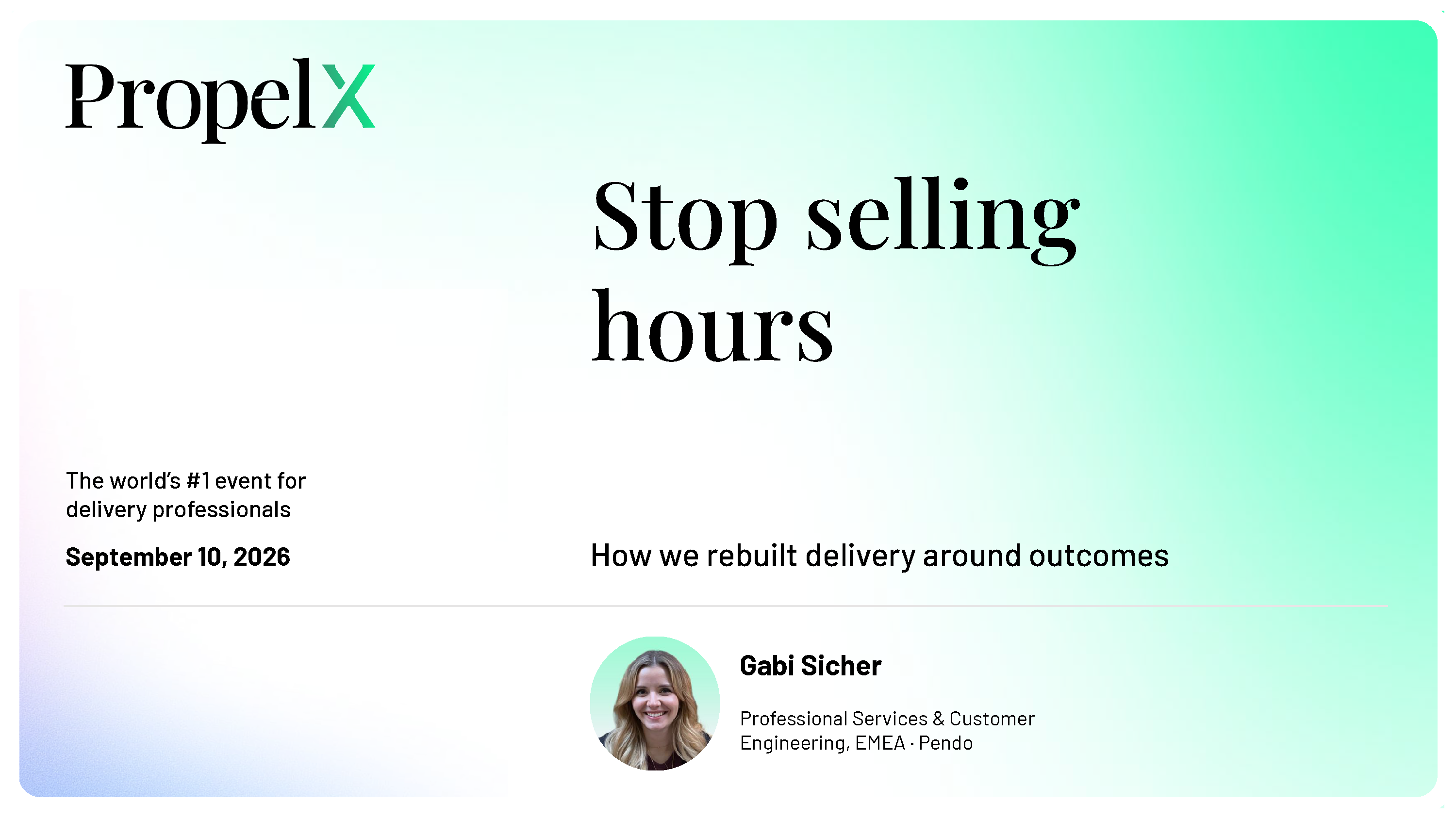
Outcome based selling: how we rebuilt delivery around outcomes


•
•
Summarize blog with






Here's a project most PS teams have closed at least once. The customer buys 20 sessions and you deliver all 20. Every session is on the calendar, every status report is green, and the project closes on track. Six months later, the customer churns.
That's exactly how it used to work at Pendo, and Gabi Sicher (Sr. Director of Professional Services at Pendo) didn't sugarcoat it: "We delivered every single hour we sold." The delivery wasn't the problem. The definition of "done" was. Done meant the sessions had run out, not that the customer had achieved what they bought Pendo for.
Which is why she ended her session with a question worth taking back to your own team: what does done really mean? If the answer is a number of sessions or a number of hours, then you're just selling hours.
Gabi leads Pendo's customer engineering and professional services teams across EMEA. At PropelX 2026 in London, she walked through how Pendo rebuilt its delivery around outcomes about two years ago, and she was honest about everything that broke along the way.
Why doesn't delivering every hour you sold lead to renewals?
For years, Pendo's delivery was product-first. One session covered how to tag a page, the next covered how to build a guide, and the team taught the product feature by feature. They ran those sessions well, because it was muscle memory and they knew the product inside out. But nothing tied the work to an outcome the customer's business actually cared about, and that link was optional in the old world.
The feedback came from everywhere. Customers struggled after PS walked away. Sales reps heard about it. Customer success told PS, "you didn't do your job." In Gabi's view, professional services in a SaaS company should be a lever for growth and help secure the renewal, and nobody renews because you delivered a set number of hours. If there's no ROI on the product, you're out of luck.
What is outcome based selling in professional services?
Outcome based selling means scoping, packaging and pricing services around the result the customer wants, not the effort it takes to get there. At Pendo, that result always ladders back to one of three PBOs, or positive business outcomes: increasing revenue, cutting costs or reducing risk.
Pendo is a product experience platform that sits on top of its customers' software. It shows them how users behave, where they get stuck, and helps them ship changes such as in-app guides to improve the experience. So every milestone, session and piece of enablement in the new model has to connect to one of those three outcomes. Anything that doesn't is just activity.
What are Pendo's five value milestones?
About two years ago, Pendo rebuilt its delivery around five value milestones, and uses the same language on every engagement:
Packages are now sized by milestones instead of hours. Larger, more complex engagements go all the way to "outcomes measured," while smaller down-market packages, where there's less money to spend, might stop at "operationally ready." That gave scoping and customer expectations a real anchor for the first time.
Why is the use case discovery session so important?
Pendo made one session mandatory: a deep use case discovery session at the start of every engagement. It's not optional, it doesn't depend on whether the customer happens to mention it, and it doesn't rely on whatever sales heard in the first few days. Everything that follows has to ladder back to the use case agreed in that session.
The hard part is getting past the customer's first, usually vague, answer to a business metric tied to real dollars. Gabi admitted the team still struggles with it, but it's non-negotiable, because "we can only prove our own KPIs once their KPIs have been proven." It's the same principle as a strong customer success plan, just moved right to the start.
How a small behaviour change ladders up to a business outcome
Gabi's onboarding example shows the chain. In Pendo, a customer can watch a user click around a screen and get stuck. The customer ships an in-app guide at that friction point, the user gets it right the first time, and they onboard faster. On its own, that's a small behaviour shift. But at scale, faster onboarding means users adopt more features, upgrade sooner and churn less, and that lands on a PBO. If all you can say at the end is that a guide went live, that's an activity, not an outcome your customer can take into a renewal or ROI conversation.
How does outcome based selling change day-to-day delivery?
Moving to outcomes didn't mean throwing away what the team already knew. In the old model, every customer got the same five generic sessions on tagging, analytics, guides and segments. When those sessions ran out, it was "see you later."
In the new model, a customer with an onboarding use case still learns tagging, but the team tags their onboarding flow. They still build segments, but it's a new-user segment. They ship an onboarding guide and then measure activation. It's the same skills and the same knowledge, repackaged around one outcome, and the engagement ends at the milestone Pendo committed to, not at an arbitrary session count.
What broke when Pendo moved to outcome based selling?
Gabi was refreshingly honest here. Every conference talk shows a clean framework that works every time, she said, and almost none of them show how it actually rolled out. Change management is where this lives or dies, and Pendo got a good amount wrong.
Nobody was thinking in outcomes yet
Internally, the team still planned by session count, but the new model meant flexing to the customer: doubling up on a topic when they needed it, skipping something irrelevant, or spending far longer on one area. Consultants kept asking whether they should really spend extra time on a topic the customer needed (yes, they should). Sales reps kept asking, "how many sessions do they get in this package?"
Gabi had to reframe it over and over across the whole go-to-market team, and said changing how people think about an engagement was harder than any process or template change.
Discovery is a skill, not a calendar slot
Adding a discovery session to the calendar doesn't teach anyone how to run one. The hardest part is the baseline: you need one to prove success, but ask a customer for it and they'll often say they don't have one. Gabi's response: "Here's the thing. It exists." It might be a small anecdote or a number buried in a report, but you have to ask different questions and get creative to surface it.
Pendo's team knew the product and the methodology, but this kind of creative business value discovery was new. One round of webinar training only went so far. People needed practice, real-time coaching and continuous feedback, the same way any customer-facing skill gets built.
It was treated like a process rollout
If you take one thing from Gabi's talk, she said, take this: Pendo treated the shift like a process rollout, with new milestones, a new template and a new tracker, and thought everything was fine. It wasn't. This is a mindset change, and it reaches past delivery into the whole go-to-market team and even to customers. In her words, "if you plan for a process rollout, not a mindset change, then old habits are going to win." That's true of almost any change management in professional services.
What's still unsolved two years in?
"Anyone that tells you that you do a transformation and it's done is lying," Gabi said. She listed four problems Pendo is still working through:
- The discovery muscle: a few weeks before PropelX, the team ran reinforcement training across the field, and started using Granola recipes for live feedback after customer calls, so people can keep practising.
- Exit criteria: behaviour change takes time to measure, so it's hard to know when an engagement is actually done without pulling away too early or letting it drag on too long.
- Procurement: tell procurement it's a fixed price based on outcomes and the reply is often "great, so how many hours is that?", followed by an attempt to reverse-engineer an hourly rate and negotiate it down. Sometimes that's a conversation you can't escape cleanly, especially with a fixed-price quote.
- Tracking: Pendo still needs better visibility into where it's over-delivering, how long projects take as a result, and how that affects margin.
How do you wire outcome based selling into your system of record?
"A model in a slide deck is kind of just a wish," Gabi said. To make it real, it has to live in the tool your team opens every day, and for Pendo that's Rocketlane.
There's one project template for every package, with the milestones as tracked checkpoints. When a deal closes in Salesforce, the plan reshapes itself, adjusting the phases to match what was sold and assigning tasks by role through the Salesforce integration.
The part Gabi is most excited about is traceability. Because every milestone is tracked, the team can see how long each one takes and where projects stall, which is the next thing she wants to dig into. As she put it, you don't just roll out a methodology, you roll it out inside your system of record.
Proving it works
Gabi was careful not to overclaim a company-wide ROI, because Pendo's delivery team is still building its own measurement muscle. She also admitted the irony: "Before Rocketlane, we didn't have any baseline data. Isn't that ironic?" But she shared one customer result. A Fortune 500 benefits platform wanted to cut its support costs.
The team found the friction points, shipped in-app guides and measured against the baseline. Support calls dropped by 15%, which the customer valued at about $1M in savings, and that's the kind of value story that makes the renewal and upsell conversation a lot easier.
5 key takeaways on outcome based selling
- Hours aren't valued. Delivering every session you sold doesn't stop a customer churning if they never reach value.
- Milestones replace session counts. Size packages by how far along the value milestones they go, not by hours.
- Discovery is mandatory. Tie every engagement to a customer KPI linked to real dollars before delivery starts.
- It's a mindset change. Plan for months of reframing across delivery, sales and procurement, not just a new template.
- Put it in the system. A model only works when it lives in the tool your team uses every day.
Best practices for outcome based selling
- Rewrite "done." Define done for your best-selling package as a milestone and a customer KPI, not a session count.
- Make discovery mandatory. Run a use case discovery session on every engagement and dig for the baseline.
- Coach discovery live. Use call feedback and practice runs instead of one-off webinars to build the skill.
- Prepare for procurement. Have a clear answer ready for "how many hours is that?" and keep steering back to the outcome.
- Track milestone duration. Measure how long each milestone takes to spot stalls and over-delivery.
About Rocketlane
Rocketlane is an agentic AI-powered professional services automation (PSA) platform built for services teams running complex implementations.
Its AI layer, Nitro, deploys named agents that do the work, not just flag it:
- Migration Agent — data preparation and transformation
- Workforce Agent — repeatable configuration at scale
- Documentation Agent — project context current across calls and emails
- Project Governance — delivery standards enforced proactively
- Nitro Signals — account risk surfaced before it escalates
The core distinction: Nitro agents produce the deliverable or enforce the gate. Most platforms advise. Rocketlane acts.
Teams using Rocketlane ship faster, recover margin through tighter governance, and scale delivery without proportional headcount growth.
Related sessions from PropelX
- Outcomes vs outputs: translating customer outcomes into measurable success: David Dixon's working-backwards framework for proving customer outcomes.
- Implementation partner management: how a $1M guarantee rewired our deployment services: how Fin rebuilt scoping and delivery around an outcome guarantee.
- Professional services trends for 2026: why delivery is the new moat: Sri Ganesan on why utilization is fading as a PS metric.
Table of Contents

Regsiter for the live webinar


Great consultants didn't join your team to spend Fridays writing documentation.
Table of contents
18 of Forbes Cloud 100 chose Rocketlane. The best PS teams aren't waiting around.
FAQs
What is outcome based selling in professional services?
Outcome based selling in professional services means packaging, scoping and pricing services around the business result a customer wants to achieve, instead of a set number of sessions or hours. At Pendo, every engagement is tied to a customer use case and measured against positive business outcomes: increasing revenue, cutting costs or reducing risk. It's closely linked to outcome-based billing.
What are value milestones in professional services?
Value milestones are checkpoints that define progress by customer results rather than time spent. Pendo uses five: use case identified, install complete, operationally ready, experience activated and outcomes measured. Packages are sized by how many milestones they include, which is a practical way of productizing services.
Why is a use case discovery session important?
A use case discovery session connects the engagement to a customer KPI tied to real dollars before delivery starts. Without it, PS teams can't set a baseline or prove an outcome at the end. Pendo made this session mandatory for every engagement, and it works best as part of a structured kickoff meeting.
What are the biggest challenges of moving away from selling hours?
According to Pendo's Gabi Sicher, the biggest challenges are changing how internal teams and sales think about engagements, building discovery skills, setting clear exit criteria, and dealing with procurement teams that still try to convert fixed prices back into hourly rates. Tracking over-delivery and its impact on project billing is another open problem.
How can PS teams measure outcomes if customers don't have a baseline?
PS teams should dig for a baseline even when customers say they don't have one, using different questions, small anecdotes or existing reports. Pendo found that a baseline almost always exists, and that tracking milestones in a system of record made it possible to measure results such as a 15% drop in support calls, a clear signal of time to value.
What are positive business outcomes (PBOs)?
Positive business outcomes, or PBOs, are the three results Pendo uses to anchor every engagement: increasing revenue, cutting costs and reducing risk. Every milestone and piece of enablement has to connect back to at least one of them, which keeps delivery focused on the value delivery the customer bought.
How do you size PS packages without hours?
Pendo sizes PS packages by how many value milestones they include. Larger, more complex engagements go all the way to "outcomes measured," while smaller down-market packages might stop at "operationally ready." This gives customers a clear commitment without tying the price to a session count, and supports more predictable professional services pricing.
How do you handle procurement teams that ask for hourly rates?
Procurement teams often try to reverse-engineer an hourly rate from a fixed, outcome-based price so they can negotiate it down. Pendo's approach is to keep steering the conversation back to the outcome, explaining that the price covers reaching the milestone regardless of hours, while accepting that some conversations can't be avoided entirely. Clear SOW terms help.
Why is outcome based selling a mindset change rather than a process change?
New milestones, templates and trackers are easy to roll out, but people keep planning by sessions and hours unless their thinking changes. At Pendo, consultants, sales reps and procurement all defaulted to session counts, so the team had to reframe engagements repeatedly. Treating it as a process rollout alone lets old habits win.
How does Pendo use Rocketlane for outcome based delivery?
Pendo uses one Rocketlane project template per package, with value milestones as tracked checkpoints. When a deal closes in Salesforce, the plan adjusts its phases to match what was sold and assigns tasks by role. Milestone tracking shows how long each stage takes and where projects stall, giving Pendo the delivery visibility it previously lacked.













Copyright © 2026 Rocketlane Corp. All rights reserved.

















.webp)