AI professional services management: The complete 2026 guide for PS leaders


•
•
Summarize blog with






The VP of PS at a 300-person B2B SaaS company just got a message from the CRO: Q3 utilization forecast, needed by end of day. She knows the number is scattered across three spreadsheets, a legacy PSA, and a Slack thread from last Tuesday. Pulling it together will take at least 90 minutes.
Meanwhile, two project managers are buried in status updates. One project went red yesterday without a single early warning signal. A senior consultant is at 140% utilization for the next six weeks, and no one flagged it.
This is not a people problem. It is an AI professional services management problem. And it is the gap separating professional services firms running on fragmented manual workflows from those building toward a fundamentally different operating model.
The fix is not a better spreadsheet or a stronger weekly standup. It is a different operating model. This guide covers all three levels of that model: what Operations AI automates first, how Delivery AI catches risk before it surfaces on a call, and what it looks like when agents execute the work instead of just tracking it.
What is AI professional services management?
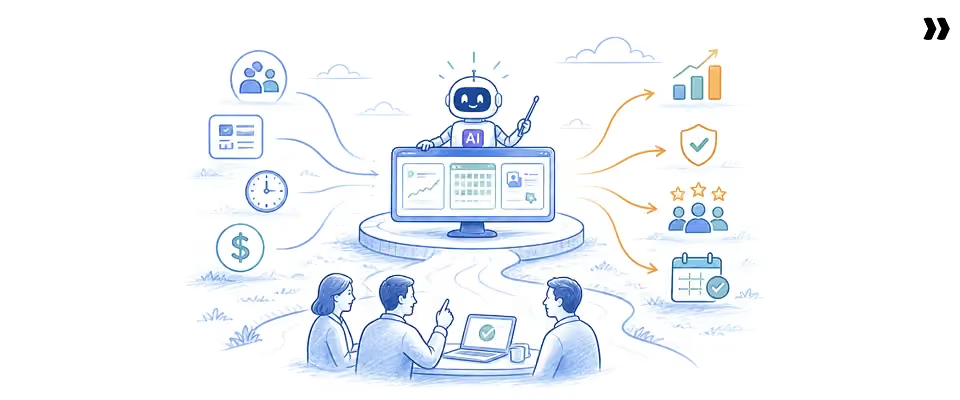
AI professional services management is the discipline of running PS delivery operations using intelligent automation and AI agents across resource allocation, project governance, financial tracking, and delivery execution, replacing manual, reactive processes with systems that sense, decide, and act autonomously.
Modern professional services organizations manage enormous operational complexity: 20 to 100 concurrent projects, resource constraints across specializations, real-time financial exposure on fixed-fee engagements, and customer-facing accountability across every milestone. Traditional PSA platforms and spreadsheet workflows cannot keep pace at the speed modern teams require.
According to SPI Research's 2025 Professional Services Maturity Benchmark, PS teams without intelligent automation report utilization rates 15 to 20 percentage points below those of top performers and spend 30 to 40% of their delivery capacity on non-billable administrative work.
AI professional services management platforms address this across three levels: automating operations (Level 1), predicting and governing delivery risk (Level 2), and deploying AI agents to execute delivery work autonomously (Level 3). This guide explains how each level works, what to evaluate, and how to build the business case.
The three-level AI PS management framework
- Level 1 - Operations AI: Automates the PS back office: timesheet governance, resource allocation, billing automation, financial tracking, capacity forecasting.
- Level 2 - Delivery AI: Monitors and governs project execution: predictive risk signals, automated project governance, real-time health monitoring, status reporting automation.
- Level 3 - Labor AI: Executes PS delivery tasks autonomously: documentation agents, migration agents, configuration agents, workforce agents.
The shift: from "AI tools that help you work" to "AI agents that work for you." This is the same transition developers experienced moving from traditional IDEs to AI-powered coding assistants.
AI-assisted vs. AI-native: why the architecture distinction matters
AI-assisted platforms are legacy PSAs with AI features added on top: think Certinia or Kantata adding AI dashboards to a back-office financial architecture. AI-native platforms are built around agentic workflows from the ground up with a unified data model.
This architectural difference determines whether a team reaches Level 2 and Level 3 transformation or stays permanently at Level 1. A legacy PSA can automate report generation. It cannot deploy documentation agents that synthesize 12 recorded calls into a 38-page design document, or migration agents that cut data transformation time from six hours to under one hour. The architecture prevents it.
This is not a features argument. It is a data model argument. AI agents need access to project, resource, financial, and customer interaction data from a single schema. When those live in separate systems, AI outputs reflect that fragmentation directly.
Why AI professional services management is a 2026 imperative
PS teams that manage operations manually are falling structurally behind top performers in utilization, time to value, and margin. Not incrementally, but at a rate that now affects competitive positioning and talent retention.
Benchmark data: the performance gap
- Billable utilization: Top-performing PS teams operate at 78-82%. Industry median: 62 to 67% (SPI Research, 2025).
- Time to value: Best-in-class: 30 to 45 days. Industry median: 60 to 90 days.
- Gross margin on services: Top performers: 65 to 72%. Median: 48 to 55%.
- Admin overhead: Median PS teams spend 35% of consultant time on non-billable activities.
These gaps do not close through hiring. They close through AI professional services management.
Three converging pressures make 2026 the inflection point for most professional services organizations:
Scale without headcount math no longer works manually. PS teams targeting 50 to 100% revenue growth cannot hold utilization targets while manually managing resource allocation across 50 to 150 concurrent projects. The spreadsheet breaks before the headcount arrives.
Fixed-fee margin exposure is accelerating. As more PS work is priced on outcomes, financial accuracy requirements increase. A project 20% over budget, without early detection, directly erodes margins. AI financial visibility closes this gap before the damage compounds.
Customer expectations have reset. B2B buyers now expect implementation transparency on par with consumer product experiences. Teams still delivering via email and weekly status calls lose deals to competitors offering real-time portals and automated milestone reporting.
The AI overview for this topic identifies three clusters of operational benefits: Project and Resource Optimization, Workflow Automation, and Billing Transformation. Each maps to a level of the AI PS management framework and represents a distinct competitive advantage for professional services industry leaders who adopt it as part of a deliberate AI strategy.
Level 1: AI-powered operations -- automating the PS management back office
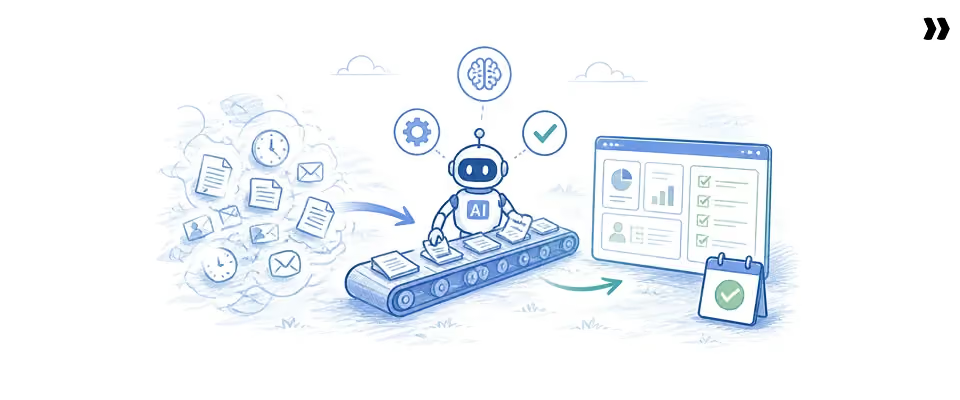
Level 1 AI automates the operations and reporting layer of PS management: workflow automation for timesheet compliance, billing transformation for accurate real-time revenue recognition, and resource allocation intelligence that replaces manual spreadsheet planning with AI-recommended staffing decisions.
The back office of a PS organization runs on rule-bound, data-intensive processes. Every one of them is automatable. Most professional services organizations are still doing them manually.
Resource management AI analyzes skills matrices, availability, utilization rates, cost rates, and project requirements simultaneously to surface optimal allocation recommendations. The resource manager's role shifts from manual search to reviewing and approving AI-generated staffing decisions. What takes 15 to 20 minutes per project manually becomes a 2- to 3-minute conversation with the agent.
Timesheet governance enforces billing rules at submission. Regional holiday compliance, overtime thresholds, billable vs. non-billable categorization, project-specific rules. Violations are flagged at point of entry, not at month-end review. Teams deploying timesheet governance agents consistently report a 40% efficiency improvement on compliance overhead, and finance gains accurate financial data in real time.
Workflow automation and billing transformation eliminate the 1- to 2-week gap between sales close and project kickoff. Billing milestone automation ensures revenue recognition triggers fire without manual intervention. Auto-allocate means resource forecasts update automatically when project timelines shift, with no manual re-plotting required.
The 30 to 40% problem: quantifying what Level 1 AI recovers
Most PS leaders know their teams spend too much time on admin. Fewer have calculated what it costs.
A 50-person PS team where each consultant spends 35% of their time on non-billable admin is losing roughly 17.5 FTE-equivalents of billable capacity. At a blended billing rate of $175 per hour, recapturing 40 to 50% of that overhead within the first 90 days of Level 1 deployment returns $2.4M to $3M in annual capacity without a single new hire.
This is the Level 1 ROI calculation. It is also the foundation for the conversation with your CFO, and for getting AI implementation funded internally.
Level 2: AI-powered delivery management -- from reactive oversight to predictive control
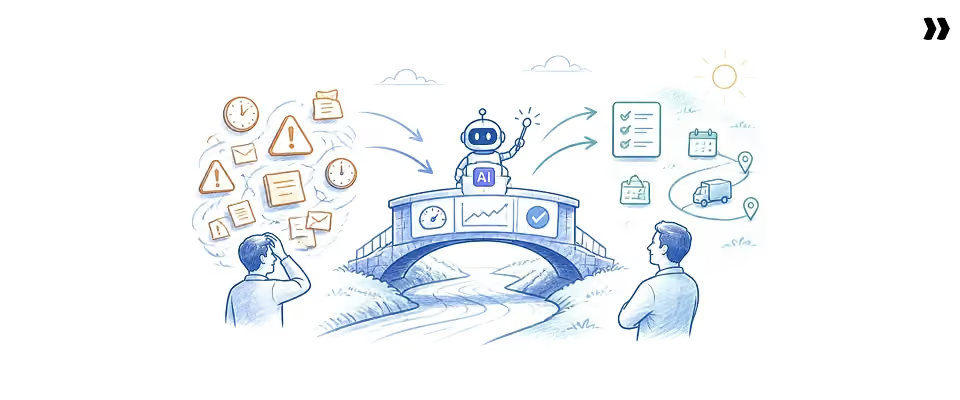
Level 2 AI transforms PS delivery management from reactive crisis response to predictive project and resource optimization, surfacing project health risks 48 to 72 hours before they compound, automating governance enforcement, and reforecasting resource demand in real time.
The most expensive moment in PS delivery is the Friday afternoon call when a project has already gone red. Level 2 AI eliminates that moment by detecting the signals early: scope drift, utilization compression, milestone slippage patterns, before they become client-visible problems.
Project governance AI automatically enforces project execution standards. Tasks cannot be marked complete without required documentation. Milestones cannot be closed without the sign-off criteria being met. Phase transitions require all predecessor conditions satisfied. Consistency scales without PM experience variance and without relying on any single person's institutional knowledge to enforce it.
Predictive signals and risk detection analyze project activity, timeline patterns, customer engagement rates, and resource data to automatically surface risk flags. A project showing declining customer task completion rates, two sequential milestone delays, and a utilization spike on the lead consultant is flagged as at-risk before the PM notices, not after the client escalates.
Automated status and reporting generate executive summaries, board-level dashboards, and customer-facing status updates from project data. The PS leader's weekly update is not pulled from four spreadsheets. It is generated by the system.
The revenue recognition connection: why Level 2 AI directly protects margin
Milestone-based billing requires milestone governance. When governance is manual, milestones slip, revenue recognition delays, and the gap between work delivered and revenue recognized widens.
When governance is automated, milestones fire when conditions are met, not when someone remembers to close them. A single project escalation undetected for three weeks costs senior PS and executive time, client relationship risk, and potential scope renegotiation. Early detection costs a notification and a 30-minute course correction.
Teams running automated delivery governance consistently report that project budget overruns caught before 80% completion are recoverable. Caught after, they are write-offs. The margin arithmetic makes the Level 2 case without any vendor involvement.
Level 3: AI-powered labor management -- agents that execute PS work
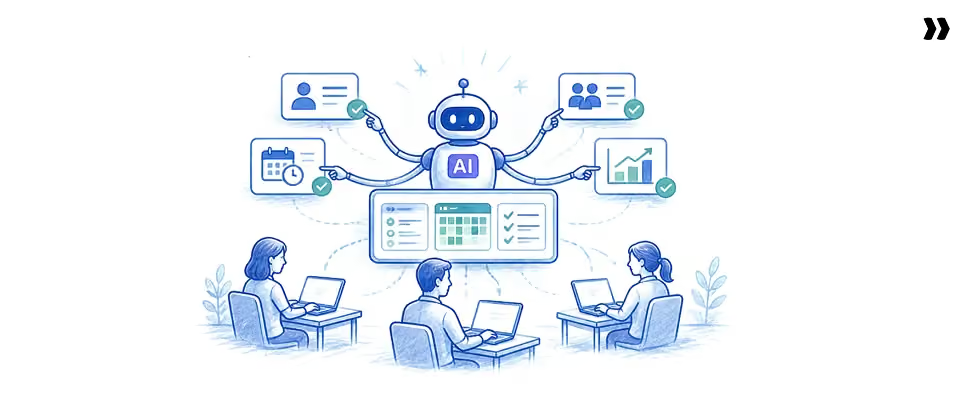
Level 3 AI executes delivery work end to end, producing value-based deliverables autonomously: design documents, migration artifacts, configuration outputs, with the PS professional operating as a quality gate rather than a production resource.
Level 1 and Level 2 make humans more efficient. Level 3 changes the output-to-headcount ratio.
Documentation agents analyze recorded calls, workshops, and email threads to generate complete design documents, SOWs, handoff summaries, and solution documents, with citations showing exactly which source each piece of content was drawn from. This is where knowledge management stops being a spreadsheet problem and starts being a solved one.
Proof point: 38-page design documents requiring 300 questions answered. Previously 16 to 17 hours of work per document. With the documentation agent: 1.5-2 hours. That is 90% time savings on a critical, revenue-qualifying deliverable.
Migration agents handle data transformation, the most time-consuming and error-prone component of most PS implementations. Plain-language mapping rules, a native review interface with inline error highlighting, and validation logic built in. Poor data quality issues that would take days to surface manually get flagged in minutes. Proof point: data transformation reduced from 5 to 6 hours per migration project to under one hour.
Workforce agents handle configuration automation, bulk data operations, custom field creation, document review tasks, and system setup. These agents convert structured, repeatable processes into autonomous workflows without requiring engineering involvement.
What Level 3 AI does not replace: the human value threshold
Level 3 agents do not replace client relationship management, novel scope negotiations, ethical judgment calls, or organizational change management. They cannot evaluate whether their own AI outputs are correct without human review.
The agent produces. The expert evaluates and approves.
This framing matters for the change management conversation with your team. Consultants who understand that Level 3 AI handles documentation, data transformation, and configuration, freeing them for the client-facing work that requires judgment and trust, adopt the tooling. Those who feel the framing is ambiguous resist it.
Positioning Level 3 AI as scope reduction is the most common AI adoption mistake PS organizations make.
How Do You Evaluate AI Professional Services Management Software in 2026?
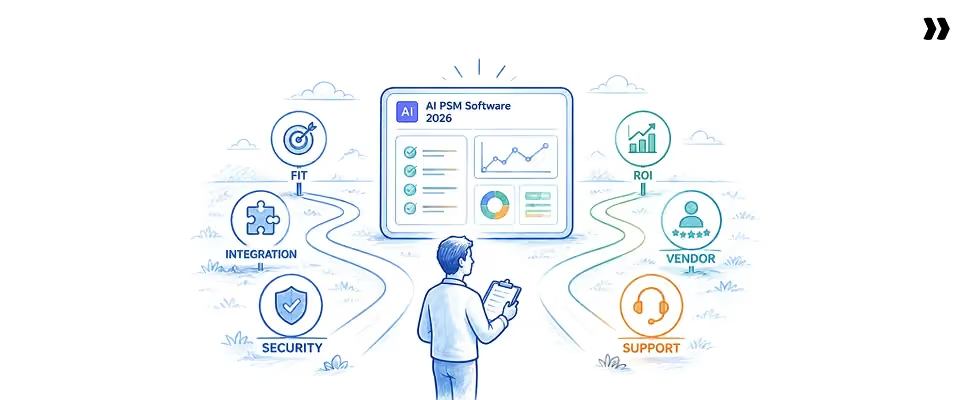
Evaluating AI PS management software requires distinguishing AI-native platforms from legacy PSAs that add AI features. The architectural difference determines whether a platform reaches Level 2 and Level 3 transformation or stays permanently at Level 1 automation.
The right AI tools for PS management are not the ones with the longest feature list. They are the ones whose architecture was built to support the level of transformation your team needs.
Five evaluation criteria:
1. AI architecture: native vs. bolted on. Can AI agents access project, resource, financial, and customer interaction data from a single unified schema, or do they query separate systems via integrations? Fragmented data produces fragmented AI outputs. This is the most important question in any evaluation of an AI implementation.
2. Level coverage. Which of the three levels are natively supported? Most platforms in 2026 deliver Level 1 and partial Level 2. Level 3 is available only on platforms with agentic architecture. Ask directly: can the platform's agents produce documentation, run migrations, and execute custom workflows, or only surface insights and trigger notifications?
3. Implementation velocity. Legacy PSA implementations typically take 6 to 12 months and require dedicated Salesforce admins for configuration changes. AI-native implementations run 4 to 12 weeks. Implementation timeline is a proxy for architectural complexity. The harder to implement, the harder to configure AI agents on top of it.
4. Unified platform vs. integration dependency. When a project timeline changes, does resource allocation update automatically, or does a human manually sync the changes across systems? The answer reveals whether the platform is truly unified or assembled from integrated modules with a thin API layer.
5. Customer-facing capability. AI PS management that addresses only internal operations leaves the front office manual. Evaluate whether the platform provides customer portals, automated milestone notifications, and customer accountability tracking as native capabilities, not add-ons.
Certinia and Kantata vs. AI-native PSA: the architectural gap
Certinia and Kantata were built for back-office financial management: billing, revenue recognition, Salesforce-based reporting. They were not designed for agentic workflows or real-time delivery intelligence.
Adding AI features to a legacy architecture produces Level 1 automation at best. The data model of a Salesforce-native PSA prioritizes financial reporting, not the real-time signal processing that Level 2 predictive delivery requires, nor the multimodal input handling that Level 3 documentation agents depend on.
This is not a criticism of their financial reporting capabilities. It is a structural constraint. Moving to Level 2 and Level 3 requires a platform built for it from the ground up. Evaluating on roadmap promises rather than deployed architectural capability is one of the five pitfalls below.
What Are the Five Most Common AI PS Management Adoption Pitfalls?
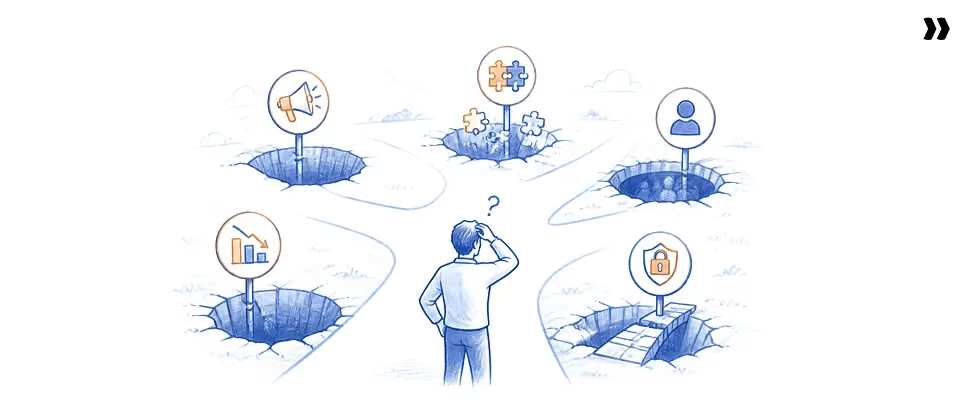
The most common pitfall in AI PS management adoption is treating it as a tooling change rather than an operating model change. Deploying AI automation on top of broken processes produces faster broken processes, not transformation.
Pitfall 1: automating the wrong things first. Starting with high-complexity workflows like resource optimization or predictive signals before establishing data foundations produces unreliable AI outputs. Clean resource profiles, consistent time tracking, and standardized project templates are prerequisites. Start with Level 1 clean, rule-bound processes, then advance.
Pitfall 2: treating AI as a reporting layer. Teams that deploy AI to generate better dashboards but keep manual workflows unchanged capture 10 to 15% of available efficiency gains. Transformation requires workflow redesign, not just improved visualization. The AI strategy has to touch the workflow, not just the report.
Pitfall 3: underestimating change management. The fastest AI implementation failure mode is deploying an AI-native platform without a structured adoption plan. Show consultants specifically how AI reduces their personal admin burden within the first 30 days. Without visible personal relief, adoption stalls. With it, adoption is self-reinforcing.
Pitfall 4: evaluating on roadmap instead of current capability. Every PSA vendor in 2026 has an AI roadmap. Evaluating announced features rather than deployed architectural capabilities leads teams to platforms that will not natively support Level 2 or Level 3, regardless of roadmap promises. Ask: What does the platform do today in production for paying customers?
Pitfall 5: no pilot outcome definition. AI transformation pilots without a baseline metric and a defined success threshold cannot produce a business case for full deployment. Target one high-friction workflow, establish one measurable baseline, define one success metric before starting.
How Do You Build the Business Case for AI Professional Services Management?
The business case rests on four quantifiable levers. Each maps to a metric the PS leader, the CFO, and the CRO all track.
- Admin time recaptured: (team size x avg billable rate x recovered hours per week x 52). A 50-person team, recovering 8 hours per consultant per week at $175/hr, recaptures $3.6M in annual billable capacity.
- Utilization improvement: A 10-point improvement in utilization on a 50-person team at $175/hr, running at 65%, generates approximately $1.4M in additional annual revenue without a single additional hire.
- Margin protection: Calculate: (number of at-risk projects per quarter x average project value x historical overrun rate x % prevented by early detection). Budget overruns caught before 80% project completion are recoverable. Caught after, they are write-offs.
- Escalation cost reduction: One PS escalation undetected for three weeks costs 40 to 60 hours of senior PS and executive time plus client relationship risk. Apply a 40-50% reduction to Level 2 predictive management and multiply by the annual escalation frequency.
These four calculations, tied to utilization rate, time to value, client satisfaction scores, gross margin, and forecast accuracy, give the CFO a specific, defensible ROI model rather than a vendor promise.
Decision routing: which AI PS management approach is right for your team right now?
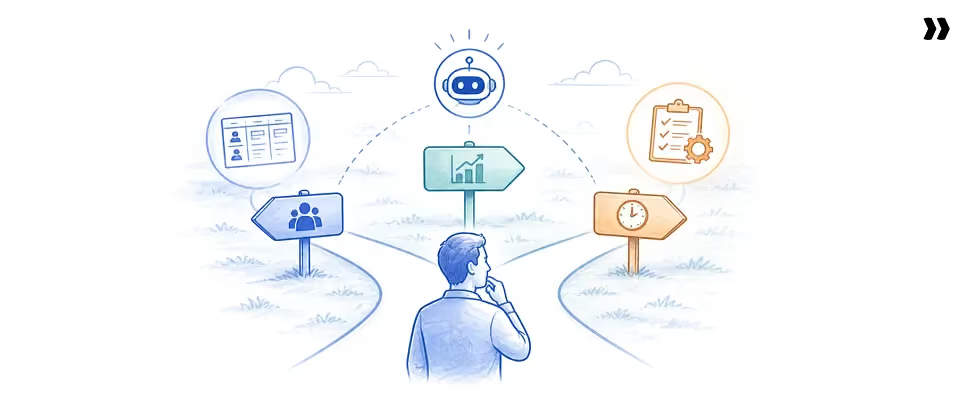
The right AI PS management tier depends on team size, operational maturity, and primary pain. Teams with fewer than 30 delivery professionals should start at Level 1. Teams between 30 and 75 should build toward Level 2. Teams above 75 managing multi-region delivery should evaluate unified Level 1, Level 2, and Level 3 capabilities.
The routing inflection point occurs at two thresholds: when team size reaches 50 delivery professionals and when PS revenue reaches $50M ARR.
Below both, Level 1 automation captures most of the available efficiency gains and provides the data foundation required for Level 2. Above both, especially in multi-region, multi-product environments, the absence of Level 2 predictive management becomes a structural bottleneck.
Level 3 agent capability becomes economically decisive when the same delivery workflow repeats across 20 or more projects per quarter, and the cost per repetition exceeds the investment in agent configuration.
How Does AI Professional Services Management Work for Global PS Teams?
Global PS management considerations by region
- North America: Largest and most competitive PS talent market. NA PS teams face the highest time-to-value expectations from SaaS buyers and the greatest pressure to deliver faster implementations. Strong sales-to-delivery handoff via Salesforce integration and AI-driven resource management that handles complex skills matrices are the primary evaluation criteria for teams managing both SMB and enterprise implementation tracks.
- EU (Germany, Benelux, Nordics, France): GDPR compliance requires data residency options and audit-ready data trails for customer-facing project data. Multi-currency billing and multi-entity financial reporting are baseline requirements. AI PS platforms that automate cross-border billing governance and offer EU data residency reduce compliance overhead meaningfully for PS teams operating across multiple jurisdictions.
- UK (post-IR35): IR35 compliance requires granular categorization of contractor time and audit-ready timesheet records that distinguish between inside-IR35 and outside-IR35 engagements. AI timesheet governance agents that enforce IR35-compliant categorization rules at submission reduce compliance risk and audit preparation time. PS teams with high contractor ratios should make timesheet governance AI their first Level 1 deployment.
- APAC (India, ANZ, SEA): Fastest-growing PSA adoption region, with high billable utilization targets (85 to 90%) driven by cost-competitive delivery AI models. Real-time resource utilization visibility and skills-based allocation AI are the primary value drivers. Level 3 documentation agents produce immediate ROI in markets where implementation documentation is thorough and mandatory but consultant time is the primary cost constraint.
- MENA (UAE, Saudi Arabia, Egypt): Multi-currency support and VAT compliance following the 2018 GCC implementation are non-negotiable. Friday/Saturday work-week configuration for Saudi Arabia-based teams requires platform support for regional calendar rules. Configurable compliance rules and multi-currency financial management natively support MENA delivery structures.
What Should You Look for in an AI-Native PS Management Platform?
An AI-native PS management platform must provide unified project, resource, financial, and customer management within a single data model, with AI agents that operate natively across all three transformation levels, rather than as features layered onto a legacy PSA architecture.
G2 ratings as of May 2026. Certinia and Kantata from the G2 PSA category. Monday from G2 Project Management category.
How Rocketlane delivers AI professional services management across all three levels
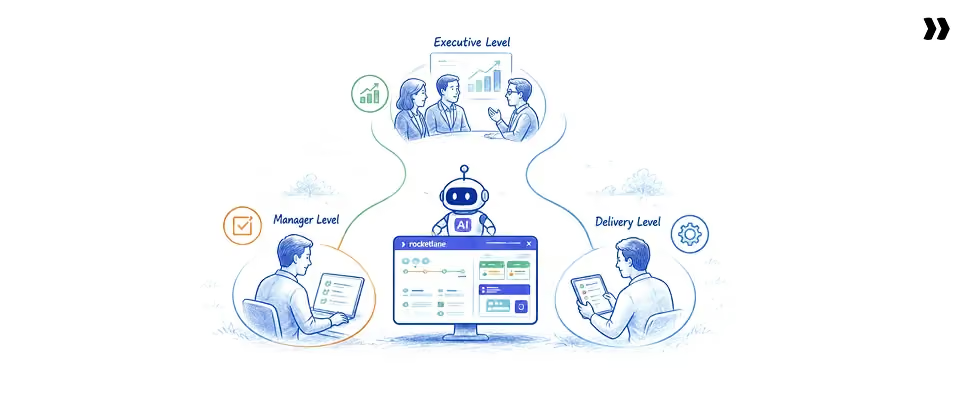
Rocketlane is the only PSA with native AI capability across all three levels of PS management transformation: operations automation (Level 1), predictive delivery governance (Level 2), and agent-executed delivery work (Level 3), in a single unified architecture where every agent has access to the complete project, resource, financial, and customer data model.
Rocketlane was purpose-built for modern customer-facing project management and added PSA financial capabilities on top, rather than starting with back-office accounting and adapting it for delivery.
This architectural decision means AI agents access complete project context from a single schema. The result is AI integration that is useful on day one without custom middleware or months of configuration.
More than 750 customers, a 94% G2 recommendation rate, and a $60M Series C focused on scaling its agentic AI capabilities.
Rocketlane Nitro: Level 1 operations AI
Nitro is Rocketlane's agentic AI layer, embedded inside the PSA platform and operating inside live project data in real time. Nitro agents execute delivery work autonomously. They do not sit alongside the work. They operate within it.
The Timesheet Policy enforces billing rules at submission. Regional holiday compliance, overtime thresholds, billable vs. non-billable categorization, project-specific rules. Violations are flagged before they reach review, not after they reach the invoice. Compliance at point of entry, not at review.
The Nitro Analyst answers natural language questions across all portfolio data in real time. "Which projects are at risk of overrunning this quarter?" "What is our blended utilization for the past 30 days?" "Which accounts have missed two consecutive milestones?" Portfolio answers in seconds, without building a report. It also identifies allocation problems vs. hiring problems, surfacing AI outputs that previously required hours of ops team time to compile.
Resource management agent (currently in active rollout) analyzes every resource across skills, certifications, active allocations, availability windows, cost rates, and time-off simultaneously to surface optimal team composition for incoming projects. Two optimization modes: load balancing or margin maximization. Right resource, right project, right cost, in seconds.
Auto-allocate means resource forecasts update automatically when project timelines shift. No manual re-plotting. No chasing teams for updated forecasts the week before a board review.
Rocketlane Nitro: Level 2 delivery management AI
The Project Governance Agent enforces execution standards at every phase transition. Tasks cannot be completed without required descriptions. Milestones cannot close without approval chains satisfied. Dependencies are enforced. Customer sign-off gates are mandatory. Proactive governance, not reactive fire-fighting.
Nitro Signals monitors customer calls, emails, and project activity across all active accounts and automatically surfaces early warning signals. Two distinct modes:
Project Signals monitor within active delivery: critical tasks overdue with no update, budget burn rate trending above plan, milestone completion rate falling behind schedule, no project activity logged past the threshold. Account Signals monitor cross-project external data: churn risk when a champion goes quiet, expansion cues when a client mentions a second team needing onboarding, and escalation warnings when budget-anxiety language appears in email threads. Early warning, not post-mortem.
Nitro Meetings captures, transcribes, and summarizes project and client meetings. Surfaces action items, open blockers, and decisions from call transcripts. Connects meeting content directly to project records automatically. Works with Gong or Rocketlane's native call recorder. Every call captured, connected, and actioned, automatically.
Soft booking and pipeline forecasting enable project creation from Salesforce opportunities before deals close. Resource planning before the contract is signed, not after. Capacity forecasting, informed by pipeline probability, ensures the PS team is never caught flat-footed at quarter-end.
Rocketlane Nitro: Level 3 labor management AI
The Documentation Agent turns knowledge from recorded calls, workshops, and emails into complete project documentation: BRDs, handoff documents, status summaries, SOW compliance summaries, onboarding runbooks. With citations showing exactly which source each piece of content came from. Institutional knowledge that survives team turnover.
Proof: 38-page design documents with 300 questions answered. Previously 16 to 17 hours of effort per document. With the Documentation Agent: 1.5 to 2 hours. That is 90% time savings on a critical, revenue-qualifying deliverable.
The Migration Agent guides customer data migrations end to end. Validates data quality against the target schema in real time. Flags mapping errors and data conflicts before they become go-live blockers. Produces a reusable migration playbook for the next customer on the same platform. Go-live without surprises; every migration a repeatable playbook.
Proof: data transformation reduced from 5 to 6 hours per migration project to under one hour.
Workforce Agents convert SOWs into fully structured, ready-to-execute project plans. The agent reads the SOW, maps deliverables to tasks and phases, sets dependencies, assigns resource types, and builds the delivery plan. Non-billable setup time reduced by 60 to 70%. Delivery starts day one, not day five.
Teams can also build Workforce Agents for their own specific repeatable workflows: custom field creation, system setup, document review tasks, bulk data operations, and configuration work that currently consumes consultant hours on every engagement.
Enterprise-grade PS management at scale
SSO/SAML, advanced permissions and role-based access, audit logs, multi-currency support, multi-entity financial management, GDPR-compliant data residency options. Native bi-directional integration with Salesforce and HubSpot. NetSuite integration. Slack and Teams integration. Native Jira integration. HRIS integration (BambooHR) with no middleware dependency.
Implementation guaranteed in 4 to 12 weeks, or your money back. Compare that to 6 to 12 months for legacy PSA platforms, with high upfront professional services costs and Salesforce admin dependency for every configuration change.
[See how Rocketlane's AI agents handle resource allocation, project governance, and delivery execution. Book a 20-minute walkthrough]
What to know before you buy: 4 objections PS leaders have about AI PS management tools
The four objections that most frequently stall AI PS management investment each have a specific, data-backed resolution.
What to know before you buy
Objection 1: "AI is just hype. Show me the actual value."
Level 1 AI has documented, measurable outcomes: 40% efficiency improvement on timesheet management, 15 to 20 percentage point utilization improvement, 30 to 40% reduction in PM admin time.
Ask any vendor for three customers willing to share pre and post metrics on utilization and admin time. If they cannot produce three with specific numbers, the claim is marketing, not product evidence.
Objection 2: "Change management is too hard. My team is already overwhelmed."
Change management burden is highest when a tool change does not reduce work for the people being asked to change. AI PS management reduces PM admin time by 30 to 40% within 90 days.
When consultants see their timesheet friction disappear, project setup time cut from an hour to minutes, and documentation burden reduced by 90%, adoption becomes self-reinforcing. Start with Level 1 workflows that produce the fastest visible personal relief before advancing.
Objection 3: "We already have Certinia or Kantata. Switching is too disruptive."
The switching cost question requires comparing two disruptions: the one-time migration vs. the ongoing operational cost of manual processes and missing AI capability. Teams on legacy PSAs cannot reach Level 2 or Level 3 AI transformation regardless of roadmap promises.
Calculate the ongoing cost of manual resource management, spreadsheet forecasting, and reactive project oversight. Then compare to an 8 to 12 week migration with implementation support and a go-live guarantee.
Objection 4: "We need Salesforce-native."
"Salesforce-native" means Salesforce admin dependency for configuration changes, Salesforce licensing costs for every PS user, and an architecture that prioritizes CRM data over delivery data.
Bi-directional integration with Salesforce delivers the data sync requirement without the licensing overhead or admin bottleneck. The right question: can my PS team configure and modify the platform without a Salesforce admin?
Conclusion
The VP of PS we opened with is not running a broken team. She is running a capable team on an architecture that was never designed for this level of complexity. Ninety minutes to pull a utilization number that should take ten seconds. Two PMs underwater on status updates. A senior consultant at 140% with no early warning. That is not a talent problem. That is an AI professional services management problem.
The teams pulling ahead in 2026 are systematically eliminating the 30 to 40% admin tax at Level 1, catching project risk before it becomes client-visible at Level 2, and deploying agents to execute the delivery work that currently consumes consultant capacity at Level 3.
The three-level framework in this guide gives you a precise diagnostic: which tier matches your current pain, what the ROI calculation looks like, and which capabilities are production-ready today vs. still maturing.
The sequence matters. Clean data and Level 1 foundations first. Level 2 signal monitoring once the operational layer is stable. Level 3 agent deployment only with the template investment to support it. Teams that respect this sequence consistently outperform those who skip to the most impressive capability first.
For PS organizations at B2B SaaS companies managing complex implementations at scale, the architectural difference between AI-native and AI-bolted-on is not a features question. It is a transformation ceiling question. Platforms built specifically for this operating model, where the front office and back office run on the same data, where AI agents operate inside delivery rather than alongside it, are where the performance gap gets closed.
Table of Contents

Regsiter for the live webinar


Great consultants didn't join your team to spend Fridays writing documentation.
Table of contents
18 of Forbes Cloud 100 chose Rocketlane. The best PS teams aren't waiting around.
FAQs
What is AI professional services management?
AI professional services management is the discipline of running PS delivery operations using intelligent automation and AI agents across resource allocation, project governance, financial tracking, and delivery execution, replacing manual, reactive processes with systems that sense, decide, and act autonomously across three transformation levels.
How is AI transforming the professional services industry?
AI is shifting the professional services industry from manual, reactive management to predictive and autonomous delivery. Top-performing AI-enabled PS teams achieve utilization rates 15 to 20 points above manual operations teams and time to value 30 to 50% faster than industry median, according to SPI Research (2025).
What are the challenges of implementing AI in professional services?
The four primary challenges are: poor data quality in existing systems, deploying AI on broken processes instead of fixing them first, change management without visible personal benefit to consultants, and choosing legacy PSAs with AI features that are architecturally limited to Level 1 automation regardless of roadmap claims.
What manual work can AI eliminate in PS management?
AI PS management eliminates the highest-volume manual workflows: timesheet compliance review (40% efficiency gain), resource allocation per project (15 to 20 minutes reduced to 2 to 3 minutes), design document creation (90% time reduction), and data migration transformation (5 to 6 hours reduced to under one hour).
How long does it take to see value from AI PS management tools?
Teams report initial efficiency gains within 30 to 60 days starting with Level 1 automation. Full operational transformation takes 90 to 120 days. Level 3 agents (documentation and migration) produce measurable ROI within the first month given the scale of time savings per project. Clean data is the critical prerequisite.
How does AI improve resource allocation in professional services?
AI resource allocation analyzes skills, availability, utilization rates, cost rates, certifications, and timeline constraints simultaneously to recommend optimal allocations in seconds. Emergency reallocation scenarios are handled conversationally. Teams report 15 to 20 percentage point business development within six months of deployment.
What is the difference between AI-powered PSA and traditional PSA?
Traditional PSA platforms were built for back-office financial management. AI-powered PSA platforms use a unified data model giving agents access to project, resource, financial, and customer interaction data simultaneously. This architectural difference determines whether a platform reaches Level 2 and Level 3, or stays at Level 1.
What does a successful AI PS management pilot look like?
A successful pilot runs 60 to 90 days, targets one high-friction workflow, establishes a baseline metric before deployment, and measures a single primary outcome. Start with timesheet governance AI. Teams consistently report 35 to 40% efficiency improvement within the first 60 days, generating the ROI data for full deployment approval.
How does AI professional services management affect the PS operating model?
AI transforms the PS operating model by reducing the cost basis per project without reducing margin. When admin, governance, and delivery execution are automated across all three levels, PS teams can price on outcomes rather than hours. Teams that add AI tooling without updating their operating model capture only a fraction of available gains.
Why do consulting firms and PS teams choose Rocketlane?
PS teams choose Rocketlane because it is the only platform with native AI solutions across all three transformation levels in one unified architecture. Documentation agents cut design document creation from 16 to 17 hours to 1.5 to 2 hours. Migration agents cut data transformation to under one hour. 750+ customers, 94% G2 recommendation rate.













Copyright © 2026 Rocketlane Corp. All rights reserved.
















.webp)