Building AI customer onboarding: redesigning professional services teams for the outcome era


•
•
Summarize blog with






Sukanya took to that podium by talking about an author from Paris, and his long book without using a particular symbol most common in... Alright, I can't.
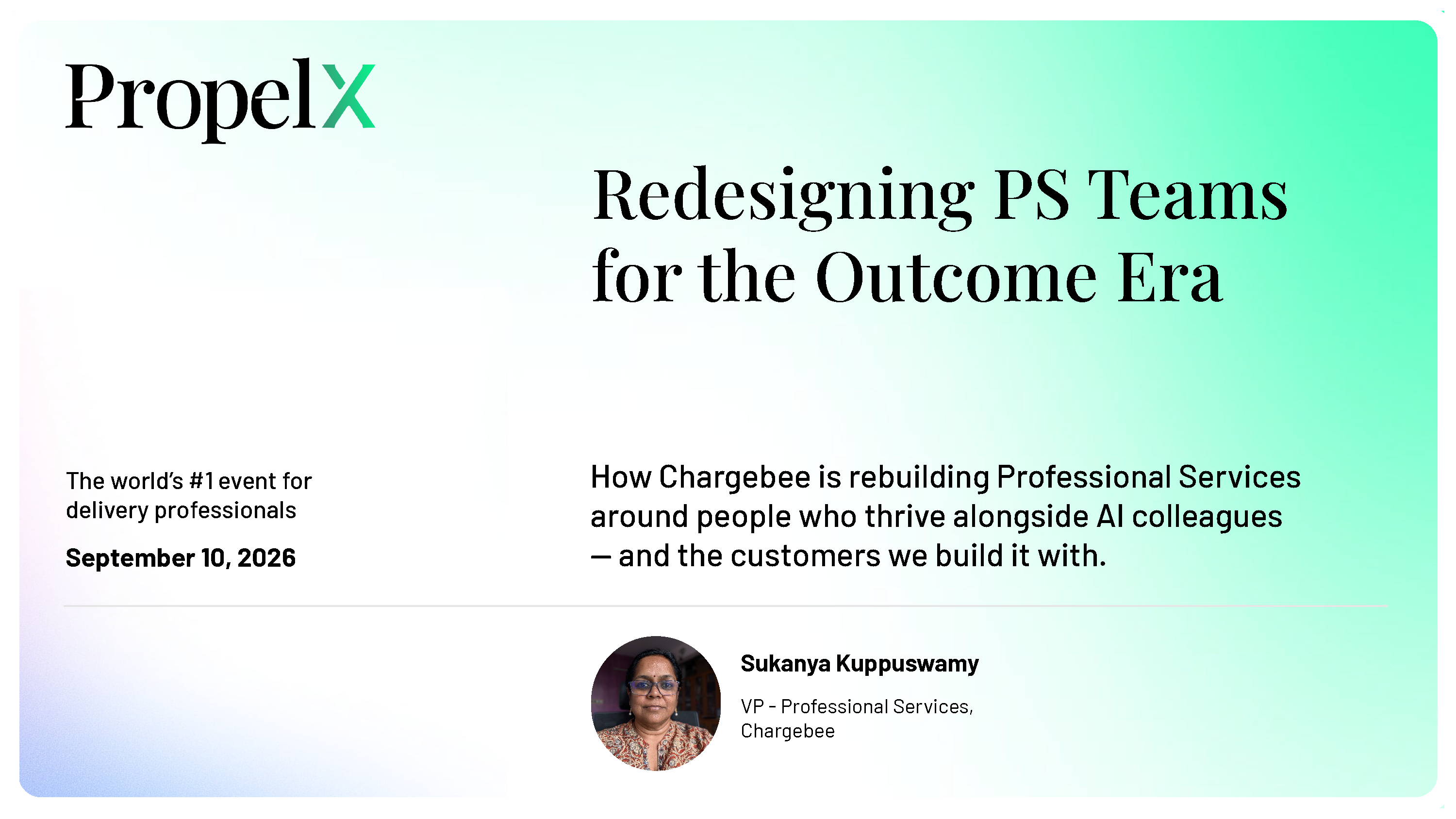
Sukanya Kuppuswamy (VP of Professional Services at Chargebee) began the session with a French author, Georges Perec, who wrote a whole detective novel spanning 300 pages without using the letter E, the most common one in French. I couldn't cross the first line, even in English.
That's the point she makes: constraints don't restrict you, they only make your work better. Constraints are great and all, but we'll be breaking this one, since there's no PropelX without an E. Never have I appreciated the letter E more in my life.
Sukanya knows a thing or two about constraints. Billing sits inside some of the most unforgiving workflows in any business, so her team at Chargebee works with zero fault tolerance. At PropelX 2026 in London, she walked through how Chargebee has been rebuilding PS around "people who thrive alongside AI colleagues," and what building AI customer onboarding actually looks like when a single wrong invoice is a very bad day.
Why do PS teams need to be redesigned for the outcome era?
Sukanya opened with two numbers. According to McKinsey, 70% of IT projects fail, "not because people chose the wrong product, but because we showed up poorly as implementation teams." On the other side, businesses are 2.5x more likely to achieve ROI when they deploy structured professional services teams as part of a transformation.
The pressure on those teams is only growing. Buyer personas are converging, CFOs have a bigger say in what gets bought, and executives are experimenting with AI themselves. Almost every prospect asks the same two questions in the first call: how quickly can you take me live, and how soon can I see ROI?
They're easy questions to ask and very hard to answer with anything better than a range, especially in billing, where every edge case nobody dreamt of eventually shows up in UAT.
How do handoffs cause context loss in customer onboarding?
When Chargebee mapped its customer journey, it found 7 distinct handoff points between sales, solution consulting, implementation, data migration, customer engineering and customer success.
Every one of those teams was operating with good intentions. But from the customer's side, it meant saying the same thing again and again to seven different teams, and every human handoff meant a little more context lost.
A living design document that everyone writes into
To fix it, Chargebee co-designed a Documentation Agent with Rocketlane, as one of its early design partners. As Sukanya put it, "a lot is said and a lot is understood, very less is documented." The agent collects context from every conversation and turns it into a formatted design document that moves from sales into implementation and beyond as a continuous living document.
Everyone who touches the customer adds to the same document, including customer success later in the lifecycle. Agents add to it too, and the LLMs Chargebee uses to fetch
from it. That's how context retention "is no longer a myth" at Chargebee, and it's working across every customer segment.
How can AI agents make onboarding discovery faster?
The second fix is specific to billing: the product catalogue. Every Chargebee customer has to bring in what they sell and how they sell it, and asking them to explain it again at every stage isn't a great customer experience. So Chargebee built a Product Catalog Agent that reads a prospect's pricing page before the first design call and builds a draft catalogue on its test sites.
That changes how the kickoff starts. Instead of opening with "can you tell us how you sell?", the team opens with "this is how we think you sell, can we just take this forward?" It sounds like a small wording change, but it tells the customer you've done your homework before asking them to do theirs, and Sukanya said the difference is already paying off.
Why is go-live no longer the finish line?
Time to go-live, utilization and billable hours are still measured at Chargebee, and most hands in the room went up when Sukanya asked who uses them today. Her point wasn't that these metrics will disappear, but that they're no longer enough. Taking a customer live used to be the end of implementation. Now it's just the beginning.
The new measure is value adoption. If a customer signed up for 50 features, are they actually using them, in the way they were meant to solve the business problem? Chargebee uses telemetry to find out. The end goal is customer-led expansion, built on solving the two or three critical workflows the customer came to fix rather than switching on every feature. Some Chargebee customers are already expanding on their own while still in implementation.
How does Chargebee use AI agents across the company?
Before getting into PS, Sukanya showed how the whole company has been reinventing itself with agents:
- Bumblebee: an IT service agent that now resolves 51% of all IT queries, deployed in just the last three months, freeing up the support load on internal teams.
- Marvin: a marketing agent that cut deep marketing analysis from weeks to 30 minutes, and helps keep web pages updated straight from Slack.
- Customer 360: the most widely used agent in the company, pulling context from every customer conversation and system of record into a single unified customer profile for sales, CS and implementation.
- An "amber customer" agent (in beta): it warns teams before signing a prospect that looks like past customers who struggled, so everyone has the same view of customer health before implementation starts.
Access plus guardrails builds trust
Trust is central to professional services, and that includes your team's trust in their AI colleagues. Chargebee gave everyone access to the tools, along with clear guidance on which models to use for which work, and measured how they were used. Sukanya credits that mix of broad access and firm guardrails with helping people see AI as a collaborator rather than a competitor.
About four or five months before PropelX, she went a step further and told her team: "I've built this. What are you building?" She asked each person to build one skill or agent that makes one annoying job easier, for them or for the customer. The result was "a problem of plenty": an onboarding hub of 27 agents that now power parts or all of every implementation phase.
How is AI changing PS roles in customer onboarding?
Each Chargebee consultant works with around five customers, and each enterprise customer brings dozens of settings, integrations and edge cases. "Your mind is so clouded with transactional data," Sukanya said, that operating consultatively is almost impossible. With agents taking on that load, PS can shift both left and right.
Shifting left means onboarding architects now join the sales cycle early to do deep solutioning before the deal closes, then carry the customer into implementation with all the context. Shifting right means onboarding consultants can think in business workflows instead of settings.
A consultant might realise a new media customer has the same credits, payments and tax problem another media customer had six months earlier, and solve it the same way.
How is AI automating data migration in SaaS onboarding?
Picture a business moving to Chargebee with $200M ARR, 10,000 enterprise customers and a million records. Traditionally, the customer gets handed a template with 500 fields and told to fill it in, because they're the custodian of the data. In fintech there's no room to compromise on compliance, so Chargebee kept that rule but changed the approach. Now the message is closer to: show us where your data is, and we'll do the heavy lifting.
That only works because every step of migration (validation, extraction, transformation, loading, sandbox review, UAT and cutover) has been individually tooled, tuned and checked for compliance. Every step is now automated, and the team is working on orchestrating them into a single end-to-end onboarding agent, much like a migration agent that runs the whole pipeline.
From three migration roles to one
This is what role compression looks like in practice. Until Q1 2026, Chargebee needed three different roles to run a data migration. Today it needs one: a consultant who knows the product well, backed by agents that handle the scripts and the data engineering. It doesn't matter whether the customer is coming from a competitor, an in-house billing system or any other source.
One European beauty-tech customer with around $200M ARR had 1.7 million records to move. Data analysis dropped from 7 weeks to 2, and sandbox migration from 5 weeks to 2. The part Sukanya was happiest about was the customer touchpoints: 4 from start to finish, instead of 20.
How is Chargebee forward deploying itself?
Product-market fit is never 100% for enterprise customers. You either stick rigidly to your ICP, or you get creative with customisation and connectors. Chargebee created Adaptive Solutions (previously its custom engineering team) as an early answer to forward deploying itself, and it worked well through 2024 and 2025. Getting there meant hard calls on how to build, price, package and host that work, and whether it should stay outside the product or go back into it.
Today, Chargebee forward deploys in several ways: through agents, through engineers and through subject matter experts. It does this for new customers and for its existing base, where many customers are in the middle of their own AI transformation and welcome someone who knows the product well showing up to help. That's the land and expand motion, driven by delivery rather than sales.
What should stay human in AI customer onboarding?
Every tool Sukanya showed speeds up outcomes, but "none replace the judgment, the empathy, the curiosity that a human brings to the table." Then she added: "Not yet." Those human qualities are what build trust, and as long as customers are still human, that trust is what turns post-sale conversations into services being the hero.
Sukanya closed with a hope for redesigned, hybrid PS teams: that they help professional services "play for pride," and become the value accelerator in a sales conversation rather than the elephant in the room.
5 key takeaways on building AI customer onboarding
- Fix handoffs first. A living design document stops customers repeating themselves to seven different teams.
- Do the homework before kickoff. "This is how we think you sell" beats "tell us how you sell" and builds trust early.
- Go-live is day one. Measure value adoption and customer-led expansion, not just time to go-live.
- Automate step by step. Tooling each migration step made 3 roles become 1 and cut customer touchpoints from 20 to 4.
- Keep people at the centre. AI accelerates onboarding, but judgement, empathy and curiosity still build the trust.
Best practices for AI customer onboarding
- Map every handoff. Find the point where the most context gets lost and fix that one first, using an onboarding playbook as your map.
- Give access with guardrails. Let everyone use AI, with clear model guidance, instead of limiting it to a pilot team.
- Ask what your team is building. One small agent per person for one annoying job adds up fast, as Chargebee's 27-agent hub shows.
- Pull PS into the deal. Put onboarding architects into the sales cycle so solutioning starts before the contract is signed.
- Measure adoption, not just go-live. Track whether customers use what they bought, the way it was meant to be used, with onboarding metrics that go past launch.
About Rocketlane
Rocketlane is an agentic AI-powered professional services automation (PSA) platform built for services teams running complex implementations.
Its AI layer, Nitro, deploys named agents that do the work, not just flag it:
- Migration Agent — data preparation and transformation
- Workforce Agent — repeatable configuration at scale
- Documentation Agent — project context current across calls and emails
- Project Governance — delivery standards enforced proactively
- Nitro Signals — account risk surfaced before it escalates
The core distinction: Nitro agents produce the deliverable or enforce the gate. Most platforms advise. Rocketlane acts.
Teams using Rocketlane ship faster, recover margin through tighter governance, and scale delivery without proportional headcount growth.
Related sessions from PropelX
- Professional services trends for 2026: why delivery is the new moat: Sri Ganesan's keynote on role compression, faster go-lives and outcome-based delivery.
- AI native organization: building the AI-native PS function: why 100 agents can still deliver low ROI without intent.
- Forward deployed engineering team: scaling the FDE motion: how FDE teams scale without scaling headcount.
Table of Contents

Regsiter for the live webinar


Great consultants didn't join your team to spend Fridays writing documentation.
Table of contents
18 of Forbes Cloud 100 chose Rocketlane. The best PS teams aren't waiting around.
FAQs
What does building AI customer onboarding look like in practice?
Building AI customer onboarding means using agents to handle context capture, documentation, product setup and data migration, so people can focus on solutioning and customer outcomes. At Chargebee, it includes a living design document, a product catalogue agent and a 27-agent onboarding hub covering every implementation phase. More examples are covered in Rocketlane's guide to customer onboarding tools.
What is a living design document in implementation?
A living design document is a single record of customer context that follows the customer from sales through implementation and customer success. At Chargebee, a Documentation Agent builds it from customer conversations, and every team and agent adds to it, which prevents context loss across customer onboarding handoffs.
How does AI change data migration in SaaS onboarding?
AI can take over validation, error correction, transformation and loading, which reduces customer back-and-forth. For one European customer with 1.7 million records, Chargebee cut data analysis from 7 weeks to 2, sandbox migration from 5 weeks to 2, and customer touchpoints from 20 to 4. Faster migration also shortens overall time to value.
What is role compression in professional services?
Role compression is when AI agents take on enough work that fewer specialised roles are needed to deliver the same outcome. Chargebee went from three data migration roles to one between Q1 and September 2026, with a single consultant supported by agents instead of separate script writers and data engineers. It changes how teams think about customer onboarding roles.
What should stay human in AI customer onboarding?
Judgement, empathy and curiosity should stay human, according to Chargebee's Sukanya Kuppuswamy. AI speeds up onboarding tasks, but those human qualities build the trust that turns implementation into expansion, especially in high-touch customer onboarding.
How many handoffs happen in a typical enterprise onboarding?
Chargebee found 7 distinct handoff points between sales, solution consulting, implementation, data migration, customer engineering and customer success. Each handoff risks context loss and forces customers to repeat themselves, which is why breaking down departmental silos is one of the first places to apply AI in onboarding.
What does "shift left and shift right" mean for PS teams?
Shifting left means PS joins the sales cycle earlier, with onboarding architects doing deep solutioning before a deal closes. Shifting right means PS stays involved after go-live, focusing on adoption and expansion. AI makes both possible by taking on the transactional work that used to fill consultants' time, helping teams scale customer onboarding.
How do you get PS teams to trust AI agents?
Chargebee built trust by giving everyone access to AI tools, with clear guidance on which models to use for which work, and by measuring usage. Leaders also modelled the behaviour themselves, asking "I've built this, what are you building?" That approach is part of a wider shift in AI for professional services teams.
What is value adoption in customer onboarding?
Value adoption measures whether customers actually use what they bought, in the way it was meant to solve their business problem, rather than just whether they went live. Chargebee tracks it using product telemetry and treats it, along with customer-led expansion, as a core measure of PS success and customer retention.
What is a forward deployed approach to customer onboarding?
A forward deployed approach sends engineers, subject matter experts or agents into customer environments to solve problems the standard product can't. Chargebee's Adaptive Solutions team, formerly custom engineering, was its early version, and it now forward deploys into existing customers as well as new ones. Rocketlane's forward deployed engineer guide covers the model in more detail.













Copyright © 2026 Rocketlane Corp. All rights reserved.

















.webp)